Episode Transcript
[00:00:00] Speaker A: You know, when you picture the legal system in your head, it's.
Well, it's almost always this purely cinematic moment, right?
[00:00:07] Speaker B: Oh, yeah, completely. You think of the courtroom drama exactly
[00:00:11] Speaker A: like the judge is banging a wooden gavel.
The brilliant attorney is delivering this breathtaking closing argument.
[00:00:19] Speaker B: Right. The sudden gasp from the jury box.
[00:00:21] Speaker A: Yes. It feels like this. I don't know, this purely intellectual battlefield where everything is decided by sheer rhetoric and. And legal precedent.
[00:00:30] Speaker B: It is a very clean, very dramatic image. I mean, we like to imagine justice as this grand philosophical concept just floating in the air of a mahogany paneled room.
[00:00:40] Speaker A: Right.
[00:00:40] Speaker B: The focus is entirely cerebral.
[00:00:43] Speaker A: But then, you know, you look at the actual logistics, the boots on the ground reality of how a lawsuit even gets into that mahogany room in the first place, and that pristine image completely evaporates.
[00:00:52] Speaker B: Oh, it shatters.
[00:00:53] Speaker A: Because before a judge can even hear a case, I mean, before anyone argues anything, someone has to physically find the
[00:00:58] Speaker B: people involved, which is way harder than it sounds.
[00:01:00] Speaker A: Totally. So today, for you listening, we're taking a deep dive into the operational documents, the service lists, and the strict legal disclaimers of Lafayette Process Servers llc. We are unpacking the invisible physical machinery that keeps the legal system moving in southwest Louisiana.
[00:01:19] Speaker B: Specifically, we're looking at Lake Charles and Calcocy Parish.
[00:01:22] Speaker A: Right. And we're also putting a brief spotlight on the local Acadiana business ecosystem because.
Well, specifically, this company called 337 Media, because we really want to understand how these highly localized physical services actually function in a digital world.
[00:01:39] Speaker B: Yeah. That contrast between the digital theory of law and the physical reality of it is really the core tension here. I mean, we often use the word local as a cozy marketing buzzword. Right.
[00:01:51] Speaker A: Like shop local.
[00:01:52] Speaker B: Yeah, shop local or local produce. But when we were talking about process serving, which is the physical delivery legal documents to initiate a lawsuit, being a local is a strict operational requirement.
[00:02:02] Speaker A: It's not just a nice to have.
[00:02:03] Speaker B: No, it is the absolute difference between a successful service and a failed one.
[00:02:07] Speaker A: So let's look at Lake Charles to really understand the friction here.
It's. It's the fifth largest city in Louisiana, and the sources explicitly point out that it is a massive industrial hub.
[00:02:19] Speaker B: Right.
[00:02:20] Speaker A: It's not just a sleepy little town with one main street where everyone knows everyone.
[00:02:25] Speaker B: Far from it. I mean, Lake Charles is a sprawling, incredibly complex landscape. It's dominated by the petrochemical industry. So you have these massive labyrinthine industrial plants coexisting right alongside distinct residential zones,
[00:02:39] Speaker A: which has to be a nightmare to navigate if you don't know it.
[00:02:42] Speaker B: Oh. The sheer logistical difference in trying to locate a specific individual, or even just a registered agent in a quiet, historic neighborhood versus tracking someone down with an amaze of heavy industry is staggering.
[00:02:55] Speaker A: I can imagine.
[00:02:56] Speaker B: Like, if a process server is unfamiliar with how to navigate a refinery's front gate protocols, or if they don't understand the shift work schedules of the local industrial workforce, they are going to waste incredibly valuable time.
[00:03:08] Speaker A: Yeah, I think of it almost like a. Like a last mile logistics network in supply chain management.
[00:03:13] Speaker B: You know, that's a great way to put it.
[00:03:15] Speaker A: Like, you can move the data 99% of the way across the country instantly via email or cloud servers. But that crucial last mile, handing the physical paper to a human being at a specific address is entirely dependent on physical infrastructure.
[00:03:31] Speaker B: That is a highly accurate way to frame it. The global digital infrastructure gets the lawsuit to the state line, essentially. But the last mile logistics network actually executes it.
[00:03:42] Speaker A: And time is ticking, right?
[00:03:44] Speaker B: Always. Time is the ultimate enemy of any legal proceeding.
Legal documents have very strict expiration dates for service.
[00:03:52] Speaker A: Wow. Yeah.
[00:03:53] Speaker B: So if a server spends three hours just, you know, figuring out how to navigate an industrial complex in Lake Charles, or wandering around an unfamiliar neighborhood.
[00:04:01] Speaker A: Vicious, wasted time.
[00:04:02] Speaker B: Exactly. That is three hours they aren't spending verifying the target is actually there.
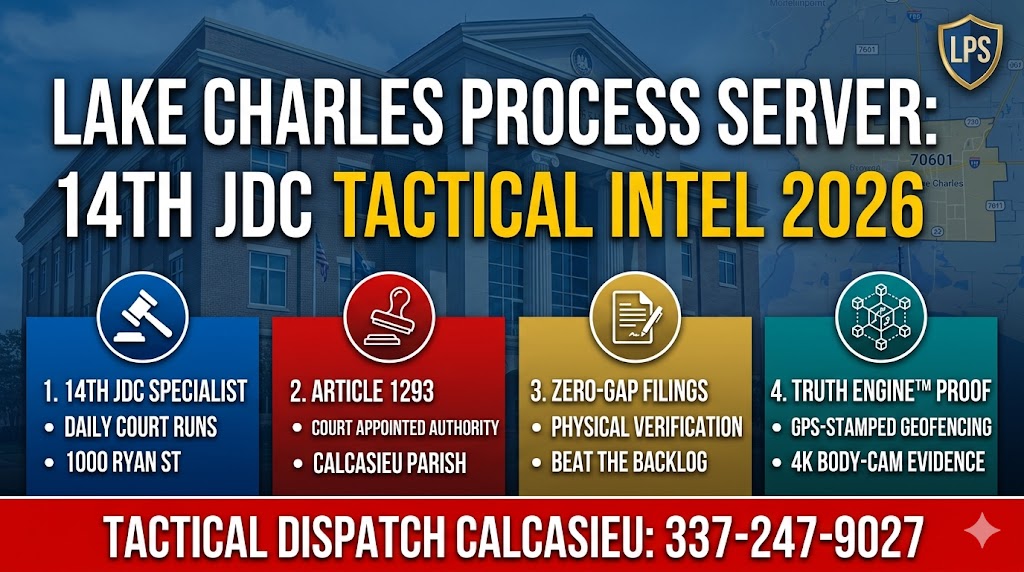
[00:04:06] Speaker A: And the sources get highly specific about this localized knowledge. Lafayette Process Servers, llc. They maintain a dedicated network of servers on the ground in Calcasu Parish daily. Yeah, they go and they highlight specific zip codes where this intimate knowledge is critical. So we're talking about 70601, 70605 and 70607. Yeah.
[00:04:26] Speaker B: And those zip codes aren't just random numbers. Right. They represent very distinct operational challenges.
[00:04:31] Speaker A: How so?
[00:04:31] Speaker B: Well, so 70601 covers the downtown area and the more historic, densely packed neighborhoods. Okay, then 70605 generally covers the southern part of the city, which is heavily residential and commercial. You've got a lot of sprawling subdivisions there.
[00:04:45] Speaker A: Gotcha.
[00:04:46] Speaker B: And then 70607 pushes into the more industrial and transient area.
So knowing the traffic patterns, the gate access codes for specific subdivisions, the physical layout of these distinct zones, it means the server spends far less time searching.
[00:05:01] Speaker A: Right, which directly translates to higher success rates.
[00:05:04] Speaker B: Exactly. The quicker the person is served, the quicker the legal clock starts for the plaintiff.
[00:05:09] Speaker A: Think of it like trying to deliver a pizza in a maze. But the pizza is a lawsuit, and the person you're delivering it to might actively be hiding from you.
[00:05:17] Speaker B: Yeah, nobody is excited to get the pizza Right.
[00:05:20] Speaker A: But navigating the physical geography and successfully handing over the document is really only the first failure point in this logistics chain, isn't it?
[00:05:29] Speaker B: Oh, absolutely.
[00:05:30] Speaker A: Because handing over the document is completely useless if you don't interact flawlessly with the specific courts where all this paperwork originates.
[00:05:38] Speaker B: Yeah. That is the second major hurdle. You have to file the proof of that delivery, which is called the affidavit of Service, perfectly.
[00:05:45] Speaker A: And if you make a mistake there, you're in trouble.
[00:05:48] Speaker B: If you are dealing with significant legal actions in Lake Charles, you are going to be interacting with one of two major legal centers detailed in our sources.
[00:05:56] Speaker A: Right.
[00:05:57] Speaker B: The primary Hub is the 14th Judicial District Court, the 14th JDC, which is located at 1000 Ryan Street.
[00:06:04] Speaker A: Okay. And that's a judicial center handling the heavy hitting civil litigation. Right.
[00:06:09] Speaker B: Major civil cases.
And the sources emphasize that Scott Frank, who is the founder of the firm, has over 20 years of experience in this field.
[00:06:17] Speaker A: Wow, 20 years.
[00:06:18] Speaker B: Yeah. Meaning his team knows the deeply specific idiosyncratic procedures of the 14th JDC. I mean, they are in that courthouse daily.
[00:06:27] Speaker A: And then the second hub is the Lake Charles City Court, Right down on Bilbo Street.
[00:06:31] Speaker B: Right now, City Court handles a completely different scope of legal action. It's the center for smaller civil claims, and crucially, it is the engine for eviction support.
[00:06:41] Speaker A: Evictions. Okay.
[00:06:42] Speaker B: Yes. For example, the proper and swift service of five day notices to vacate. The procedural knowledge required to navigate an eviction in City Court is entirely different from a complex corporate lawsuit in the 14th JDC.
[00:06:55] Speaker A: So if you are a law firm managing a caseload in Calcasieu Parish right now, maybe from another city or another state, this is where you really can't just rely on someone to blindly hand out papers.
[00:07:05] Speaker B: No, you absolutely cannot.
[00:07:06] Speaker A: The sources detail the use of daily courthouse runners. Basically, firms outsource the heavy lifting. Physical filings, complex document retrieval, court research, and even this blew my mind. Professional document binding.
[00:07:19] Speaker B: Yeah, the professional document binding is actually a perfect example of procedural friction. Courts have incredibly specific formatting requirements.
[00:07:28] Speaker A: Really? Like what?
[00:07:29] Speaker B: Oh, like margin sizes, specific tabbing for exhibits, cover page weights, paperweights.
[00:07:35] Speaker A: Are you serious?
[00:07:36] Speaker B: I am dead serious. If your legal briefs aren't bound correctly According to the 14th JDC's historical rules, they will be summarily rejected by the clerk.
[00:07:45] Speaker A: Wow.
[00:07:47] Speaker B: So a daily courthouse runner acts as a quality control agent. They handle that friction before it causes a major delay.
[00:07:54] Speaker A: Okay, but let me push back on the necessity of this for a second though.
[00:07:56] Speaker B: Sure.
[00:07:57] Speaker A: Because I mean, we are operating in an era of robust E filing systems. Right. Secure legal portals, digital signatures. It feels highly archaic that a physical courthouse runner is still such a vital piece of the puzzle for a major court like the 14th JDC.
[00:08:12] Speaker B: I get that.
[00:08:13] Speaker A: Like, why hasn't this entire process been automated into a software platform by now?
[00:08:17] Speaker B: It's a really valid pushback, but it highlights a fundamental misunderstanding of how the legal system guards its historical integrity.
[00:08:24] Speaker A: Okay, explain that.
[00:08:25] Speaker B: Yes, e filing exists and it is widely used, but the legal system is built on an unbroken chain of custody and strict procedural tradition.
There are still crucial moments that defy digitization.
[00:08:37] Speaker A: Like what?
[00:08:38] Speaker B: Like original wet signatures. They are still required for specific affidavits. Certain complex exhibits exceed e filing file size limits, or they require physical inspection.
[00:08:49] Speaker A: Oh, I hadn't thought about file size limits.
[00:08:51] Speaker B: Yeah, and historical document retrievals often involve pulling physical microfiche or bound ledgers that just haven't been digitized yet.
[00:08:59] Speaker A: So the bureaucracy hasn't entirely moved to the cloud.
[00:09:02] Speaker B: It hasn't. And in some cases, it legally cannot. And furthermore, E filing systems go down. They have outages.
[00:09:07] Speaker A: Oh, true. Technology breaks.
[00:09:09] Speaker B: Exactly. If you have a hard statute of limitations deadline at 4:30pm on a Friday, and the state's portal is throwing a server error, an email won't save your client's multimillion dollar lawsuit.
[00:09:21] Speaker A: That is terrifying.
[00:09:22] Speaker B: It is having a physical proxy who knows the clerks, who knows the specific physical intake counter, and who can literally walk an emergency writ directly to a judge's chambers that bridges the dangerous gap between digital efficiency and physical legal reality.
[00:09:37] Speaker A: That is wild. And that makes the connection to the digital toolkit even more fascinating.
Because while the court itself requires this archaic physical presence, the modern process server has to abstract all of that friction away for the client.
[00:09:53] Speaker B: Right.
[00:09:53] Speaker A: The paralegal sitting in New York doesn't want to think about the Ryan street courthouse parking lot.
[00:09:58] Speaker B: Exactly. They just want it done. The user experience for the client has to be highly optimized.
[00:10:02] Speaker A: Right.
[00:10:02] Speaker B: The sources outline this completely seamless onboarding process. The client simply goes online, clicks the secure link, and uploads their legal documents directly to the firm.
[00:10:12] Speaker A: Just like any other cloud upload.
[00:10:13] Speaker B: Exactly. Or they just call the firm. Yeah, but that simple upload instantly triggers this entire physical logistics network.
[00:10:20] Speaker A: And this brings up that connection in the sources to the local Acadiana business ecosystem. Because this seamless digital front end doesn't just happen by magic for a hyperlocal business.
[00:10:31] Speaker B: No. It takes specialized infrastructure.
[00:10:34] Speaker A: Right. The sources highlight 337 Media, which is a local company that builds Websites and drives, local SEO For Acadiana brands, they
[00:10:41] Speaker B: are the invisible digital engine. Support companies like 337 Media are what allow hyper local physical businesses to project a national grade digital infrastructure.
[00:10:51] Speaker A: That makes sense.
[00:10:52] Speaker B: Yeah. The law firm relies on the process server for the physical execution. But the process server relies on the local tech support to manage the data intake, the secure file transfers and the client portal. It's a deeply interconnected localized economy.
[00:11:07] Speaker A: Okay, so a client triggers this system, they upload the documents through the secure portal. What are the actual mechanical timelines we are talking about for execution? Like how fast does this happen?
[00:11:18] Speaker B: So the firm operates on a triaged tiered approach based on the urgency of the legal matter.
They offer a routine service where the first physical attempts at the address are made within three to five days.
[00:11:32] Speaker A: Okay, three to five days.
[00:11:33] Speaker B: Then a rush option accelerates that initial attempt to within one to two days.
[00:11:38] Speaker A: And for the true emergencies, for highly
[00:11:41] Speaker B: urgent matters, they offer a same day service for Lake Charles sulphur and the immediately surrounding areas.
[00:11:46] Speaker A: Wow, same day?
[00:11:47] Speaker B: Yeah, that requires dropping everything, routing a server specifically to that zip code and executing the delivery immediately.
[00:11:54] Speaker A: Okay, let's run a scenario. Because the real world is messy, always a client uploads the documents, selects the rush service, the local server navigates the industrial straw, finds the specific address and the 7607 zip code. But the target is gone, the house is empty. Or the business has boarded up its windows. The individual has completely vanished from their last known Lake Charles address. The trail is physically cold.
What happens then?
[00:12:20] Speaker B: This is where we shift from physical logistics to data logistics. This is where their skip tracing service is deployed.
[00:12:27] Speaker A: Now, skip tracing is one of those terms that gets thrown around a lot on tv. Usually sounding a bit more dramatic than it probably is. Yeah, we aren't talking about dusting for fingerprints here.
[00:12:36] Speaker B: No, no fingerprints. We are talking about rigorous data driven investigation. It's not just looking someone up on Facebook.
[00:12:44] Speaker A: Right.
[00:12:44] Speaker B: When an individual evasively relocates, especially in a transient industrial economy where contract workers move frequently, the firm accesses specialized restricted databases.
[00:12:55] Speaker A: Restricted databases? Like what kind of data?
[00:12:57] Speaker B: They are cross referencing credit headers, recent utility connections, vehicle registrations and property deeds. They are aggregating data scraping techniques to locate hard to find defendants or witnesses.
[00:13:09] Speaker A: So they are essentially looking for the digital exhaust that a person leaves behind when they set up a new life somewhere else.
[00:13:15] Speaker B: Precisely. The digital exhaust. If the individual has moved, whether they are just sleeping on a different couch somewhere else in Calcasu Parish or they fled to another state entirely the skip tracing service synthesizes that data to generate a new actionable physical address.
[00:13:31] Speaker A: That's incredible.
[00:13:32] Speaker B: It is. And the firm supplements this with other localized tools, too, like mobile notaries who travel directly to clients to execute documents and secure illegal couriers for time sensitive chain of custody transport.
[00:13:44] Speaker A: Okay, so you have people scraping restricted databases to hunt down vanished defendants. You have servers navigating complex industrial hubs to confront people. You have couriers rushing documents to judges.
[00:13:56] Speaker B: There's a lot of moving parts.
[00:13:57] Speaker A: It is. And the power dynamics here are fascinating because they operate in a highly restricted, legally defined lane.
Which brings us to really, the most crucial part of the sources. The strict boundaries of legal authority.
[00:14:11] Speaker B: I would argue it is the single most important aspect of their operation. There is a rigid boundary between being a process server and being law enforcement.
[00:14:19] Speaker A: And the sources provide explicit legal disclaimers regarding the firm's role, their operational authority, and their absolute limitations.
[00:14:27] Speaker B: Yes. Methodically. The documents make it abundantly clear. Lafayette Process Servers, LLC are not law enforcement. They do not have the power of arrest.
[00:14:38] Speaker A: Right. They are court appointed process servers.
[00:14:40] Speaker B: Exactly. Their authority to compel a person to receive a document is derived specifically from the Louisiana Code of Civil Procedure, Article 1293.
[00:14:49] Speaker A: Okay. Article 1293.
[00:14:51] Speaker B: That is the legal framework that authorizes the delivery. It does not grant them a badge, a weapon, or the authority to detain anyone.
[00:14:59] Speaker A: Okay, but what about regarding the skip tracing and the investigation into a target's whereabouts? Does that authorize them to act as general private investigators?
[00:15:08] Speaker B: Absolutely not. And the disclaimer is unyielding on this point. They are not private investigators for the general public.
[00:15:13] Speaker A: So I can't just hire them to figure out where someone is?
[00:15:15] Speaker B: No, you cannot hire them to follow a spouse or conduct corporate espionage or anything like that.
[00:15:20] Speaker A: Good to know.
[00:15:21] Speaker B: Any skip tracing, any stakeouts, any investigative data gathering they perform is done strictly and solely in connection with a court appointed process service.
[00:15:31] Speaker A: I see.
[00:15:32] Speaker B: The investigation exists only to facilitate the delivery of the specific legal document. The moment that document is delivered, their investigative authority evaporates.
[00:15:41] Speaker A: So the power to investigate is tethered entirely to the piece of paper in their hand.
[00:15:46] Speaker B: Exactly.
[00:15:47] Speaker A: Furthermore, the sources emphasize they are not attorneys, they cannot provide legal advice, nor can they represent clients before government agencies like the IRS or the sec.
[00:15:57] Speaker B: Right. Any content they provide is strictly for informational purposes regarding service logistics. The moment you need legal strategy, you must engage a licensed Louisiana attorney.
[00:16:08] Speaker A: Makes total sense. Now, I want to look closely at how they manage client expectations around billing, because I think it reveals a lot about the integrity of the process.
[00:16:15] Speaker B: Oh, this is a huge point.
[00:16:16] Speaker A: The sources state that services are billed for time and attempt, not a guaranteed outcome.
[00:16:21] Speaker B: Yes, and that is a critical distinction that protects the validity of the entire lawsuit.
[00:16:26] Speaker A: Because you're paying for the effort, not the result.
[00:16:29] Speaker B: Exactly. You are paying for their diligent effort, their 20 years of expertise, and their localized execution. You are not paying for a guaranteed magical result.
[00:16:41] Speaker A: But why is that distinction so important?
Because, I mean, if I am paying a service, I naturally want the result guaranteed.
[00:16:48] Speaker B: Right, Because a guaranteed outcome in process serving creates a highly dangerous perverse incentive.
[00:16:56] Speaker A: How so?
[00:16:56] Speaker B: Well, if a process server's payment is entirely contingent on physically handing the paper to the person, and that person is aggressively hiding, the server might be incentivized to break the law to get paid.
[00:17:09] Speaker A: Oh, wow.
[00:17:10] Speaker B: They might trespass, they might harass family members. Or worse, they might engage in sewer service.
[00:17:15] Speaker A: Sewer service is that.
[00:17:16] Speaker B: It's a dark industry term for when a server just throws the documents in the sewer or the trash and signs a fraudulent affidavit swearing they served the person.
[00:17:25] Speaker A: You're kidding. They just throw it away.
[00:17:27] Speaker B: Yeah, and lie about it.
[00:17:28] Speaker A: Which completely undermines the foundation of the legal system.
[00:17:31] Speaker B: Exactly. It violates the fundamental constitutional right to due process. You have a right to be notified if you are being sued. If a process server falsifies that notification and the court later discovers it, the service is deemed invalid under CCP Article 1293.
[00:17:47] Speaker A: And what happens then?
[00:17:48] Speaker B: Your entire multimillion dollar lawsuit could be thrown out of court and you have to start over from zero.
[00:17:53] Speaker A: That is disastrous.
[00:17:55] Speaker B: So by strictly billing for time and attempt, Lafayette Process Servers removes that perverse incentive. It keeps the process entirely above board, legally compliant, and protects the immutable record of a constitutionally sufficient effort to notify the defendant.
[00:18:12] Speaker A: Wow.
So you aren't buying a magic trick. You are buying an unassailable legal record of effort.
[00:18:17] Speaker B: Exactly.
[00:18:18] Speaker A: We have covered incredible ground today in understanding the physical layer that underpins the intellectual theory of the legal system. For you listening, if you are managing a caseload right now, understanding this physical logistics layer gives you a massive tactical advantage. We unpack the absolute necessity of hyperlocal knowledge in a sprawling industrial hub like League. Charles, you know why?
Understanding the operational friction between the 7601 historic district and the 7607 industrial zone can really make or break a hard deadline.
[00:18:50] Speaker B: And we examined the deeply specialized procedural knowledge required to navigate the major hubs of Calcasieu Parish. Understanding when to deploy a daily Courthouse runner to the 14th JDC on Ryan street for complex filings versus managing the high volume eviction workflows at the city Court on Bilbo Street.
[00:19:07] Speaker A: Right. And we looked at the modern abstraction of this process. How the local Acadiana tech ecosystem, driven by firms like 337 Media, allows a paralegal across the country to securely upload documents and instantly trigger a localized data scraping skip trace and a physical same day rush deployment.
[00:19:23] Speaker B: It's an amazing synthesis of physical and digital.
[00:19:26] Speaker A: It really is. And finally, we clarified the strict legal boundaries governed by Louisiana CCP Article 1293, and why billing for time and attempt is the ultimate safeguard for the integrity of your lawsuit.
You aren't just trusting that the legal system works. You now understand exactly how the gears physically turn.
[00:19:44] Speaker B: And you know, as we close, there is an entirely new complication to this physical system worth pondering.
[00:19:49] Speaker A: Oh, what's that?
[00:19:50] Speaker B: Well, we've spent this time exploring a legal framework that is hyper localized. It relies on finding a specific human body at a specific physical address. In Calcasie, Paris.
[00:20:00] Speaker A: Right. The last Mile.
[00:20:02] Speaker B: But we are rapidly moving into an era of remote work and digital nomadism.
[00:20:06] Speaker A: Oh, wow.
That is a fascinating collision of trends.
[00:20:09] Speaker B: Think about it. If an individual's legal residence is technically a PO box or a registered agent, but they actually live in an RV working via satellite Internet, and they're constantly crossing state lines, how do you serve them? Exactly. How does a physical last mile logistics network catch up to them? The laws of civil procedure were written for a world where people stayed put in houses with fixed addresses.
[00:20:30] Speaker A: Yeah, they didn't anticipate the Digital nomad.
[00:20:32] Speaker B: No, they didn't. As the workforce becomes entirely untethered from physical geography, the localized physical infrastructure of the legal system is going to be forced to adapt. Or the fundamental mechanism of serving a lawsuit may eventually break down entirely.
[00:20:47] Speaker A: If the entire system relies on handing a physical piece of paper to a person, what happens when that person essentially lives nowhere?
[00:20:54] Speaker B: It's a huge problem.
[00:20:55] Speaker A: It's an incredible structural challenge for the future of civil procedure.
Something for all of us to think about. Thank you for joining us on this deep dive. We'll catch you next time. As we continue to unpack the invisible machinery that shapes the world around us.