Episode Transcript
[00:00:00] Speaker A: Imagine trying to close a multimillion dollar corporate lawsuit.
[00:00:05] Speaker B: Okay, high stakes, right?
[00:00:06] Speaker A: You've got, like, the best lawyers in the state, a mountain of undeniable digital evidence, and a judge totally ready to rule.
[00:00:15] Speaker B: Sounds like a done deal.
[00:00:16] Speaker A: You would think so. But then the entire apparatus just comes to a screeching halt, just completely frozen.
[00:00:22] Speaker B: Let me guess. Paperwork?
[00:00:24] Speaker A: Worse. It's all because a guy in a pickup truck couldn't find a dirt road in rural Louisiana.
[00:00:31] Speaker B: Wow.
Yeah, that really puts things into perspective.
[00:00:34] Speaker A: It really does. I mean, we live in a world where you can beam gigabytes of encrypted data across the globe in a millisecond. Right? Exactly. But the American legal system still absolutely relies on one human being physically walking up to another human being and handing them a piece of paper.
[00:00:49] Speaker B: It's so old school.
[00:00:50] Speaker A: It is. So today we are bringing you a deep dive into the hidden, highly geographical logistics of the legal world.
[00:00:57] Speaker B: It's a fascinating topic.
[00:00:59] Speaker A: We're looking closely at Lafayette Process Servers llc. It's a company built by Scott Frank, who has basically spent the last 25 years establishing this massive network across Louisiana
[00:01:11] Speaker B: since 2001, I believe.
[00:01:14] Speaker A: Right, 2001. And they operate particularly heavily in Jennings and the surrounding Jeff Davis Parish, which
[00:01:21] Speaker B: is a really tricky area to cover.
[00:01:23] Speaker A: It really is.
So the mission of this deep dive is to explore the strict rules that govern the people who literally deliver the law to your doorstep. And you know how a remarkably physical business survives in a hyper digital age.
[00:01:37] Speaker B: Yeah.
[00:01:37] Speaker A: Okay, let's unpack this. Because it's a pretty jarring reality when you stop and think about it.
[00:01:42] Speaker B: Oh, it really is. I mean, think about it. You can sign a mortgage on your smartphone right now.
[00:01:46] Speaker A: Yeah. Or transfer your life savings with, like, a biometric scan.
[00:01:49] Speaker B: Exactly. But a judge cannot and frankly will not move forward with a civil case based on an email read receipt.
[00:01:56] Speaker A: Right. They don't care if you left them on read.
[00:01:58] Speaker B: They absolutely do not. The court demands undeniable sworn proof of physical delivery.
It's really the cornerstone of due process. You know, you have the right to know you are being sued, which makes total sense. Right. And that Right. Creates an entire shadow industry of. Of these logistical experts. Like you mentioned, Scott Frank established his network way back in 2001, over a quarter century ago. Yeah. And over that time, he's built something that is fundamentally tethered to the physical mud, the asphalt, the back roads of Louisiana.
[00:02:32] Speaker A: And that geographic tethering is exactly what makes this operation so incredibly complex.
[00:02:37] Speaker B: Oh, completely.
[00:02:37] Speaker A: Like, let's move from the broad concept of process serving to the hyper local reality of actually navigating these terrains.
[00:02:43] Speaker B: Let's do it.
[00:02:44] Speaker A: So Lafayette Process Servers operates a primary tactical dispatch office over at 3419 NW Evangeline Thruway. That's in Karen Crow, right?
[00:02:53] Speaker B: That's their main hub.
[00:02:54] Speaker A: Yeah, but they don't just, you know, dispatch people blindly across the state from one central location.
[00:02:59] Speaker B: No, that would be a disaster.
[00:03:00] Speaker A: It would. They've built this dedicated, highly localized network specifically for Jennings, which is zip code 70546 and the broader, much more rural Jeff Davis Parish area.
[00:03:12] Speaker B: And that hyperlocal structure, I mean, it's a matter of sheer survival in this industry.
[00:03:17] Speaker A: How so?
[00:03:18] Speaker B: Well, a process server who is unfamiliar with the specific layout of Jennings, you know, the local municipal roads, and especially those unmarked rural routes, they are a massive liability.
[00:03:29] Speaker A: Because of the deadlines.
[00:03:30] Speaker B: Exactly. Let's talk about why that matters. In the legal world, time is heavily regulated by statutory deadlines.
[00:03:36] Speaker A: Right.
[00:03:37] Speaker B: So if a lawyer has a 15 day window to serve a defendant, and a server spends three days just getting lost looking for a property that doesn't map correctly on a digital grid, that
[00:03:46] Speaker A: deadline can just expire.
[00:03:47] Speaker B: Yes, and a missed deadline doesn't just mean a delay. It can literally result in a lawsuit being thrown out on procedural grounds. Wow. Yeah, the stakes are incredibly high.
[00:03:56] Speaker A: I have to admit, my initial reaction to this was a bit skeptical.
[00:04:00] Speaker B: Really?
[00:04:00] Speaker A: Yeah. I mean, we are sitting here in 2026. Can't GPS just find anyone anywhere?
[00:04:06] Speaker B: You'd think so, right?
[00:04:08] Speaker A: Like, why do we still need this highly touted on the ground human knowledge? I was thinking about it, like ordering food.
[00:04:16] Speaker B: Oh, that's a good comparison.
[00:04:17] Speaker A: Yeah. You have the out of town delivery app driver who gets hopelessly lost on a dirt road because the app pin basically drops them in the middle of
[00:04:25] Speaker B: a cornfield, which happens all the time.
[00:04:27] Speaker A: All the time versus the local pizza guy who just knows instinctively that the Smith Falls farm is like, two miles past the broken tractor on County Road 9.
[00:04:38] Speaker B: What's fascinating here is that technology, even in 2026, completely fractures when it meets the reality of rural geography.
[00:04:46] Speaker A: It just breaks down.
[00:04:47] Speaker B: It does?
[00:04:47] Speaker A: Yeah.
[00:04:48] Speaker B: GPS relies on standardized data, but in places like Jeff Davis Parish, you were dealing with private roads that aren't mapped.
[00:04:55] Speaker A: Or addresses that officially belong to one street but are physically accessed from another.
[00:04:59] Speaker B: Exactly. Or sprawling acreages where the mailbox is a half mile away from a gated, locked driveway.
[00:05:04] Speaker A: Right. The satellite just gets confused.
[00:05:06] Speaker B: Totally. Now, Lafayette Process Servers clearly utilizes technology I Mean, the sources mention they actively manage GPS rental agreements for their fleet.
[00:05:16] Speaker A: Oh, interesting.
[00:05:17] Speaker B: Yeah. But they do not rely on satellite tracking as their primary advantage. Their core product is the human being who actually knows the anomalies of the local terrain.
[00:05:27] Speaker A: Which is exactly why legal professionals in the area lean on them so heavily.
[00:05:31] Speaker B: Oh, for sure.
[00:05:32] Speaker A: Like when you look at the source material and hear from people like Janet M. She's a paralegal at a Jennings law firm.
[00:05:38] Speaker B: Oh, I saw her five star review.
[00:05:40] Speaker A: Yeah, her feedback is entirely focused on trust and speed.
She specifically noted that Scott's team is the only one they trust for Jeff Davis Parrish cases.
[00:05:50] Speaker B: Because they know the local procedures inside and out.
[00:05:53] Speaker A: Exactly. And you know, if you think about your own hometown right now, you know those quirky addresses.
[00:05:58] Speaker B: Oh, yep, Everybody has them.
[00:05:59] Speaker A: You know the street that abruptly changes names at a weird intersection or the house that has literally never had a number on the door.
[00:06:07] Speaker B: Right, the blue house with the weird fence.
[00:06:09] Speaker A: Exactly. If you are a law firm managing a million dollar liability case, having a process server with that hyperlocal edge isn't just a nice bonus.
[00:06:19] Speaker B: No, it's essential.
[00:06:20] Speaker A: It is a critical safeguard.
[00:06:22] Speaker B: It's literally the barrier between. Between moving a case forward and committing legal malpractice. Wow. But navigating the back roads and physically locating the individual, that is only the first phase of the operation.
[00:06:34] Speaker A: Right. That's just step one.
[00:06:36] Speaker B: Yeah. Once they find the target, or when they need to formalize that interaction with the local court system, the operational complexity just multiplies.
[00:06:44] Speaker A: And here's where it gets really interesting. For me, the actual arsenal of a court appointed server goes so far beyond just walking up and handing over a manila envelope.
[00:06:53] Speaker B: Oh. It's a massive suite of services.
[00:06:56] Speaker A: Sheer variety of what they are executing daily is intense. Like they are handling five day notices to vacate for evictions.
[00:07:02] Speaker B: Which is high stress.
[00:07:03] Speaker A: Extremely. Think about the mechanics of that. Walking up to a volatile situation to legally inform someone they are losing their home.
[00:07:10] Speaker B: Yeah, that requires a lot of professionalism.
[00:07:12] Speaker A: And then on the totally other end of the spectrum, they are providing same day secure legal courier services.
[00:07:19] Speaker B: Plus the mobile notaries.
[00:07:20] Speaker A: Yes, mobile notaries who travel directly to clients. And even professional document binding.
[00:07:26] Speaker B: Because the court clerks are super strict about that.
[00:07:28] Speaker A: Exactly. They have to ensure massive legal briefs meet the exact physical specifications required by
[00:07:34] Speaker B: the court to really grasp the scope of those services. We have to look at the center of gravity for all this activity.
[00:07:40] Speaker A: The courthouse itself.
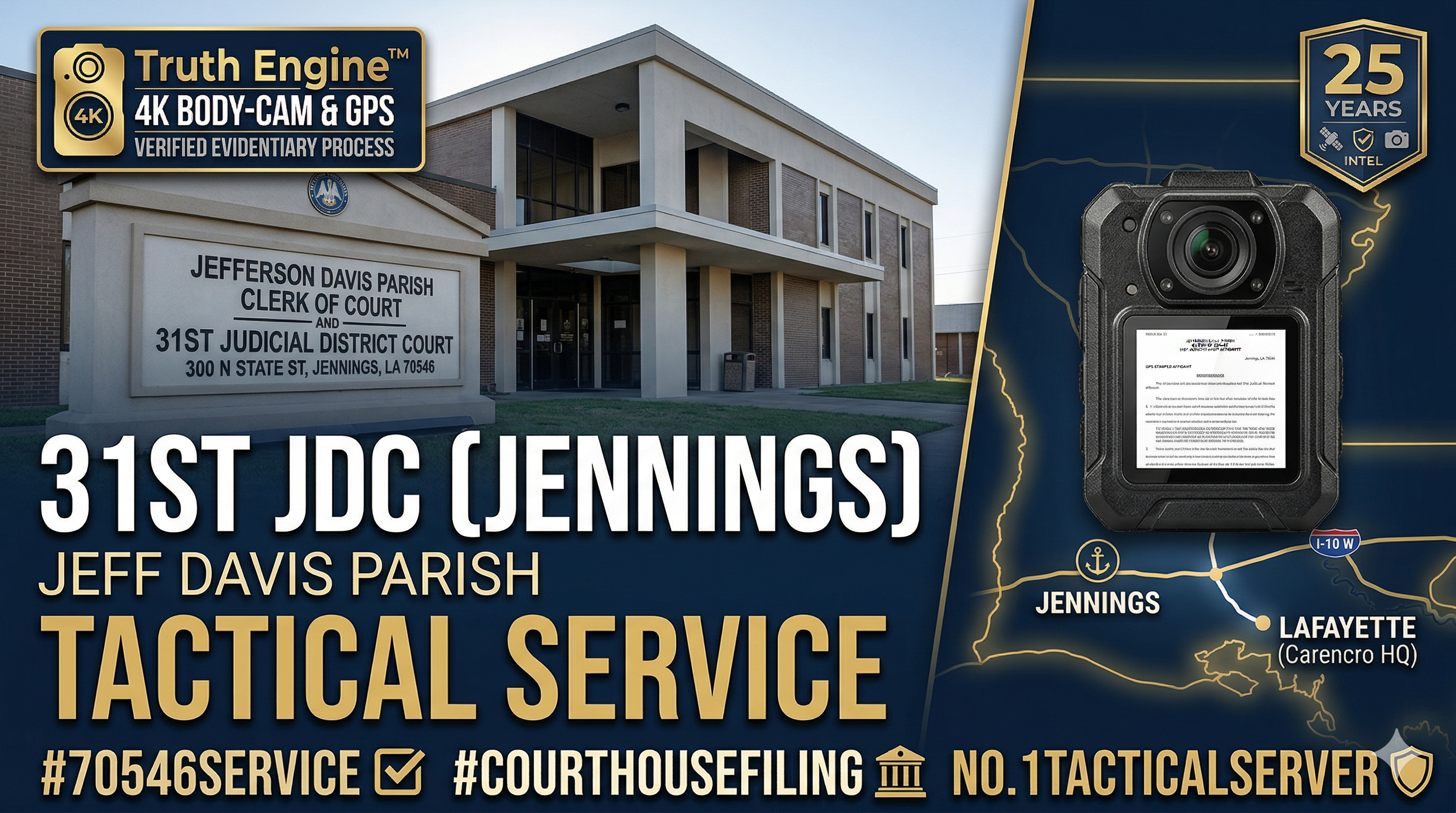
[00:07:42] Speaker B: Right. In Jennings. That is the 31st Judicial District Court,
[00:07:46] Speaker A: the 31st JDC located right at 300 N. State Street.
[00:07:50] Speaker B: Yep. These process servers operate as what the legal industry calls courthouse runners.
[00:07:55] Speaker A: I love that term.
[00:07:57] Speaker B: It's accurate. They're basically the physical circulatory system of the courthouse. They aren't just outward facing serving papers to citizens.
[00:08:05] Speaker A: They're running back and forth constantly.
[00:08:07] Speaker B: They are shuttling back and forth to the 31st JDC for physical filings, retrieving signed orders from judges, conducting onsite court research. It's nonstop.
[00:08:16] Speaker A: And they organize all of this movement around incredibly rigid timelines. They have to, like the sources show routine service takes three to five days. Rush service tightens that to just one
[00:08:27] Speaker B: to two days, which is really fast.
[00:08:29] Speaker A: And for the 70546 area, they even execute urgent same day service.
[00:08:34] Speaker B: That's impressive logistics.
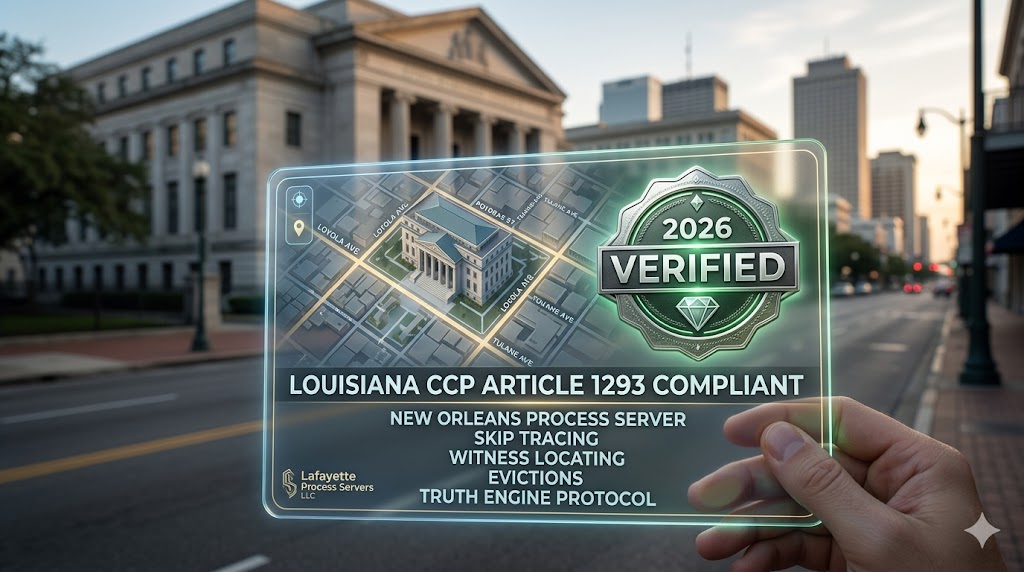
[00:08:35] Speaker A: It is. But what really caught my attention is how they institutionalize the speed they operate under these frameworks branded as the Truth Engine protocol and 2026 diamond compliance.
[00:08:47] Speaker B: Right. Those sound like, you know, aggressive corporate branding.
[00:08:49] Speaker A: Very sci fi.
[00:08:50] Speaker B: Yeah, but they represent something highly functional.
When a paralegal hands over a critical summons, they need absolute certainty.
[00:08:58] Speaker A: They need to know it holds up.
[00:08:59] Speaker B: Exactly. They need to know the server's methods will survive cross examination in court. Protocols like the Truth Engine and Diamond Compliance are basically systematic methods for verifying service.
[00:09:11] Speaker A: Like digital breadcrumbs.
[00:09:12] Speaker B: Yes. We are talking about timestamped geofenced data, photographic evidence of the property, and rigid step by step documentation of every single attempt made.
[00:09:22] Speaker A: So nobody can say they weren't there.
[00:09:24] Speaker B: Precisely. It's about building an ironclad evidentiary package so that when a defendant inevitably stands up in court and claims I was
[00:09:34] Speaker A: never served, which, you know, happens all the time.
[00:09:36] Speaker B: Constantly. The judge can just look at the process server's affidavit and. And immediately dismissed the lie.
[00:09:41] Speaker A: And the paperwork backing all of this up is just extensive. They are processing change of address request forms, affidavits of process server motions to appoint a special process server.
[00:09:53] Speaker B: It's a mountain of paper.
[00:09:54] Speaker A: It is. Which brings up a scenario I've been trying to wrap my head around.
[00:09:58] Speaker B: Okay, what's that?
[00:09:59] Speaker A: So they offer a service called skip tracing.
[00:10:02] Speaker B: Ah, yes, right.
[00:10:03] Speaker A: To find people who have actively moved or who are intentionally hiding to dodge a lawsuit.
[00:10:09] Speaker B: It happens more than you'd think.
[00:10:11] Speaker A: I bet. But if I hire them to skip trace someone. Are these process servers basically private investigators?
[00:10:17] Speaker B: That's a great question.
[00:10:18] Speaker A: Like what are they actually doing to find a person who doesn't want to be found?
[00:10:22] Speaker B: This raises an important question because the distinction between a process server and a private investigator is a massive legal boundary.
[00:10:29] Speaker A: Okay, where is the line?
[00:10:31] Speaker B: Well, skip tracing in the context of process serving is. Is the act of scouring public records, utility billing histories, court databases, and, you know, known associate addresses to track them down. Right. To locate a person for the sole purpose of delivering a legal document, they're tracing the skip the person who skipped town. Ah.
[00:10:51] Speaker A: I.
[00:10:51] Speaker B: But they are emphatically not private investigators.
[00:10:54] Speaker A: Right. And the operation is strictly governed by the Louisiana Code of civil procedure. Specifically CCP Article 1293.
[00:11:02] Speaker B: Yes. That's the crucial regulation here.
[00:11:04] Speaker A: This code dictates how an individual is officially appointed by the court to serve process.
And the legal disclosures surrounding this are incredibly firm.
[00:11:12] Speaker B: They have to be.
[00:11:13] Speaker A: Right. They state that these individuals are absolutely not law enforcement.
[00:11:18] Speaker B: And they have to state that explicitly because the public perception is often deeply skewed.
[00:11:22] Speaker A: I can imagine.
[00:11:23] Speaker B: Think about it. When someone with a badge like ID and a really stern demeanor knocks on your door, asking for you by your
[00:11:31] Speaker A: full legal name, it is very easy to confuse them for a sheriff's deputy.
[00:11:35] Speaker B: Exactly. But under CCP Article 1293, their authority is incredibly narrow. They cannot arrest you.
[00:11:43] Speaker A: Good to know.
[00:11:43] Speaker B: Right. They cannot force their way into your home. Their investigative powers are tethered entirely to the delivery of that specific court document.
[00:11:52] Speaker A: So no snooping.
[00:11:53] Speaker B: Nope. You cannot hire Lafayette Process Servers to follow your spouse to see if they are having an affair or hire them
[00:12:00] Speaker A: to dig up dirt on a business rival.
[00:12:03] Speaker B: Absolutely not. They do not provide legal advice, and they do not operate as general private
[00:12:07] Speaker A: eyes for the public, which is a necessary safeguard, really? When you think about it, the law has to carefully box in what a process server can and cannot do.
[00:12:16] Speaker B: Otherwise, it gets messy.
[00:12:17] Speaker A: Exactly. Precisely. So the power of the court isn't abused by private citizens trying to play vigilante detective.
[00:12:23] Speaker B: Right.
[00:12:24] Speaker A: And the financial structure of the business totally reflects those strict limitations. They bill strictly for time and attempt. Results are never, ever guaranteed.
[00:12:34] Speaker B: That billing structure is a fundamental reality of the legal logistics business.
A client is paying for the process server's professional effort, their time on the road, their localized expertise in navigating Jeff Davis Parish, and the fuel and time required to make the attempts mandated by law.
But the server cannot control human behavior.
[00:12:56] Speaker A: It's exactly like paying for a highly specialized guided fishing trip.
[00:12:59] Speaker B: That's a perfect analogy.
[00:13:01] Speaker A: Yeah. Like you are paying the guide for their time. You are paying for the use of their boat.
[00:13:06] Speaker B: Right.
[00:13:06] Speaker A: Most importantly, you are paying for their deep, localized, multi generational knowledge of where the fish usually hide on that specific
[00:13:15] Speaker B: lake, but they can't make the fish eat.
[00:13:16] Speaker A: Exactly. The guide cannot legally or practically guarantee that the fish are going to bite that day. It's if the fish completely evade you, you don't get a refund because the
[00:13:25] Speaker B: guide still did all the work.
[00:13:26] Speaker A: Exactly.
[00:13:27] Speaker B: And the reality on the ground makes that phishing guide look even more essential.
Sometimes, despite the absolute best skip tracing data, and despite a server knowing exactly which dirt road to take, the person just hides. Yep. A defendant successfully evades service, they might abandon the property entirely or literally hide inside and refuse to answer the door for weeks.
[00:13:49] Speaker A: That sounds incredibly frustrating.
[00:13:51] Speaker B: It is. But the process server still expended the resources to make the three, four or five attempts required to prove to a judge that the person is actively dodging.
[00:14:01] Speaker A: So even a failure has value.
[00:14:03] Speaker B: Huge value. That documented failure is actually a vital legal service. It allows the lawyer to go back to the judge and request alternative methods of service.
[00:14:12] Speaker A: Oh, like publishing the summons in a local newspaper.
[00:14:15] Speaker B: Exactly.
[00:14:16] Speaker A: But, you know, all of these strict legal constraints, the rigid billing, the inherently physical nature of the work, it's. It creates a massive problem for Scott Frank as a business owner.
[00:14:25] Speaker B: Oh, the scalability issue.
[00:14:26] Speaker A: Yeah. How do you run a profitable, expanding, modern business when your core product is so heavily regulated and relies entirely on physically knocking on doors?
[00:14:37] Speaker B: It's tough.
[00:14:37] Speaker A: The answer actually lies in an unexpected digital synergy.
[00:14:41] Speaker B: And this is where the survival Mechanics of a 25 year old local business really come into play. Lafayette Process Servers has a massive footprint.
[00:14:49] Speaker A: Yeah, they cover a lot of ground.
[00:14:51] Speaker B: They operate through distinct regional hubs. You have the Acadiana hub covering Lafayette, Crowley and Abbeville.
[00:14:57] Speaker A: Okay.
[00:14:58] Speaker B: The Southwest hub covering Lake Charles, Jennings and Welsh. The US 90 hub for Houma and Morgan City. Right. And the north central hub of. For Shreveport in Alexandria.
To sustain that geographical spread, you cannot rely entirely on word of mouth.
[00:15:14] Speaker A: Or like a Yellow Pages ad.
[00:15:16] Speaker B: Exactly.
[00:15:18] Speaker A: Well, we found a really revealing media transcript in our sources. It's from a show called Paper Trails.
[00:15:22] Speaker B: Oh, I love this part.
[00:15:23] Speaker A: Yeah. And the host of that show is none other than Scott Frank himself.
[00:15:26] Speaker B: The founder himself.
[00:15:27] Speaker A: Right. So the founder of this boots on the ground legal logistics company is literally hosting a media broadcast.
[00:15:34] Speaker B: It's brilliant marketing.
[00:15:35] Speaker A: It is. And during this show, he specifically spotlights a local sponsor called 337 Media. Yes, and 337 Media is a company that builds websites and masters local SEO.
[00:15:46] Speaker B: Search engine optimization.
[00:15:47] Speaker A: Exactly. Specifically for Acadiana brands.
So what does this all actually mean?
[00:15:53] Speaker B: Well, if we connect this to the bigger picture. It reveals the blueprint for local business dominance in the 2000s.
[00:16:00] Speaker A: Go on.
[00:16:01] Speaker B: Local SEO is the practice of optimizing your online presence so that you appear at the very top of localized search results.
[00:16:09] Speaker A: Right. When someone Googles you.
[00:16:11] Speaker B: Exactly.
Think about it. If an attorney in New York is handling a corporate bankruptcy and suddenly needs to serve a key witness in Welsh, Louisiana, they have absolutely no idea who Scott Frank is.
[00:16:22] Speaker A: They're just going to search for it.
[00:16:24] Speaker B: Right. They're going to open a search engine and type process server. Welsh, Louisiana.
[00:16:28] Speaker A: And whoever ranks first gets that lucrative contract.
[00:16:31] Speaker B: Precisely. Partnering with a local SEO firm like 337 Media is how an offline, highly geographical business captures out of state capital.
[00:16:40] Speaker A: That makes total sense.
[00:16:41] Speaker B: Lafayette Process Servers doesn't just have a static webpage. They maintain an extensive categorized blog with archives stretching back to November 2022.
[00:16:50] Speaker A: I saw that in the sources.
[00:16:52] Speaker B: Yeah. They are consistently publishing content tagged with keywords like Louisiana Registered Agent and process server. They are feeding the algorithms exactly what they want.
[00:17:02] Speaker A: It is such a brilliant juxtaposition. I mean, you have a job that fundamentally requires mud on your tires.
[00:17:08] Speaker B: Yes. Very tactile.
[00:17:09] Speaker A: You have to physically drive down a rural route in Jeff Davis par. Walk up the steps of a porch and physically identify a human being.
But to make that physical action profitable, you must first build a massive sustained digital moat around your business.
[00:17:25] Speaker B: That's the paradox of modern business.
[00:17:27] Speaker A: It really is. You have to dominate the digital terrain of search algorithms just as masterfully as you dominate the physical terrain of the 31st JDC procedures.
[00:17:36] Speaker B: It proves that in the modern economy there is no such thing as a purely physical business anymore.
[00:17:41] Speaker A: No. Everything touches the Internet.
[00:17:42] Speaker B: Everything.
The companies that survived decades are the ones that learned to translate their physical monopoly into digital authority.
[00:17:50] Speaker A: Wow.
We have covered a massive amount of ground today.
[00:17:53] Speaker B: We really have.
[00:17:54] Speaker A: We started by looking at the unavoidable reality of geography and why knowing the unmapped back roads of Jeff Davis Parish can basically make or break a lawsuit.
[00:18:03] Speaker B: Right. The pizza guy advantage.
[00:18:04] Speaker A: Exactly. We explored the vast suite of services running through the 31st JDC courthouse. From the tension of same day evictions to the rigorous documentation of that Truth Engine protocol.
[00:18:17] Speaker B: Fascinating stuff.
[00:18:18] Speaker A: We unpacked the strict boundaries of CCP Article 1293 that keep process servers carefully checked and separated from law enforcement.
[00:18:26] Speaker B: Not cops, not private eyes.
[00:18:28] Speaker A: Right.
And finally we saw how a 25 year old physical business uses local SEO and digital broadcasting to capture market share across Louisiana's regional hubs.
[00:18:40] Speaker B: You know, as we wrap up. There is a fascinating undercurrent to all of this that is worth considering for the listeners.
[00:18:45] Speaker A: What's that?
[00:18:46] Speaker B: We spend so much time worrying about our digital privacy.
[00:18:48] Speaker A: Oh, totally. Our data trails, our browser history, our digital footprints.
[00:18:53] Speaker B: Exactly. We assume that in a modern surveillance state, it is basically impossible to hide. Yet the entire legal system still acknowledges a profound vulnerability.
[00:19:02] Speaker A: Physical presence.
[00:19:03] Speaker B: That's a great point.
[00:19:04] Speaker A: You can have a person's entire digital life mapped out on a server somewhere, but if they physically retreat down a long dirt road in rural Louisiana and just refuse to open their front door,
[00:19:16] Speaker B: they can grind a multimillion dollar legal machine to an absolute halt.
[00:19:20] Speaker A: Exactly. It makes you wonder, as we push further into an entirely digital existence, will the simple ability to physically evade the world become the ultimate, most disruptive luxury?
[00:19:32] Speaker B: That is a wild thought. In a world of digital omniscience, the most powerful move left is just not answering the door.
[00:19:38] Speaker A: Pretty much.
[00:19:39] Speaker B: Thank you for joining us on this deep Div. Keep questioning the everyday things around you and never stop wondering how the hidden machinery of our world actually operates.