Episode Transcript
[00:00:00] Speaker A: Welcome back to the Deep Dive, everyone. We are really thrilled to have you sitting at the table with us today, just you as the third person in this conversation.
[00:00:07] Speaker B: Yeah, it is great to be here. We have a lot to cover.
[00:00:09] Speaker A: We really do. If you follow the legal world, you probably already know that what happens inside a courtroom is. Well, it's really just a tiny fraction of the actual battle. The real fight right now, especially in the year 2026, often happens out on the streets long before a judge even picks up a gavel.
[00:00:28] Speaker B: Absolutely. The logistics behind the law are fascinating.
[00:00:31] Speaker A: Right. And today we are looking at a really interesting stack of documents. Our sources include website copy, some very detailed legal disclosures, and transcript excerpts from a podcast called Paper Trails.
[00:00:43] Speaker B: All of this material centers around a company called Baton Rouge Process Servers.
[00:00:47] Speaker A: Exactly. Which operates as a division of Lafayette Process Servers, llc. Third, founded by Scott Frank, it is
[00:00:53] Speaker B: a highly revealing set of sources. We are getting a look behind the curtain of an industry that operates largely out of the public eye, but it fundamentally props up the entire civil justice system.
[00:01:05] Speaker A: Yeah. And to give you a sense of the broader ecosystem we are examining here, there is a brief sponsorship excerpt included in our source material. Scott Frank's podcast features a spot for a company named 337 Media.
[00:01:16] Speaker B: Right. They handle local SEO and website building for Acadiana brands.
[00:01:20] Speaker A: Exactly. And it just highlights how this niche legal logistics machine feeds right into the broader local Louisiana business economy.
[00:01:29] Speaker B: It really shows a highly interconnected professional network supporting these operations.
[00:01:34] Speaker A: So our mission for you today is to explore how the seemingly mundane act of delivering legal papers has evolved. I mean, the marketing copy in these sources is intense.
[00:01:43] Speaker B: It is very intense.
[00:01:44] Speaker A: They use terms like high velocity execution and tactical pivots.
[00:01:47] Speaker B: Yeah.
[00:01:48] Speaker A: But stripped of the dramatic branding, what we are really looking at is a case study of how law firms in Baton Rouge, Louisiana are forced to operate in 2026.
Because serving papers is no longer just, you know, knocking on a door. It has become an incredibly complex logistical science.
[00:02:04] Speaker B: It has entirely become a science.
To frame our theme for this Deep dive, the legal system relies on two non negotiable pillars.
Strict timelines and verifiable proof.
[00:02:15] Speaker A: Right.
[00:02:15] Speaker B: If an attorney fails on either front, they do not have a case. What we are exploring today is the high pressure intersection where physical boots on the ground logistics collide with modern digital verification.
[00:02:27] Speaker A: Okay, let's unpack this, because we have to start with a massive procedural shift that hit the local legal community recently. According to the sources, on January 1, 2026, Louisiana implemented Act 352.
[00:02:39] Speaker B: Yes. A very significant piece of legislation.
[00:02:42] Speaker A: And this act created what the documents refer to as the 4.15pm crisis. I want to set the scene for you here.
[00:02:49] Speaker B: Please do.
[00:02:49] Speaker A: The 19th Judicial District Court, the 19th JDC and the East Baton Rouge Clerk of Court are located at 222St. Louis St. They close their doors at exactly 4.3pm
[00:02:59] Speaker B: sharp, not a minute later.
[00:03:01] Speaker A: Exactly. The sources make it clear that Those minutes between 4.00pm and 4.3pm are an absolute pressure cooker for law firms. But why is Act 352 causing so much specific panic right before closing time?
[00:03:13] Speaker B: What's fascinating here is the history of how attorneys used to handle filing deadlines versus what Act 352 requires. Now, before this act, attorneys had a bit of a safety net known as the postmark rule.
Let's say an attorney had a crucial document, what the sources call a prescription saving motion. In Louisiana law, prescription is essentially the statute of limitations.
[00:03:36] Speaker A: So it's the ticking clock on a case.
[00:03:39] Speaker B: Precisely. A prescription saving motion is the document that officially stops the clock from running out on a client's right to sue. Historically, if you were bumping up against that deadline, you could just drop the motion in the mail. As long as it received a USPS postmark before the deadline date, the court considered it filed on time, you were in a safe harbor.
[00:03:57] Speaker A: So the panic basically ended the second that envelope dropped into a mailbox.
[00:04:01] Speaker B: That's how it used to be. But Act 352 effectively sunset that postmark rule for these specific high stakes filings. Mailing it in is no longer sufficient to save prescription. Yeah. In 2026, if that physical document is not resting in the Clerk's hand at 222St. Louis St. By 4:30pm or verify it through a very strict E filing protocol, the deadline is missed and the sources
[00:04:26] Speaker A: describe the consequences for the client as catastrophic.
[00:04:29] Speaker B: Completely. An entire lawsuit can be dismissed with prejudice, which means it is over forever, simply because a courier got stuck in downtown traffic and arrived at 4.31pm that seems incredibly stressful.
[00:04:42] Speaker A: It sounds like an environment where a single typo could ruin a career.
[00:04:45] Speaker B: It absolutely could.
[00:04:46] Speaker A: The sources mention that Baton Rouge process server steps in here with a service they call physical redaction verification. What exactly are they checking for on the courthouse steps?
[00:04:55] Speaker B: Under the 2026 privacy mandates laid out in Act 352, courts are incredibly strict about what personal information is visible on the face cage. That's a very front page of a filing. They are checking for unredacted sensitive data.
This could be a visible Social Security number, a minor's identity, or specific financial account digits.
If an exhausted paralegal forgets to black out a single digit on that front page, the clerk at the window will issue a technical rejection.
[00:05:23] Speaker A: Oh, I see. And a technical rejection at 4.28pm means you do not have time to run back to the office phase, fix it, and return before that 4.3 BM buzzer.
[00:05:33] Speaker B: Exactly. It is an unrecoverable error at that time of day. Having a trained process server physically reviewing the face page for statutory compliance right before handing it to the clerk is a crucial risk mitigation strategy.
[00:05:45] Speaker A: The sources also detail the second part of their strategy for this deadline, which they call the zero gap. Filing.
[00:05:51] Speaker B: Yes, this is brilliant logistics.
[00:05:53] Speaker A: Once the document is accepted by the clerk, how do they communicate that success back to an attorney who is likely, you know, sweating Back at the law
[00:05:59] Speaker B: firm, they eliminate the waiting period entirely. Instead of the attorney waiting for a phone call or an end of day courier report, the process server's team immediately snaps a photo of the filed timestamp
[00:06:10] Speaker A: document right there at the window.
[00:06:12] Speaker B: Right there. And they email this directly to the attorney before the server even walks out of the courthouse parking lot. There is zero gap between the moment of filing and the attorney receiving visual confirmation that their client's case is safe.
[00:06:26] Speaker A: So it's about buying peace of mind in real time.
[00:06:29] Speaker B: Exactly.
[00:06:30] Speaker A: But let's shift gears a little bit, because getting a willing clerk to accept a document is only half of the logistical battle in civil litigation. It is a completely different nightmare to hand a legal summons to a defendant who actively does not want to be found.
[00:06:44] Speaker B: That is a whole other level of difficulty.
[00:06:47] Speaker A: Right. Standard procedure usually involves relying on the local sheriff's office to serve the patient papers. But the sources note that in East Baton Rouge Parish, the sheriff's office has a massive workload and is often backed up if the standard sheriff's 10 day rotation isn't fast enough.
How do law firms bypass that waiting period without violating procedural rules?
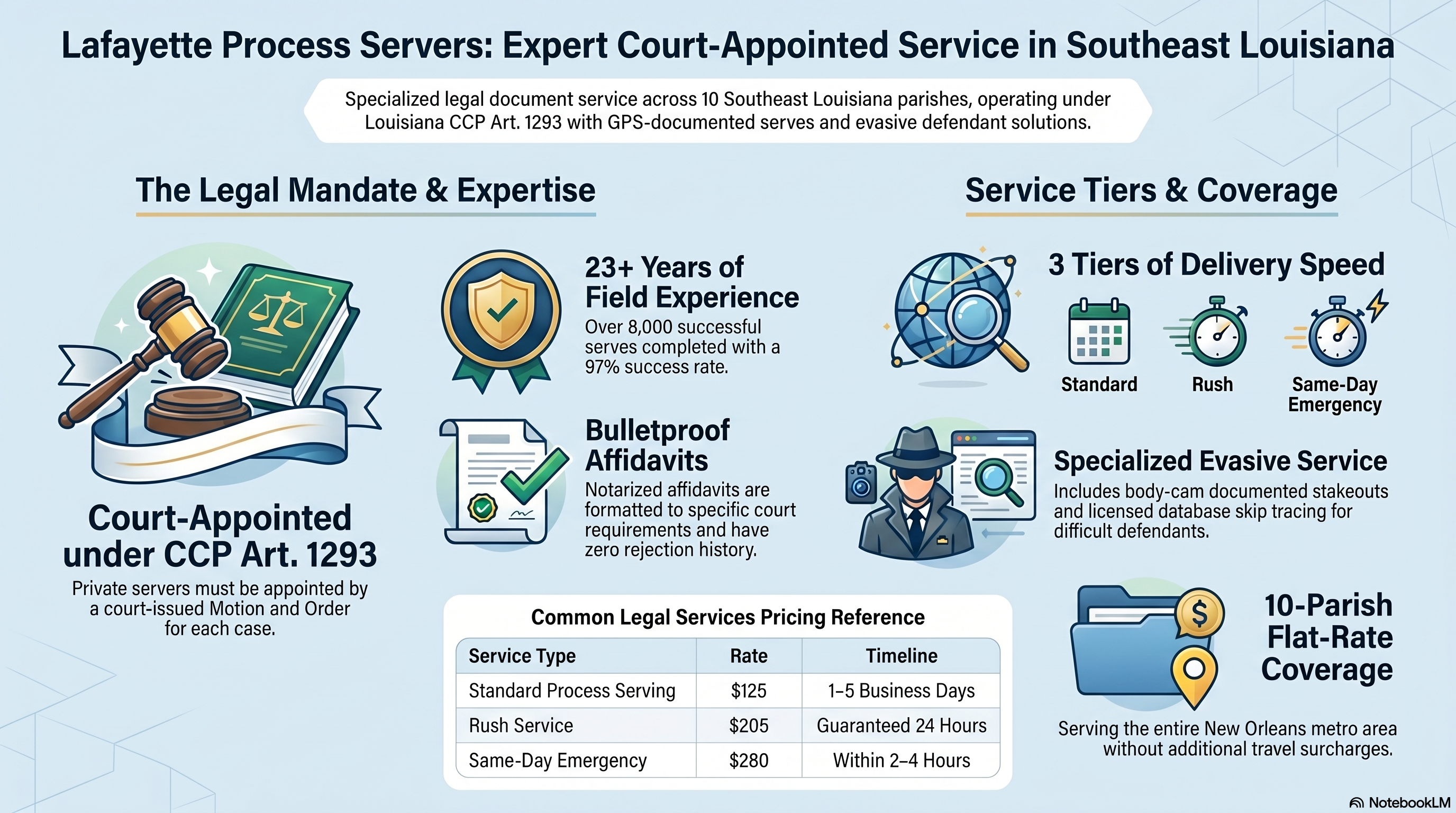
[00:07:08] Speaker B: They utilize a specific procedural remedy found in the Louisiana Code of Civil procedure. Specifically, Article 1293.
[00:07:15] Speaker A: Okay. Article 1293.
[00:07:17] Speaker B: Yes.
CCP Article 1293 states that if the sheriff has not perfected service within 10 days of the filing, the attorney then has the right to move the court for the appointment of a private process server.
[00:07:29] Speaker A: That makes sense. It transfers the logistical burden from a backlogged public sector to a specialized private sector.
[00:07:35] Speaker B: Precisely.
[00:07:35] Speaker A: But the sources describe a maneuver called the simultaneous Appointment. It sounds like they aren't even waiting for those 10 days to pass before they act. How does that work?
[00:07:44] Speaker B: Mechanically, it is a fascinating optimization of the rule.
Instead of waiting for the sheriff to fail on day 10 and then starting the paperwork, the private process server assists the law office in drafting the motion and order for private appointment concurrently with the initial lawsuit petition.
[00:08:01] Speaker A: Oh, so they file them together.
[00:08:03] Speaker B: Exactly. They file them together. But the real bottleneck they're avoiding isn't just the sheriff. It is the court's internal mail system.
[00:08:10] Speaker A: Right, because normally a judge signs an order, it goes to the clerk, the clerk puts it in an envelope, and it sits in the mail for three to five before the law firm receives it.
[00:08:18] Speaker B: Yes, and that is wasted time to bypass that. The sources describe a hold for pickup maneuver.
[00:08:25] Speaker A: Okay.
[00:08:26] Speaker B: The process server instructs the clerk of court to literally hold the judge's signed order at the window. The dispatch team retrieves it immediately. This allows for instant deployment from their dispatch hubs in Karen Crow or Baton Rouge.
[00:08:40] Speaker A: Wow. So they can have servers out in the field hitting locations in Livingston Parish, Ascension Parish, or the North Parish Corridor. Places like. Like Zachary and Baker. Before the law office even gets the automated email confirming the judge signed the paperwork.
[00:08:54] Speaker B: That is exactly right. It's high velocity execution.
[00:08:56] Speaker A: Here's where it gets really interesting. Locating the person quickly is great, but as you said earlier, the legal system requires verifiable proof. It used to be that a judge would take a process server's sworn signature on a piece of paper as gospel.
[00:09:09] Speaker B: Not anymore.
[00:09:10] Speaker A: Right. In 2026, we live in an era of deepfakes, digital mistrust, and rising judicial skepticism. A single piece of paper doesn't always hold up against a courtroom motion to quash, does it?
[00:09:20] Speaker B: It certainly does not. A motion to quash is a defensive legal maneuver where a defendant formally asks the court to render the service invalid. They might claim they were out of town or that the process server handed the papers to a neighbor instead of them.
[00:09:34] Speaker A: And if a judge believes them, If
[00:09:36] Speaker B: a judge grants that motion, the service is quashed, the timeline resets, and the plaintiff loses valuable time and money.
Because of this, the standard of evidence demanded by judges has risen dramatically. Judges don't just want a sworn statement anymore.
[00:09:52] Speaker A: They want the receipts to provide those receipts. Baton Rouge Process servers utilizes a triple layer verification system. Yes, the first layer they mention is tier one skip tracing.
Now, when I think of tracking someone down, I think of looking up their voter registration or maybe property tax records. But the sources say they use Credit header streams and utility data.
What exactly is a credit header stream, and why is it better than a public record?
[00:10:16] Speaker B: It is a massive difference in data quality. Public records like voter registrations or DMV files can be months or even years out of date. People move and simply forget to update them. A credit header stream, however, taps into the top identifying section of a person's credit report. The header. This section updates almost instantly.
[00:10:35] Speaker A: How instantly?
[00:10:36] Speaker B: Well, when an evasive defendant moves to a new apartment and turns on the electricity, the water, or the WI fi in their name, that utility company reports the new address to the credit bureaus within days.
[00:10:48] Speaker A: Oh, wow.
[00:10:49] Speaker B: So by accessing utility data via these credit headers, the process server isn't looking at where a person is registered to vote. They're looking at where that person is actively consuming electricity. It tells them where the target actually sleeps at night.
[00:11:02] Speaker A: That is incredibly precise. So once they have that active address, they move to layer 2, which is geofenced GPS logs.
The sources state that every single attempt made in the field is tracked. The attorney receives a log showing the exact coordinates down to the decimal, along with the timestamp of the attempt.
[00:11:20] Speaker B: Yes, and this is critical when an attorney has to stand before a 19th JDC judge or a family court judge and prove due diligence.
[00:11:28] Speaker A: What does that mean in this context?
[00:11:29] Speaker B: If a defendant cannot be found, an attorney eventually has to ask the court for permission to use alternative methods, like publishing a notice in a local newspaper.
But a judge will only allow that if the attorney proves they tried everything physically possible first.
[00:11:45] Speaker A: I see.
[00:11:46] Speaker B: Presenting a geofenced GPS log proves the process server didn't just drive past the neighborhood. They were physically standing at the specific latitude and longitude of the target's front door.
[00:11:56] Speaker A: And the final layer? Layer three seems to be the ultimate trump card. HD bodycam documentation.
Just like law enforcement, these private servers are wearing high definition video cameras. When they approach the door, announce themselves, and hand over the documents, the entire interaction is recorded.
[00:12:13] Speaker B: It completely eliminates the he said, she said friction in the courtroom.
[00:12:16] Speaker A: Yeah, you can't really argue with a video.
[00:12:18] Speaker B: Exactly. If a defendant stands up and claims they were never served, the attorney can simply play the HD video of that exact defendant accepting the envelope. The motion to quash is shut down instantly.
[00:12:30] Speaker A: Okay, as effective as that is, legally, we have to acknowledge the reality of this. Getting a knock on your door, opening it in your pajamas, and realizing you are being recorded on an HD body cam by a private citizen serving a lawsuit.
That sounds incredibly jarring.
[00:12:46] Speaker B: It is.
[00:12:46] Speaker A: It's Effective, but it's an aggressive posture. And that leads into the specific geography and tactics mentioned in the sources. They aren't just operating in downtown commercial buildings. They have a specialized focus on the industrial district covering West Baton Rouge and Port Allen to track down corporate entities.
They also maintain a hub in Central to handle residential service during evening hours when people are actually home from work.
But the tactic that stands out the most is what their marketing calls the weekend preemptive strike.
[00:13:15] Speaker B: Yes, the sources note that they deploy a weekend tactical unit specifically on Saturdays between 7. 00am and 10am I have to push
[00:13:23] Speaker A: back on this a little. Showing up at someone's house at 7am on a Saturday morning with a body camera rolling. Is this standard practice in civil law or is this crossing a line into harassment?
[00:13:35] Speaker B: It is a valid concern and it's important to differentiate between an average citizen and what the industry calls a professional dodger.
[00:13:42] Speaker A: A professional dodger, yes.
[00:13:44] Speaker B: The sources emphasize that this early weekend tactic is deployed against high net worth individuals or or evasive subjects who have already successfully avoided standard service attempts.
Psychologically and logistically, people who are actively avoiding a lawsuit are hypervigilant, doing normal Monday through Friday business hours.
[00:14:04] Speaker A: That makes sense.
[00:14:05] Speaker B: They look out the window before leaving for work. They screen visitors at their office. Catching them at 7:30am on a Saturday capitalizes on a natural drop in their guard. They might be stepping out to get the mail or. Or walking the dog.
[00:14:17] Speaker A: Right?
[00:14:17] Speaker B: It is aggressive, yes, but legally it is often the only window of vulnerability available to fulfill the court's mandate.
[00:14:25] Speaker A: And clearly the local attorneys rely heavily on these aggressive windows. The sources include real world validation. To back this up, there's a review from Sarah J. A family law attorney who praises their tracking abilities in Central, noting they caught a defendant who had been dodging her firm for months.
[00:14:42] Speaker B: I saw that one.
[00:14:43] Speaker A: There's another review from Michael D. A litigation partner who specifically calls out the Tier one skip tracing and those GPS logs. He says it provided the exact verification he needed to win a tough argument over a case out in Zachary and Baker. It seems the legal community has fully embraced this level of technological enforcement they have.
[00:15:02] Speaker B: And to ensure that attorneys actually understand how to leverage these tools rather than just paying for them blindly, the managing director, Scott Frank and has taken on an educational role. You mentioned his podcast Paper Trails earlier, right?
[00:15:16] Speaker A: In the transcript excerpts we reviewed. He is actively using his platform to educate local attorneys on these exact 2026 19th JDC filing secrets.
[00:15:25] Speaker B: Yes, he is.
[00:15:26] Speaker A: He's explaining why the postmark rule sunset is dangerous how to master that CCT Article 1293 simultaneous appointment and how to utilize utility data to reach the unreachable in places like the North Parish Corridor. He is actively trying to keep the local legal community from falling victim to the new procedural deadlines.
[00:15:43] Speaker B: If we connect this to the bigger picture though, and address your earlier concern about the aggressiveness of a 7.0am body cam visit, it is vital to look at the strict professional boundaries governing this activity.
[00:15:56] Speaker A: Okay, let's look at that.
[00:15:57] Speaker B: The sources feature extensive legal disclosures.
Despite using high definition cameras, dispatch hubs and advanced utility tracking, Lafayette Process Servers LLC explicitly states they are not law enforcement.
They are court appointed private individuals acting under civil authority.
[00:16:14] Speaker A: They make that boundary very clear on the text. They also emphasize that they do not provide legal advice.
[00:16:20] Speaker B: Furthermore, they state that any skip tracing or investigative work like accessing those credit header streams is performed strictly in connection with a process service under a court appointment.
[00:16:30] Speaker A: So they aren't just rogue investigators.
[00:16:32] Speaker B: Exactly. They aren't private investigators for hire. A civilian cannot just pay them to track an ex spouse using utility data. The tools are used exclusively to fulfill a judge's mandate.
[00:16:43] Speaker A: That is a crucial distinction that separates a legal logistics firm from a surveillance operation. And they back up that professionalism with a massive list of credentials. This isn't a fly by night operation.
[00:16:54] Speaker B: Not at all.
[00:16:55] Speaker A: They highlight an A rating with the Better Business Bureau. They maintain active memberships in chambers of commerce all across the state New Orleans, Youngsville, St. Bernard, Jefferson, Ascension, and the Baton Rouge Area Chamber of Commerce. Plus, they've been members of NAPPS, the National association of Professional Process Servers, since 2009.
[00:17:15] Speaker B: That's a long time in this industry.
[00:17:17] Speaker A: But why do those specific credentials matter in the context of a lawsuit? Does a judge actually care if a process server is in the local chamber of Commerce?
[00:17:24] Speaker B: A judge cares deeply about the credibility of the evidence presented. When an attorney submits an HD video or a geofence GPS log to shut down a motion to quash, the opposing council will immediately try to attack the source of that data.
[00:17:39] Speaker A: They attack the messenger.
[00:17:40] Speaker B: Exactly. They will question the reliability of the process server by maintaining a two decade history with napps, a clean BBB record and deep ties to statewide chambers of commerce. The organization presents itself as highly vetted and ethically bound to national standards.
[00:17:57] Speaker A: I see.
[00:17:57] Speaker B: Those credentials insulate the digital evidence from attacks regarding tampering or unprofessional conduct.
It grounds their high tech operations in established professional reality.
[00:18:07] Speaker A: So what does this all mean for you, our listener? I think the big takeaway here is that our justice system isn't just about grand speeches and quiet courtrooms. Beneath the surface, the law is a physical ticking clock.
[00:18:18] Speaker B: It really is a machine.
[00:18:19] Speaker A: It is a system that increasingly relies on aggressive boots on the ground logistics to function. It relies on accessing utility data to find where someone sleeps, using high definition body cams to capture the moment of truth. And perhaps most stressfully for the attorneys in Baton Rouge in 2020 26, it relies on beating that unforgiving 4:30pm Buzzer at 222St. Louis St. The law only works if the paperwork physically gets to where it needs to be on time with undeniable proof.
[00:18:47] Speaker B: This raises an important question, though, one that extends far beyond the procedural rules of the 19th GDC or the sun setting of the postmark rule.
As our legal system's fundamental concept of due process becomes permanently intertwined with this hyper accurate technology geofenced coordinates down to the decimal, real time credit header streams and high definition video documentation at our front doors.
How will the very concept of maintaining privacy change for the average citizen in the years following 2026?
[00:19:17] Speaker A: That is a heavy thought.
[00:19:18] Speaker B: When the courts demand absolute verifiable truth of our physical locations to ensure fairness, the shadows where one can simply choose to be left alone shrink to almost nothing.
[00:19:28] Speaker A: That is a fascinating thought to leave you with today. The digital footprints we leave to live our modern lives turning on the lights, connecting to wi fi are becoming the exact paths the legal system uses to find us. We want to warmly thank you for joining us on this deep dive into the source material. It has been incredibly eye opening exploring this hidden world of legal logistics with you. Keep questioning the hidden operations of the world around you and we will catch you on the next deep Dive.