Episode Transcript
[00:00:00] Speaker A: Picture this scenario for a second. It is a sweltering Tuesday afternoon in Lafayette, Louisiana. The year is 2026. You're sitting at this heavy mahogany desk staring down the barrel of a ticking clock. And the stakes, I mean, they couldn't possibly be higher.
[00:00:14] Speaker B: Oh, that 4.15pm Panic. It's real.
[00:00:18] Speaker A: It is exactly 41 5pm you have this massive, meticulously prepared stack of legal documents sitting right in front of you.
And if that physical stack of paper isn't handed over to a very specific court clerk before the heavy courthouse doors lock at 4:30pm Your entire case just collapses.
[00:00:37] Speaker B: Right. Years of work gone.
[00:00:39] Speaker A: Exactly. We are talking about months of grueling work and thousands of dollars in legal fees completely evaporating in an instant. So welcome to the unexpected high adrenaline boots on the ground world of legal process serving in Acadiana.
[00:00:51] Speaker B: It's a genuinely fascinating ecosystem. Honestly, on the surface, process serving sounds like, you know, mundane administrative work. You picture someone just walking up to a do and casually handing over a manila envelope.
[00:01:01] Speaker A: Like in the movies.
[00:01:02] Speaker B: Right, like in the movies. But when you examine the realities of operating in south Louisiana in 2026, it transforms into an incredible case study in how complex systems are forced to adapt to strict new rules.
We're looking at a space where stringent legal mandates collide with this really rugged rural geography, demanding a level of cutting edge digital intelligence that rivals, quite frankly, modern espionage.
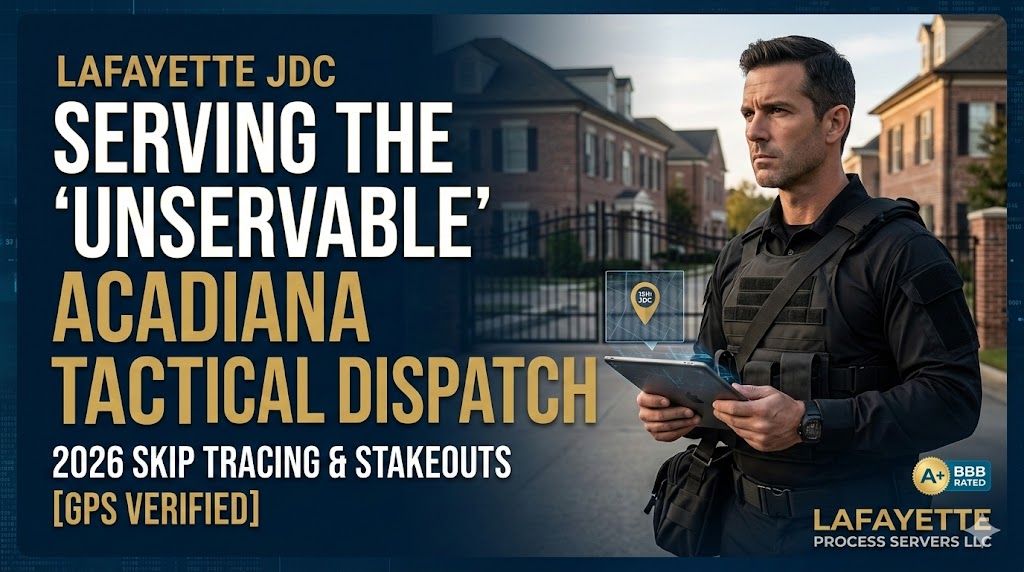
[00:01:27] Speaker A: And to guide us through this landscape today, we are pulling from a really fascinating collection of 2026 legal guides, jurisdictional disclosures and business spotlights. Yeah, all of this material originates from Lafayette Process Servers llc, which is a specialized agency operating out of Cairn Crow, Louisiana.
[00:01:44] Speaker B: Yes, very specialized.
[00:01:46] Speaker A: Our mission for this deep dive is to explore how sweeping new laws and challenging physical landscapes have turned mundane legal delivery into full blown tactical operations.
Okay, let's unpack this. Because the legal framework in Lafayette just went through a massive earthquake.
[00:02:00] Speaker B: A seismic shift is really the perfect way to describe it. And the epicenter of that earthquake is a piece of legislation known as Act 352.
[00:02:07] Speaker A: Act 352. Right.
[00:02:08] Speaker B: Exactly. So as of January 1, 2026, the 15th Judicial District Court, which is the jurisdiction covering Lafayette, Acadia and Vermilion parishes, began strictly enforcing this new mandate. Well, what Act 352 effectively did was kill off the traditional safe harbor of mail in filings for high stakes litigation.
[00:02:28] Speaker A: I was reading about that safe harbor concept. Yeah, because for decades, attorneys could just drop a critical document in the mail, get a physical postmark from the post office and breathe this massive sigh of relief knowing they met their deadline.
[00:02:41] Speaker B: Yep, a postmark was everything.
[00:02:42] Speaker A: But Act 352 wipes that out entirely. It demands a digital first approach for most things, but combined with absolute in person physical hand delivery for critical legal documents. I saw a lot of mentions in the sources about missing prescription deadlines. If this isn't handled perfectly, what exactly does that mean in plain English?
[00:02:59] Speaker B: Think of a prescription deadline like a self destruct timer on a lawsuit. Oh, in Louisiana law, prescription is essentially the statute of limitations. It's the absolute final date by which you must take a specific legal action. If that timer hits zero and your document isn't filed properly, your right to sue or defend yourself is extinguished. The case is over.
[00:03:18] Speaker A: Just gone.
[00:03:19] Speaker B: Just gone. If we connect this to the bigger picture, the removal of the mail in safe harbor fundamentally changes the operational reality for every law firm in the region.
It creates a non negotiable reliance on flawless courthouse runners and specialized legal couriers.
[00:03:35] Speaker A: Wait, so if a massive logistics company like a FedEx or UPS can drop off a package anywhere in the world overnight, why does this specific legal drop off cause such a panic? Couldn't law firm just overnight a document?
[00:03:48] Speaker B: That is the exact trap many out of state firms fall into. A national delivery driver is trained for volume and efficiency. Their job is to walk into a large building, find the general mailroom, drop a stack of packages on a desk and leave. But in the 15th JDC, dropping a critical legal motion in a general mailroom is a death sentence for your case.
That document hasn't legally been filed until it is handed directly to the specific clerk of court at the filing window at 800- Buchanan street in Lafayette.
[00:04:18] Speaker A: Ah, I see.
[00:04:19] Speaker B: The national delivery drivers simply do not know the architectural nuances of the courthouse, let alone the specific clerks who need to actually stamp that paperwork.
[00:04:28] Speaker A: Which brings us right back to that ticking clock scenario I mentioned at the top. I was looking at this incredible account from a senior paralegal in Lafayette named Jean Luc Mistress.
[00:04:37] Speaker B: Oh, that's a great example.
[00:04:38] Speaker A: Yeah, he found himself in that exact nightmare. It's 4:15pm he is staring down the unforgiving Act 352 rules, and he realizes he needs a flawless physical execution before 4.3pm so he calls in Lafayette Process Servers LLC and not only did their courier physically make the Buchanan street filing with just minutes to spare, but they also executed a simultaneous coordinated service on a highly evasive witness in the neighboring town of Broussard.
[00:05:06] Speaker B: Incredible timing.
[00:05:07] Speaker A: And the kicker, they provided body Cam proof of the service.
Jean Luc mentioned that the body cam footage was the absolute nail in the coffin for their motion. Why is that video so critical?
[00:05:19] Speaker B: Because the video footage eliminates the courtroom variable of human memory. Or worse, human deception.
[00:05:26] Speaker A: Oh, interesting.
[00:05:27] Speaker B: Historically, process serving often devolved into a he said, she said argument.
A process server swears they handed the papers to the defendant, and the defendant stands before the judge and swears they were out of town and never received anything.
[00:05:40] Speaker A: I can see how that would be a problem.
[00:05:42] Speaker B: It grinds the judicial process to an absolute halt. Body cam footage removes all of that friction. The judge doesn't have to weigh the credibility of two strangers. They simply watch the time stamped high definition tape of the handoff. But getting those papers into the right hands in the first place is where the system usually experiences massive bottlenecks, particularly when attorneys rely on traditional law enforcement.
[00:06:04] Speaker A: That stood out to me as well. The traditional route has always been to bundle up the paperwork and ask the local sheriff's office to go serve the papers. But Acadiana is a booming metro area now, right?
[00:06:15] Speaker B: And a booming population naturally leads to a heavier judicial caseload. The sheriff's deputies are tasked with public safety, criminal warrants, a thousand other high priority civic duties.
[00:06:25] Speaker A: Serving civil papers isn't exactly their top priority.
[00:06:28] Speaker B: Serving a civil subpoena for a contract dispute simply isn't at the top of their triage list. As a result, attorneys can find themselves waiting wits just to get a basic summons delivered. In high stakes litigation, waiting three or four wits can completely derail a legal strategy.
[00:06:45] Speaker A: This is where a vital legal pivot comes into play. Specifically, Louisiana Code of Civil Procedure, Article 1293. From what I gather from the sources, this statute acts like a pressure release valve for the legal system. It dictates that if the sheriff hasn't been able to make service within 10 days of receiving the papers, the attorney can petition the court to appoint a private special process server to take over the hunt.
[00:07:08] Speaker B: That 10 day mark is the magic number. It allows the private sector to step in and apply specialized resources to a problem that the public sector simply doesn't have the bandwidth to solve.
[00:07:19] Speaker A: Here's where it gets really interesting though, because it's not just about utilizing a private process server. The key is exactly how the lawyer writes the legal motion to appoint them.
There is a brilliant tactical loophole highlighted here. Lawyers are heavily cautioned against naming an individual person on that court order.
[00:07:37] Speaker B: Yes, that's crucial.
[00:07:39] Speaker A: So you never want to ask the judge to appoint John Doe to serve the papers. Instead, they Use a very specific drafting strategy. They ask the judge to appoint Lafayette Process Servers LLC or its agents.
[00:07:51] Speaker B: That specific phrasing, adding or its agents is a complete game changer for legal logistics. Think about the fragility of a system that relies on a single individual. If a lawyer names one specific process server on a court order and that person gets a flat tire on Interstate 10, or has a sudden family medical emergency, or gets stuck testifying in a different courtroom, that entire legal service grinds to a halt.
[00:08:13] Speaker A: Right, because only they are authorized to do it.
[00:08:15] Speaker B: Exactly. The attorney would have to draft a brand new motion, go all the way back to the judge, get a new signature for a new person. It's a nightmare. But by utilizing an agency appointment, you build an instant redundancy. If one agent is delayed, the agency's dispatch hub and Karen Crow can instantly pivot and send another agent out into the field. The forward momentum of the case is maintained without any bureaucratic red tape.
[00:08:40] Speaker A: And the difference in speed is staggering. There is a story from a litigation attorney in Crowley, Sarah D. That perfectly illustrates this. She had a defendant actively hiding out somewhere in rural Vermillion Parish. The sheriff's deputies have been trying to track this individual down for three, three straight weeks, coming up empty handed every single time.
[00:08:58] Speaker B: Three weeks is a lifetime in litigation.
[00:09:00] Speaker A: Right? So on a Monday Morning, Sarah utilizes CCP Article 1293 to pull the papers away from the sheriff. And she appoints Scott Frank's team.
Scott is the principal of the LLC, bringing over 25 years of specialized experience in these specific Acadiana courts. They get the official appointment on Monday afternoon.
By Tuesday morning, his team had tracked the evasive defendant down and served him in the town of Kaplan. They accomplished in one day what couldn't be done in three weeks.
[00:09:29] Speaker B: Achieving that kind of speed isn't a matter of luck. It requires an entirely different methodology, especially when you are navigating the unique physical geography of South Louisiana. Delivering legal documents in a grid like urban center with clear street signs is a straightforward task. Attempting to find someone who doesn't want to be found in rural unincorporated stretches like Griden, Morse or Iota is an entirely different discipline.
[00:09:52] Speaker A: I notice a lot of discussion about the no restrictions data gap in those rural areas. What does that actually look like on the ground?
[00:09:57] Speaker B: Imagine you're trying to find a specific individual. You pull up a standard public record and it points you to a 50 acre plot of farmland. The complication is that this land has been in the exact same family for four generations because it is unincorporated and Unrestricted. There's no traditional zoning, so it's not
[00:10:14] Speaker A: just one house with a mailbox.
[00:10:15] Speaker B: Far from it. Sitting on that 50 acres might be an original main house, three large barns, a workshop, and four different mobile homes tucked into the treeline, none of which have their own individual mailing address. You can't just drive onto the property and start knocking on every single door holding legal subpoenas. It's inefficient and frankly in rural Louisiana it can be dangerous.
[00:10:36] Speaker A: So how do they figure out which door to knock on if the public data just points to a giant empty field? I was reading about them utilizing geographic information systems or gis, along with things called credit header data and tier one utility data.
[00:10:51] Speaker B: Can you bring break those terms down specialized skip tracers? The people whose job it is to hunt down these elusive subjects, they don't rely on those cheap public people finder websites you see advertised on late night tv. They use GIS mapping overlaid with deep local property tax records to visually identify specific physical structures hidden on those unmapped tracks of land.
[00:11:14] Speaker A: Okay, that covers the structures.
[00:11:15] Speaker B: Then they cross reference that with credit header data. If you have ever applied for a credit card or an auto loan, the top section of your credit report, the header contains your most recent self reported addresses and phone numbers. It is incredibly accurate because people generally do not lie to a bank when they are asking for money.
[00:11:33] Speaker A: And the tier one utility data that
[00:11:35] Speaker B: is essentially following the electricity bill. A subject might not update their voter registration or their driver's license, but they will absolutely put their name on the water or power bill to keep the lights on. They track the infrastructure, not the mail.
[00:11:48] Speaker A: That makes total sense. But what happens when you are dealing with people living in off market housing?
The research mentions folks living in a secondary structure on their grandparents land or renting a back room from a cousin where the property deed hasn't been legally updated since the late 1990s. The traditional paper trail, even the utility trail, is completely cold.
[00:12:09] Speaker B: When the paper trail freezes, they pivot to the digital trail. This is where Soci Mint comes into play. Social media intelligence.
[00:12:17] Speaker A: I saw some brilliant examples of this in the sources.
Even if someone doesn't have a modern mailing address attached to their name, they almost certainly have a smartphone in their pocket. The research specifically points to skip tracers tracking geotagged photos or social media check ins at massive local events.
[00:12:33] Speaker B: It's highly effective.
[00:12:34] Speaker A: So an investigator might locate an evasive subject because they checked in on Facebook at the International Rice Festival in Crowley or posted a Live video from the giant omelette celebration in Abbeville. They digitally verify the physical location before they ever burn a single drop of gas driving down those rural backroads.
[00:12:51] Speaker B: Verifying that location is only half the battle, though. The element of surprise is the other half, because the physical environment of Acadiana actively works against the process server.
Consider a long, private gravel driveway leading up to a rural property. If an agent drives a standard sedan up that path, the crunching of the gravel and the massive cloud of dust are going to announce their arrival from a mile away.
[00:13:15] Speaker A: Like a gravel road early warning system.
[00:13:18] Speaker B: Exactly. If the subject is actively evading service, they have all the time in the world to casually slip out the back door and disappear into the fields.
[00:13:25] Speaker A: So how do you beat an environment that announces your arrival?
[00:13:28] Speaker B: You don't drive up the driveway at all. Modern process serving heavily relies on the art of the stakeout.
These specialized agents utilize unmarked vehicles and discreet surveillance to map out the target's daily patterns. Instead of bringing the paperwork to the heavily guarded house, they wait for the subject to come out into the open.
[00:13:46] Speaker A: They let the target come to them.
[00:13:48] Speaker B: They look for a local bottle mix. If you live out in a deep rural area, eventually you have to drive into town to visit the only local gas station, or you have to stop by the local post office.
That public neutral ground is where they safely and surprisingly make the handoff. This raises an important question, though, regarding the statutory compliance of this kind of surveillance. The operational guidelines are incredibly strict about their legal guardrails. It is vital to clarify that these agents are not law enforcement officers. They have no police powers. Furthermore, they are not private investigators available for hire by the general public.
[00:14:23] Speaker A: So someone can't just call up Lafayette process servers because they are suspicious of their spouse and want them followed to a motel.
[00:14:30] Speaker B: Absolutely not. All of this highly tactical skip tracing, the digital shadowing, the stakeouts at the gas station. It is strictly 100% performed in connection with a court appointed process service. Under CCP Article 1293. They are acting exclusively as an administrative arm of the court, nothing more. And importantly, they state clearly that they do not provide legal advice. They execute the physical logistics of the law. They do not interpret it for the
[00:14:54] Speaker A: clients, which is probably for the best because they are incredibly busy handling a surprisingly broad spectrum of logistical needs. For these law firms, it's not just about hunting down evasive witnesses for lawsuits. For example, the Acadian housing market in 2026 has seen a massive surge in complex eviction proceedings. Serving a strict 2026 commercial or residential eviction notice requires exact statutory timing and highly specific notice to vacate. Language across all these different parishes, the
[00:15:22] Speaker B: administrative burden on law firms is immense. The 15th JDC is noted for having famously strict rules regarding how trial exhibits are physically prepared.
We are talking about the tangible presentation of evidence here. Lafayette Process Servers actually provides high capacity thermal binding for trial notebooks.
[00:15:41] Speaker A: Thermal binding? Wow.
[00:15:42] Speaker B: They ensure that the tabbed indices and the document binders are flawlessly physically prepared before their couriers simultaneously deliver them to the judge's bench and the opposing counsel. This ensures an unbroken chain of custody and prevents a minor formatting error from causing a mistrial.
[00:15:58] Speaker A: I was also fascinated by the registered agent requirement. Under Louisiana statute Rs 12.1501, if a massive corporation from Texas or New York wants to legally do business in the Lafayette metro area, they are legally required by the state to have a physical address locally to receive official government correspondence. The LLC steps in to serve as that registered agent, providing their physical Karen Crow hub address. So these multinational companies remain in good legal standing.
[00:16:25] Speaker B: It's a smart service to offer.
[00:16:26] Speaker A: It's wild to think that in an era of globalized cloud based business, a corporation's legal standing literally depends on someone maintaining a physical desk. In Caring Crow, it is the ultimate
[00:16:38] Speaker B: irony of our modern era. It all comes back to the necessity of a verified physical presence. But it's not just the judicial system demanding physical proof anymore. The Internet is now actively demanding it too. Which leads to a fascinating point about how the digital world now relies entirely on the physical world to validate itself.
[00:16:57] Speaker A: Oh, the truth engine concept. I love this part of the deep Dives. We spent all this time talking about digital intelligence, E filings, GIS mapping, Socium Int. But in 2026, the Internet requires physical tangible proof. The research refers to the 2026 SEO diamond standard. Basically, Google's search algorithms have evolved far beyond just scanning text. They operate as a truth engine.
[00:17:19] Speaker B: Yes, that's a great way to put
[00:17:21] Speaker A: it to rank highly online as a local business, you can't just build a website and stuff it with clever keywords. You have to prove to the algorithm that you are a real breathing entity executing real actions in the physical world.
[00:17:32] Speaker B: That is a profound shift in how we understand digital authority. It means actively documenting daily courthouse runs, proving you have physical hubs in specific jurisdictions, and demonstrating real world localized interactions. A business's digital presence is merely a reflection of its physical reality, and there is a great glimpse into the local ecosystem that makes this reflection possible.
[00:17:54] Speaker A: There is a fantastic detail woven into the materials regarding their local sponsor, a company called 337 Media. 337 Media operates as an Acadiana brand builder. They are the digital engine behind successful local brands. Mastering that local SEO and building out these complex web platforms. It highlights this deeply interconnected local symbiosis.
[00:18:15] Speaker B: It really does.
[00:18:15] Speaker A: You have tactical process servers physically executing the hard mandates of the 15th JDC on the ground in the dirt, and local media experts like 337Media translating that localized physical work into digital authority. They feed into each other perfectly.
[00:18:29] Speaker B: It proves that a globalized, hyperconnected Internet hasn't erased the need for the localized expert. In many ways, it has made the local expert even more vital. A massive firm in New York can access all the global data in the world, but if they don't know the difference between a general mailroom and the specific clerk's window in Lafayette, or or they don't know how to navigate an unmacked gravel road in Vermilion Parish without being seen, their case will fail.
[00:18:54] Speaker A: So what does this all mean for you? Whether you are a litigation attorney managing heavy caseloads, a business owner expanding it to South Louisiana, or just someone who's insanely curious about how the hidden gears of society actually turn, the takeaway is clear. We are living in an era where E filings, thermal drones and social media intelligence are the absolute norm. Yet the definitive linchpin of the judicial system remains localized boots on the ground execution. You simply cannot digitize a hand to hand legal delivery at a gas station in Kaplan.
[00:19:25] Speaker B: Ultimately, the law is only as powerful as its ability to be physically enforced. These tactical process servers act as the vital physical bridge between a judge's signature on a piece of paper and the real world compliance of an evasive individual. Without that physical bridge, the entire legal system remains entirely theoretical.
[00:19:45] Speaker A: Which leaves us with a rather provocative thought to chew on as we wrap up. We've seen how today's skip tracers use digital breadcrumbs, geotags, credit headers, utility data social media to find people hiding out in the physical world.
But as privacy technologies inevitably evolve to actively mask those breadcrumbs as people transition to decentralized networks, dummy digital identities, and untrackable off grid tech, our digital and physical lives will become completely decoupled when the digital trail vanishes entirely. How will the judicial system of the future enforce its physical mandates? If the truth engine goes dark, how will the law find you? Thank you so much for joining us on this deep dive into the fascinating high stakes world of Acadiana's legal process servers. Keep questioning the systems around you, and we will catch you on the next one.