Episode Transcript
[00:00:00] Speaker A: Imagine just for a second that you are the lead plaintiff in this massive, totally urgent legal case.
You've got, you know, millions of dollars on the line, or maybe there's this critical injunction that absolutely has to be filed right this very second to save your business.
[00:00:16] Speaker B: Right. Something super high stakes.
[00:00:18] Speaker A: Exactly. High stakes. You've hired the best lawyers in the state. You have airtight evidence. The judge is sitting on the bench completely ready to hear your case.
The entire system is paralyzed, just completely frozen. And it's not because of some complex legal maneuvering by the opposing council.
[00:00:36] Speaker B: Right.
[00:00:37] Speaker A: It's paralyzed because the local government is simply too backlogged to hand a physical piece of paper to the defendant.
[00:00:43] Speaker B: It really is like the ultimate anticlimax, isn't it?
[00:00:46] Speaker A: Oh, totally.
[00:00:46] Speaker B: I mean, you have this incredibly sophisticated, centuries old machinery of the justice system, and it just, it grinds to an absolute halt over a pure logistical bottleneck. The state literally cannot physically deliver the mail.
[00:01:01] Speaker A: It's wild.
So today we are taking a deep dive into an incredible stack of sources from 2026 that reveal exactly what happens when that delivery mechanism just totally collapses.
[00:01:13] Speaker B: Yeah, these sources are fascinating.
[00:01:15] Speaker A: They really are. We've got strategic briefings from tactical Private Process servers in Baton Rouge, specifically Lafayette Servers llc.
[00:01:24] Speaker B: Right.
[00:01:25] Speaker A: We have their legal disclosures, their court service pages, and we even have a media sponsorship spotlight from a local Acadiana show. I think it's called Paper Trails.
[00:01:33] Speaker B: Yeah, paper Trails, yeah. Featuring a tech agency called 337 Media.
[00:01:37] Speaker A: Exactly. So our mission for this deep dive is to basically figure out how top tier law firms are bypassing this gridlock public system. We want to know what it actually takes to navigate the messy geography of a sprawling city. And how in a world of deepfakes, you can undeniably prove that a fictional physical interaction actually happened.
[00:01:56] Speaker B: Which is just a brilliant place to start, because these sources, they reveal a really profound vulnerability in the bedrock of our whole legal framework.
Well, due process, it's the absolute core of the justice system. Right. And it fundamentally relies on this concept of notice.
[00:02:11] Speaker A: Right. Like you have to know you're being sued.
[00:02:13] Speaker B: Exactly. The Constitution basically dictates that the state cannot take your property or your money or your freedom in secret. You literally cannot be sued or evicted without being formally notified. So you actually have a chance to defend yourself.
[00:02:27] Speaker A: Makes sense.
[00:02:28] Speaker B: So if that physical delivery mechanism fails, like if you are not served that physical piece of paper, the entire philosophical concept of justice just completely breaks down. The court literally cannot act.
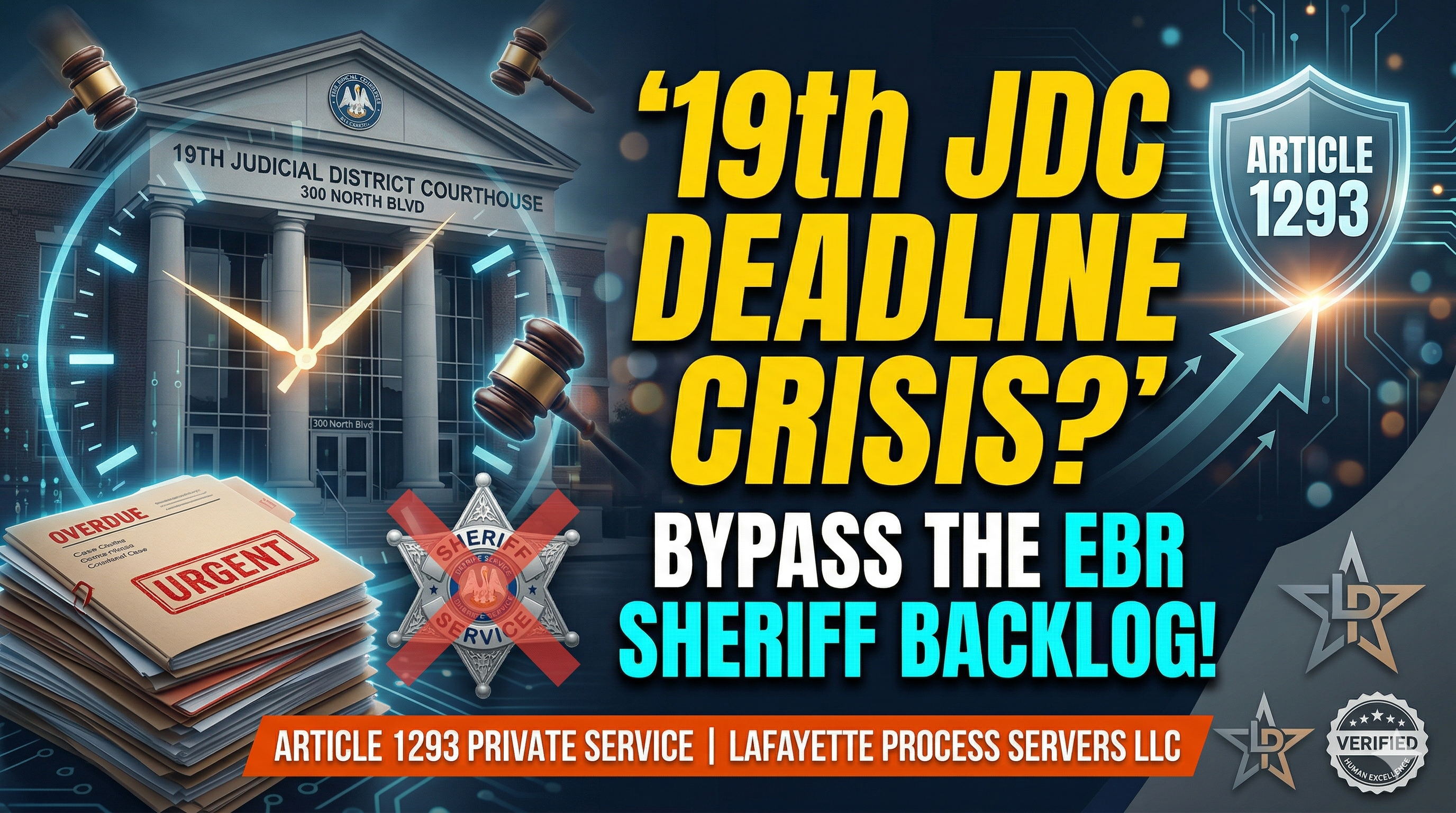
[00:02:40] Speaker A: Okay, let's unpack this. Because the Core problem documented in these briefings centers around East Baton Rouge parish, specifically the 19th Judicial District Court, or the 19th JDC.
[00:02:52] Speaker B: Right, the 19th.
[00:02:54] Speaker A: And they are facing just an absolute administrative nightmare at the public sheriff's level. The traditional government run channels. They simply have way too many lawsuits, too many papers to serve, and nowhere near enough deputies to handle the sheer volume. With a massive backlog, massive law firms are literally having their hearing dates vacated. Meaning the judge just throws the schedule out the window because the government couldn't deliver the paperwork in time.
[00:03:18] Speaker B: Which is just crazy.
[00:03:19] Speaker A: Think about how insane that is. You are paying thousands of dollars in legal fees and your case just dies in a mail room.
[00:03:26] Speaker B: Well, it's a systemic failure. I mean, you're essentially relying on a generalized public utility to handle what is a highly specialized, totally time sensitive emergency. Yeah, and the cost of that public utility failing isn't just that, you know, a package arrives a few days late.
[00:03:42] Speaker A: Right. It's not like a delayed Amazon order.
[00:03:45] Speaker B: Exactly.
The cost is the dismissal of your entire case. The statute of limitations might actually expire while you're just sitting there waiting for a deputy to knock on a door.
[00:03:55] Speaker A: Which brings us to the escape hatch. Because when the public system is drowning like this, the law firms deploy a highly specialized legal loophole. In Louisiana, it's known as Code of civil procedure article 1293. And the rule basically says that if the public sheriff hasn't made service within 10 days, or, you know, if there's a massive time sensitive emergency, a judge can just authorize a private process server to take over.
[00:04:21] Speaker B: Right.
[00:04:21] Speaker A: You're basically paying to pull your lawsuit out of a stack of thousands of backlog documents and putting it into a dedicated one on one deployment queue. It's the legal equivalent of hiring a hyper specialized tactical private courier when the standard postal service is just overwhelmed.
[00:04:38] Speaker B: And we should probably Clarify that Article 1293 is a formally sanctioned, highly regulated bypass.
[00:04:44] Speaker A: Oh, definitely.
[00:04:45] Speaker B: Like the courts are openly recognizing that their own public apparatus is failing to meet the speed required for modern litigation. So they're legally empowering these specialized private entities to keep the wheels of justice turning.
[00:04:56] Speaker A: Yeah, they need them.
[00:04:57] Speaker B: They absolutely do. But stepping into that role, as the briefings really detail, it, requires a level of precision and local intelligence that is completely separate from just, you know, driving a car from point A to point B.
[00:05:08] Speaker A: But hold on, that creates a massive logistical contradiction for me.
[00:05:12] Speaker B: How so?
[00:05:13] Speaker A: Well, in the briefings, they strongly emphasize that relying on national networks of gig economy drivers or like standard consumer grade GPS is a total recipe for failure. And I'm like, wait a minute. In 2026, standard mapping tools fail.
[00:05:30] Speaker B: Oh, they absolutely do.
[00:05:31] Speaker A: But I can pull out my phone right now, order a burrito, and watch the driver navigate to my exact coordinates down to the foot in real time. Can't my phone find literally any address on earth? Why do you need a highly specialized local agent when we have, you know, satellites mapping the entire globe?
[00:05:48] Speaker B: Well, if we connect this to the bigger picture, you really have to distinguish between a geometric map and what these tactical servers call ground truth. Ground truth? Yeah. A map gives you a route. It draws a line on a screen. But ground truth gives you the messy, totally unpredictable physical reality of that route.
[00:06:04] Speaker A: Okay, give me an example.
[00:06:06] Speaker B: Think about how you use GPS on your phone. A GPS will tell a gig worker to take the i10 on 12 split in Baton Rouge at 4:30pm because it looks shorter on paper. But local ground truth intelligence knows that traffic shift is going to trap you in a parking lot of cars for an hour, and that's going to cause you to miss the exact, say, 15 minute window the defendant is actually arriving home from work.
[00:06:27] Speaker A: Ah, okay, so the burrito delivery analogy kind of falls apart because the guy ordering the burrito actually wants you to find him.
[00:06:36] Speaker B: Precisely. The geography of justice is adversarial. You are trying to find someone who actively, desperately does not want to be found.
Standard GPS doesn't understand the sprawling, complex entry protocols of, say, the industrial parks in Port Allen. Oh, sure, it might direct you to a massive metal warehouse, but it doesn't know which of the 12 unmarked loading dogs the business owner actually uses to sneak in and out. It doesn't know the specific narrow timing windows you need to safely and successfully make contact in neighborhood neighborhoods along Plank Road or Government Street.
[00:07:09] Speaker A: Wow. Yeah, and it definitely doesn't help you when you are dealing with high net worth defendants who have the resources to just build fortresses around themselves.
[00:07:17] Speaker B: Oh, exactly. The gated communities.
[00:07:19] Speaker A: Right. The sources detail the absolute nightmares of navigating private security protocols in gated communities like Shenandoah or the Country Club of Louisiana. If you just follow a gps, it literally drives you right up to a locked iron gate and a private security guard who. Whose literal job description is to turn you away.
[00:07:39] Speaker B: They will not let you in.
[00:07:40] Speaker A: No. So these process servers can't just knock on the front door. They have to use calculated strike times based on local intelligence. It's about knowing the target's habits, their routines, and like, the exact hour they are vulnerable to being approached outside of those security Perimeters.
[00:07:57] Speaker B: Which fundamentally changes the job description from courier to tactical investigator.
[00:08:02] Speaker A: Absolutely.
[00:08:03] Speaker B: But navigating that physical geography and slipping past the security guard at the Country Club of Louisiana, that is only the preamble.
[00:08:09] Speaker A: Wait, there's more?
[00:08:10] Speaker B: Oh, yeah. Once you actually stand face to face with the evasive defendant and hand them the lawsuit, you face an entirely new, uniquely modern problem. In the past, the server would just sign a piece of paper, an affidavit, swearing to the court that they handed over the documents, and the judge would just take their word for it. We do not live in that world anymore.
[00:08:31] Speaker A: Oh, here's where it gets really interesting.
Because finding the person is literally just the physical battle. Since we are looking at 2026, proving to a judge that the encounter actually happened requires absolute sci fi levels of technological proof. It's why people are fighting back with not at home defenses or even courtroom deepfake allegations.
Imagine standing in court and the defendant points at the video of them being served and tells the judge, that is totally AI generated. I wasn't even in the state of Louisiana that day.
[00:09:01] Speaker B: It is a terrifying prospect for the legal system, because as digital manipulation becomes, you know, seamless and totally accessible to anyone, the burden of proof for a simple, everyday human interaction just skyrockets. Yeah, a standard smartphone video is no longer considered bulletproof evidence.
What's fascinating here is how Lafayette Process Servers combats this courtroom skepticism with what they call their truth engine protocol.
[00:09:25] Speaker A: Truth engine.
Sounds intense.
[00:09:28] Speaker B: It really is. They are outfitting their servers with 4K body cam verification for every single service encounter.
[00:09:36] Speaker A: Wait, but even a 4K video could theoretically be manipulated, right? Like, if I'm a skeptical judge. High resolution doesn't mean it's not a deep fake. Doesn't that just kind of kick the can down the road?
[00:09:46] Speaker B: That is exactly why the camera alone isn't enough. The Truth Engine protocol layers the video with blockchain lock metadata.
[00:09:53] Speaker A: Oh, wow.
[00:09:53] Speaker B: Yeah. So when the encounter happens, the camera captures the 4K video, but it simultaneously captures captures the GPS geofence data points, the exact millisecond timestamp, and a cryptographic hash of the video file itself.
And all of that metadata is immediately locked into an immutable digital ledger.
[00:10:11] Speaker A: I have to admit, when I read blockchain in a legal logistics briefing, my eyes rolled so hard.
[00:10:16] Speaker B: I'm sure.
[00:10:16] Speaker A: Isn't that just a buzzword crypto bros use to sell digital real estate? Why on earth does a local court in Baton Rouge care about a cryptographic ledger?
[00:10:25] Speaker B: Well, because of immutability. You kind of have to forget the cryptocurrency associations. The true power of a blockchain is that once data is written to cannot be retroactively altered by anyone.
[00:10:37] Speaker A: Period.
[00:10:37] Speaker B: Period. Not by the process server, not by the defendant, not by an AI generator. It basically creates an indisputable digital receipt for justice.
[00:10:46] Speaker A: That's a great way to put it.
[00:10:47] Speaker B: So when a defendant claims the video is a deep fake, the process server doesn't just argue back.
They point to the ledger. And this perfectly satisfies modern digital evidence standards, like the 19th JDC Rule 3.5, which governs how technology and electronic evidence are handled in that specific court. It completely neutralizes the modern technological excuse that is wild.
[00:11:08] Speaker A: It's literally an unbreakable mathematical proof that a piece of paper changed hands.
[00:11:12] Speaker B: Exactly.
[00:11:13] Speaker A: But what if the person just totally goes off the grid? Like, what if there's no physical encounter to record? The briefings mention something called forensic skip tracing, which, I mean, sounds very cool, but what is the actual mechanism there? How do you trace a ghost?
[00:11:26] Speaker B: Forensic skip tracing is far more sophisticated than just, you know, Googling someone's name or checking their Instagram.
[00:11:32] Speaker A: I would hope so.
[00:11:33] Speaker B: Yeah. When a subject goes dark, to avoid a lawsuit, these firms utilize proprietary databases to track digital exhaust across parish lines. We are talking about pinging utility bill activations, tracking vehicle registration updates, pulling property tax records, and analyzing credit header data.
[00:11:53] Speaker A: Jeez.
[00:11:54] Speaker B: They cross reference all these massive data pools to create a heat map of where this ghost is actually spending their time. You might be hiding in a cabin in the woods, but if you turn the electricity on under your name, the skip trace will find the exact geographic coordinates of that meter.
[00:12:09] Speaker A: So they are hunting ghosts through municipal utility data and then trapping them on a cryptographic ledger.
[00:12:14] Speaker B: Pretty much.
[00:12:15] Speaker A: The sheer intensity of it is mind blowing. But as we dig deeper into the sources, you realize all of this extreme field technology is essentially useless if the administrative paperwork isn't perfect.
[00:12:25] Speaker B: Oh, absolutely. All the tactical maneuvers, the 4K cameras, the forensic heat maps, they are entirely subservient to the strict administrative rules of the court. You can have the most flawless blockchain verified body cam footage in the world, proving beyond a shadow of doubt that you served a billionaire in his gated community. Yeah, but if you make one clerical error when you file the return, the technology doesn't matter. The judge just throws the case out.
[00:12:52] Speaker A: So what does this all mean for the paralegals and attorneys who are actually, you know, managing these cases behind desks? Because the briefings highlight some pretty brutal changes to the law that make this landscape incredibly unforgiving. For example, LA Act 352. The sources note that this act eliminated what was known as the Postmark rule for the 19th JDC. Can you explain why that was such a massive shift?
[00:13:16] Speaker B: It completely changed the timeline of legal logistics.
[00:13:18] Speaker A: Yeah.
[00:13:19] Speaker B: Historically, if you had a strict deadline to file your proof of service, which is the document proving you handed over the lawsuit, you were protected by the postmark rule. So if your deadline was Friday, as long as you dropped that paperwork in the mail by 11.59pm on Friday and the post office stamped it with that date, you were legally safe.
Even if the court didn't actually open the envelope until the following Wednesday, the postmark was your shield. Got it. Act 352 stripped that shield completely away.
[00:13:46] Speaker A: Meaning the mailman is no longer a valid extension of the court system.
[00:13:51] Speaker B: Mailing a return to protected deadline is no longer legally valid. The physical piece of paper must be in the actual hands of the clerk of court at 222St. Louis St. Before the deadline expires. Or you have to utilize specific E filing portals like lcraa.
[00:14:07] Speaker A: Lcra?
[00:14:08] Speaker B: Yeah, it stands for the Louisiana Clerk's Remote Access Authority. Or another system called Clerk Connect. Essentially, the digital portals or the physical front desk are your only options.
[00:14:17] Speaker A: Which means the gritty physical reality of driving downtown to 222St. Louis St. Fighting for parking and standing in line at the courthouse is suddenly a life or death matter for a multi million dollar lawsuit.
[00:14:28] Speaker B: Exactly. The physical hurdles are just as dangerous as the legal ones.
[00:14:32] Speaker A: And the rules just keep piling up. For instance, Louisiana CCP Article 253 mandates that the filer, not the clerk of court, is strictly responsible for redacting sensitive data.
[00:14:44] Speaker B: Yep.
[00:14:45] Speaker A: If you leave a Social Security number on a document, it's your liability.
But the detail that really made me sweat was a specific warning for paralegals regarding suit accounting.
Walk us through what happens if a paralegal forgets to check their balance.
[00:15:01] Speaker B: Oh, this is the perfect example of administrative hygiene being just as critical as tactical field operations.
[00:15:06] Speaker A: Yeah.
[00:15:06] Speaker B: Imagine you are a senior partner at a top law firm. You spent a million dollars preparing a case. You've hired these tactical process servers to bypass the sheriff's bottleneck and to get the judge to sign the article 1293 ordered to deploy them. You have to file a motion.
[00:15:21] Speaker A: Right.
[00:15:21] Speaker B: But let's say the law firm has an outstanding balance of $5 in court costs at the Clerk's office. Just a minor forgotten digital.
[00:15:28] Speaker A: Okay.
[00:15:28] Speaker B: Clerk of court will see that $5 deficit and literally stall the appointment. They just freeze the paperwork. $5 over $5. The paperwork just sits there. The tactical server isn't deployed, the clock ticks down, the deadline passes, and the entire case experiences a total legal reset.
[00:15:46] Speaker A: Wow.
[00:15:46] Speaker B: The case is dead. You have to start all over again. The client pays more money, the timeline is pushed back months. All because a 22 year old paralegal forgot to top up a $5 digital courthouse toll before submitting the motion.
[00:16:00] Speaker A: That is agonizing a razor thin margin for error where the smallest clerical oversight unravels millions of dollars of legal work.
[00:16:08] Speaker B: Yeah, it's brutal.
[00:16:09] Speaker A: And it explains why firms like Lafayette Process Servers LLC are so incredibly explicit about their legal disclosures. The sources emphatically state they are not law enforcement, they do not possess police powers, they cannot make arrests, and they do not act as private investigators for the general public. And any skip tracing or field surveillance they do is strictly mandated by that specific court appointment.
[00:16:30] Speaker B: They have to draw that hard line because they operate in a very narrow, highly regulated space between private citizen and agent of the court. I mean, they are tactical specialists, but their actual battlefield is bureaucracy.
[00:16:44] Speaker A: And surviving that battlefield requires a surprisingly traditional hyperlocal ecosystem. If you think about everything we've discussed, the blockchain ledgers, the forensic skip tracing, it all sounds like science fiction, sure, but the firm also provides daily Courthouse runners to 300 North Blevidie in Baton Rouge, hitting the suit, accounting and civil processing departments in person.
They physically handle 100% compliant 5 day notices to vacate for tricky evictions. They act as corporate registered agents. They even dispatch mobile notaries for time sensitive contracts near the state capitol.
[00:17:19] Speaker B: What's fascinating here is the juxtaposition. You have an industry deploying the absolute bleeding edge of digital verification tech. But the foundation of the work remains fundamentally rooted in the physical world, right? It requires a human being making daily physical runs to the courthouse to ensure that $5 suit accounting balance is paid. It relies on a totally local ecosystem
[00:17:40] Speaker A: of support, which perfectly explains a rather interesting detail buried in our sources.
If you are an attorney in a panic needing to deploy one of these tactical servers immediately, how do you even find them? You don't just open the yellow pages in 2026.
[00:17:55] Speaker B: No, you definitely don't.
[00:17:57] Speaker A: This is where the media spotlight from the show Paper Trails comes in. The founder of Lafayette Process Servers is doing a sponsorship read for a company called 337 Media, which is an Acadiana brand that builds websites and handles local SEO.
[00:18:10] Speaker B: It is the Unseen glue holding this entire legal machinery together. You have this high stakes, highly technical legal logistics firm, but they are practically invisible without local tech agencies like 337 Media building their digital infrastructure.
[00:18:25] Speaker A: Exactly. The law firms rely on the process servers to keep their multimillion dollar cases alive. And the process servers rely on local media and tech companies to ensure their digital footprint actually shows up when a panicked paralegal searches for help.
[00:18:37] Speaker B: It's totally interconnected.
[00:18:39] Speaker A: It's an intricate ecosystem of local businesses supporting other local businesses just to keep the macro level justice system functioning.
[00:18:47] Speaker B: And it perfectly illustrates to you, the listener, that the concept of the law isn't some abstract, lofty ideal floating in the clouds.
The law is a gritty, physical, highly localized mechanism.
It only works because real people in East Baton Rouge Parish are continuously maintaining these interconnected systems. From the digital architecture of an SEO website, to the cryptographic hash of a body cam video, down to the actual physical footsteps of a courthouse runner fighting for parking on St. Louis Street.
[00:19:20] Speaker A: Which really brings the stakes of this deep dive right to your front door. If you think about your daily life, we all walk around assuming the systems that govern our world, the courts, the enforcement of contracts, the laws protecting our property, we assume they're just automatic. We assume they run on a frictionless track.
[00:19:36] Speaker B: But they don't.
[00:19:36] Speaker A: They don't. They run on people physically navigating traffic on the i10 split, dodging private security guards and meticulously hand filing paperwork because a postmark isn't good enough to save you anymore.
The abstract, grand concept of justice only exists because of this grueling, highly tactical last mile of logistics.
[00:19:56] Speaker B: And as we look at how radically that last mile is changing, it leaves us with a rather profound implication about the future of human trust. Yeah, we are now living in an era where the simple act of handing a piece of paper from one person to another requires a 4K body camera and an immutable blockchain locked metadata ledger just to prove to a judge that it actually occurred to.
The legal system is actively adapting to a reality where basic human testimony and even standard video are no longer trusted.
[00:20:25] Speaker A: Because the baseline of reality is constantly being questioned by deepfakes and digital manipulation.
[00:20:30] Speaker B: Precisely. Which leads to a broader, perhaps unsettling question for you to mull over. If the absolute legal baseline for verifying a simple physical interaction now requires immutable cryptographic proof, are we heading toward a future where every significant human interaction with will require the same treatment?
[00:20:47] Speaker A: Oh, wow.
[00:20:48] Speaker B: Will a handshake business deal, a medical consultation, or a verbal agreement with a contractor eventually require a continuous blockchain verified ledger just to prove it happened. If the physical ground truth must always be backed by a digital truth engine, what happens to the concept of basic trust in our everyday lives?
[00:21:08] Speaker A: That is a heavy, fascinating thought to leave on when the basic fabric of reality can be successfully questioned in a local parish court. The receipts we keep for our own lives have to become bulletproof.
[00:21:21] Speaker B: They really do.
[00:21:21] Speaker A: It definitely makes you look at the background machinery of our world a little differently. Keep questioning those quiet systems running around you, because as we've learned today, the real story is almost always hiding in the logistics. Thanks for taking this deep dive with us and we will catch you on the next one.