Episode Transcript
[00:00:00] Speaker A: So picture this. A guy in a pizza delivery uniform knocks on your front door, right? You open it, he tosses a stack of papers at your chest, yells, you've been served, and then just sprints away across your lawn.
[00:00:14] Speaker B: A classic Hollywood moment.
[00:00:16] Speaker A: Exactly. It's a total punchline. It's clean, it's highly cinematic, and the whole dramatic encounter is over in, like, five seconds.
[00:00:24] Speaker B: Yeah, but when you step out of the movie theater and actually look at the gritty, complex reality of the legal system, that snap, snappy little moment just completely disappears.
[00:00:34] Speaker A: Oh, totally.
[00:00:35] Speaker B: The reality is it's far less about theatrical disguises and much more about this rigorous, exhausting, and highly regulated logistical execution.
Because the entire judicial process, I mean, every lawsuit, every divorce, every massive corporate settlement, it all rests entirely on this one foundational, physical step.
[00:00:54] Speaker A: Which is wild when you think about it.
[00:00:56] Speaker B: It is. Yet it remains almost entirely misunderstood by the general public.
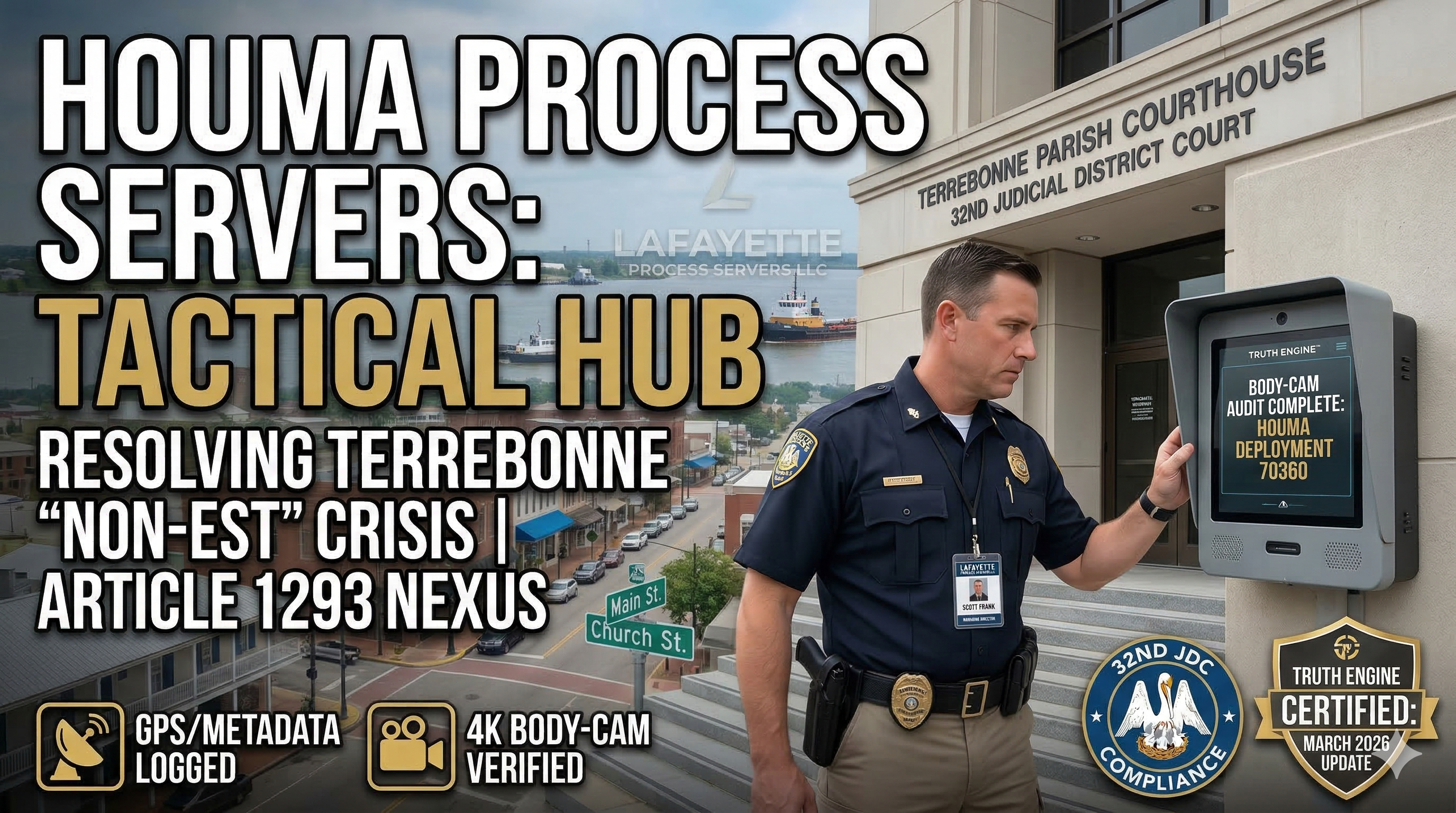
[00:00:59] Speaker A: Well, welcome to today's Deep Dive. Our mission today is to pull back the cur and really explore the hidden machinery of the legal system's last mile. We are talking about the actual art and science of process serving. And to do this, we're using real field data. We are looking at the operational details and the legal disclosures of Lafayette Process Servers, llc, or lps.
[00:01:22] Speaker B: A great case study.
[00:01:23] Speaker A: Yeah. They are a firm operating right in the thick of Louisiana's bayou country.
And treating their operations as a case study kind of strips away those Hollywood myths to show us the actual mechanics of the law right at ground level.
[00:01:36] Speaker B: It really does. Looking at a firm like LPS provides the perfect archetype for the modern legal technician. You know, it reveals exactly how a theoretical constitutional right is transformed into a physical, real world action.
Because due process is a fundamental right. It's the bedrock of the entire legal system.
[00:01:54] Speaker A: Right, but it doesn't mean anything if it's just on paper.
[00:01:56] Speaker B: Exactly. Due process completely stalls if individuals are not officially legally notified of actions against them. A judge cannot proceed, a case cannot advance, and a remedy cannot be granted if that initial service of process fails. And our deep dive frames this massive systemic challenge around Scott Frank, the founder of LPS, who brings over 20 years of legal support experience to the table.
[00:02:22] Speaker A: Okay, let's unpack this. If you look at modern logistics, you constantly hear industry experts talk about the last mile delivery problem.
[00:02:31] Speaker B: Oh, sure.
[00:02:31] Speaker A: It is the concept that getting a shipping container from a factory halfway across the world to a massive distribution center in your city is actually the easy part.
[00:02:40] Speaker B: The bulk movement is easy.
[00:02:41] Speaker A: Yeah. Right. The hardest, most expensive, most chaotic Part of the journey is getting that specific cardboard box from the local warehouse to your exact front porch.
[00:02:50] Speaker B: Yeah, the literal last mile.
[00:02:52] Speaker A: Exactly. Now apply that to the justice system. Imagine process serving as the ultimate last mile delivery problem. But instead of dropping off an Amazon package containing, like, a pair of headphones, you are hand delivering a lawsuit, a subpoena, or an eviction notice.
[00:03:06] Speaker B: And the states are infinitely higher.
[00:03:08] Speaker A: Way higher. And you aren't delivering it to a neatly paved suburban cul de sac. You are delivering it deep into a Louisiana swamp or a labyrinth of industrial parks, or down a bayou side dirt road where your smartphone's GPS just gives up and spins in circles.
[00:03:24] Speaker B: Yeah, that framing completely changes the perspective.
Because if that legal last mile fails, the entire multimillion dollar machinery of the court system just comes to a grinding halt.
[00:03:34] Speaker A: It just stops.
[00:03:35] Speaker B: It does. You can have the most brilliant attorneys and the most compelling evidence, but without that confirmed delivery, you have absolutely nothing.
[00:03:43] Speaker A: I want you to really imagine this scenario. Imagine you are involved in a high stakes legal dispute. Your business is on the line, or perhaps it is a crucial family matter.
[00:03:52] Speaker B: A very stressful situation.
[00:03:53] Speaker A: Extremely. You have spent thousands of dollars on attorney fees, you've gathered all your docum, and you are finally ready for your day in court. Then the entire case derails.
[00:04:03] Speaker B: It falls apart.
[00:04:04] Speaker A: Yep. The judge throws it out. And not because of a clever legal loophole discovered by the opposing counsel, but simply because the person hired to deliver the initial papers got hopelessly lost in a Terrebonne Parish bayou.
[00:04:17] Speaker B: And you know, it is a painfully common reality for out of town law firms who underestimate the terrain.
[00:04:22] Speaker A: I bet.
[00:04:22] Speaker B: Moving from the broad constitutional necessity of process serving to the incredibly specific physical challenges of doing it in a place like Terrebonne Parish reveals a lot about the job.
[00:04:33] Speaker A: Yeah, the geography of justice in this region is just wild. The sources highlight that LPS covers Huma and the entirety of Terrebonne Parish, branching into smaller, distinct communities like Shriver, Gray, and Chauvin.
[00:04:46] Speaker B: Right.
[00:04:47] Speaker A: We are talking about a massive interconnected network of waterways, isolated neighborhoods, and sprawling commercial zones. You cannot just look at a map, count the blocks, and find the front door.
[00:04:57] Speaker B: No, Absolutely not. Out of town servers frequently face severe delays because they rely on standardized navigation tools that simply do not apply to this topography.
[00:05:06] Speaker A: Like just plugging an address into Apple Maps.
[00:05:08] Speaker B: Exactly. You cannot parachute someone in from a different state, hand them a printed Google map, and expect them to efficiently navigate a dirt road that might be flooded or entirely unmarked.
[00:05:20] Speaker A: Yeah, local knowledge is a strict logistical necessity. There is actually a testimonial in the sources from a local attorney, Jeffrey D. That really hammers this home.
[00:05:32] Speaker B: Oh, what does he say?
[00:05:33] Speaker A: He states that LPS is the only team we call because they know the local courts and they get the paper served without fail.
[00:05:40] Speaker B: Without fail. That's a strong phrase, Right?
[00:05:43] Speaker A: When a practicing attorney uses the phrase without fail, they're talking about their own professional survival. Their livelihood depends on the process server successfully navigating that swamp. True, but the navigation is only half of the equation, isn't it? Because finding the person is totally useless if you don't speak the administrative language of the local courthouse.
[00:06:02] Speaker B: What's fascinating here is the absolute symbiotic relationship between the physical geography of a region and its legal jurisdiction. Well, it is never just about physically locating a difficult address at the end of a winding bayou road. It is about understanding the exact administrative demands of the jurisdiction governing that road.
[00:06:20] Speaker A: Ah, I see.
[00:06:21] Speaker B: In this specific region, the entire legal universe orbits around the 32nd Judicial District Court, the 32nd JDC, which is located at 7856 W. Main St. In Houma.
[00:06:34] Speaker A: Okay, so you could theoretically execute the physical delivery perfectly. Like you hand the papers to the right guy at the exact right time, but if you fumble the paperwork afterward, the whole lawsuit is still garbage.
[00:06:45] Speaker B: Precisely. The legal challenge is ensuring that the affidavits of service, which are the sworn official documents proving to the judge that the delivery occurred, are absolutely flawless.
[00:06:55] Speaker A: Right. They have to be perfect, and they
[00:06:56] Speaker B: have to adhere to the specific idiosyncrasies of the 32nd JDC. Every single courthouse has its own unique filing procedures, its own local rules, and its own clerks who will reject a document over a minor formatting error.
[00:07:10] Speaker A: Oh, wow. Just a formatting error.
[00:07:12] Speaker B: Oh, definitely. If your process server successfully navigates the swamp, but incorrectly files the affidavit on West Main street, the service is legally invalid.
The marathon was run, but the runner forgot to cross the finish line.
[00:07:26] Speaker A: That makes an expert Hama process server an administrative necessity just as much as a navigational one.
[00:07:32] Speaker B: Absolutely.
[00:07:33] Speaker A: I mean, they need that parish wide expertise to physically find the defendant. And they need the administrative expertise to ensure the 32nd JDC actually accepts the proof.
[00:07:43] Speaker B: It requires a dual skill set. You are part rugged navigator, part meticulous legal clerk.
[00:07:49] Speaker A: Here's where it gets really interesting though.
[00:07:51] Speaker B: Okay.
[00:07:52] Speaker A: We know the terrain is tough, and we know the administrative rules are incredibly strict, but what happens when the person doesn't want to be found?
[00:08:00] Speaker B: Ah, evasion.
[00:08:01] Speaker A: Right. Because if you know you are being sued for a Massive sum of money. You are probably not sitting on your porch waiting to greet a stranger, holding a clipboard.
[00:08:10] Speaker B: Definitely not.
[00:08:11] Speaker A: You might actively hide.
Looking at a testimonial from a private individual named Mike T. He mentions they had a difficult serve in Huma.
He says Scott Frank's team located the individual and completed the serve in less than 48 hours.
[00:08:26] Speaker B: Impressive turnaround.
[00:08:27] Speaker A: Wait a minute though. If they are skip tracing, hunting down difficult individuals who don't want to be found and doing it in under 48 hours, aren't they basically acting like private investigators or law enforcement? It kind of borders on vigilante justice.
[00:08:41] Speaker B: That is the number one misconception about this industry. And the legal disclosures in our sources dismantle that idea very firmly. Oh, yeah. The legal context is the most crucial part of this entire operation. The sources explicitly state that LPS personnel are absolutely not law enforcement. They do not possess police powers, they cannot make arrests, and they are not above the law in any way.
[00:09:04] Speaker A: So they can't just kick down a door or like pull someone over on the highway.
[00:09:08] Speaker B: They absolutely cannot. They are court appointed process servers whose authority is highly delegated and strictly defined under the Louisiana Code of Civil procedure, specifically Article 1293.
[00:09:20] Speaker A: Article 1293.
Yeah. This statute legally authorizes them to deliver the court's documents, but it does not grant them any special investigative immunities. Furthermore, they do not act as private investigators for the general public.
[00:09:34] Speaker B: Meaning I couldn't just throw them a few hundred bucks and ask them to track down a former business partner who owes me money just for my own personal records.
[00:09:41] Speaker A: Exactly. You cannot hire them to just snoop on someone. Yeah. Any skip tracing, which is the process of locating a person using advanced digital databases, utility records and credit headers, is strictly legally tethered to a court appointed process service.
[00:09:56] Speaker B: That makes sense.
[00:09:57] Speaker A: They are only deploying those tracking tools because a judge or the formal legal apparatus has mandated that this specific individual must be officially notified of a pending action.
[00:10:08] Speaker B: That distinction changes everything. It contains their power to the specific scope of the lawsuit. It does.
[00:10:13] Speaker A: And the sources also clarify. They provide zero legal advice and do not represent clients before entities like the IRS or the sec. They are strictly the physical messengers of the court.
[00:10:24] Speaker B: This raises an important question for anyone observing the justice system.
How do you balance the relentless pursuit of a defendant with the fierce protection of a citizen's privacy?
[00:10:35] Speaker A: That's a tough line to walk.
[00:10:36] Speaker B: It is. On one hand, you cannot allow a lawsuit to evaporate just because the defendant refuses to answer their doorbell.
The system must have teeth.
[00:10:45] Speaker A: Right.
[00:10:45] Speaker B: But on the other hand, you cannot have rogue agents harassing citizens, staking out homes illegally, or violating civil rights just to deliver a piece of paper.
The strict adherence to statutes like CCP Article 1293 is the only thing keeping the system legitimate.
[00:11:01] Speaker A: That balance between relentless pursuit and strict compliance is fascinating. And it brings up the actual business model of how they operate day to day.
[00:11:09] Speaker B: Yeah, the mechanics of it.
[00:11:10] Speaker A: Because you would think that to ensure maximum effort, a process server would only get paid if they actually manage to hand the papers to the person. But the sources note they bill by time and attempt, not by guaranteed outcomes.
[00:11:24] Speaker B: Paying for time and attempts, rather than a guaranteed outcome, is a critical ethical safeguard.
[00:11:30] Speaker A: How so?
[00:11:31] Speaker B: Well, think about the moral hazard involved. If they were paid like bounty hunters.
[00:11:35] Speaker A: Oh, I see. If they only got paid upon successful delivery, you would immediately incentivize them to break those privacy rules.
[00:11:42] Speaker B: Exactly.
[00:11:42] Speaker A: It would be trespassing, harassing neighbors, doing whatever it takes to get their paycheck right.
[00:11:47] Speaker B: By charging for the time. The legal system ensures the server remains an impartial officer of the court.
They are there to make a rigorous, legally compliant attempt.
[00:11:56] Speaker A: And if they fail, if the person
[00:11:58] Speaker B: successfully evades them after the allotted attempts, the server provides an affidavit of those failed attempts.
[00:12:03] Speaker A: Okay.
[00:12:04] Speaker B: The attorney can then use that to ask a judge for alternative methods of service, like publishing it in a newspaper. The server remains a neutral party, not a mercenary.
[00:12:13] Speaker A: And their operations are highly structured around the urgency of that time. The sources show they offer routine service, which covers attempts within three to five days. They have rush service pulling that down to one to two days. And for cases where the legal clock is ticking aggressively, they offer same day
[00:12:31] Speaker B: service, which is incredibly fast for that terrain.
[00:12:34] Speaker A: Yeah, but what surprised me was the sheer diversity of what they are actually delivering. It isn't just lawsuits.
[00:12:41] Speaker B: No, not at all.
Process servers handle the foundational paperwork for almost every major civil action. For example, they execute five day notices to vacate.
[00:12:51] Speaker A: Which is the eviction process, right?
[00:12:53] Speaker B: Yes. It is the absolute first step in
[00:12:55] Speaker A: the eviction process, which is an incredibly high stakes delivery. I mean, if a landlord is trying to evict a tenant, that five day notice is a strict legal countdown.
[00:13:04] Speaker B: Extremely strict.
[00:13:05] Speaker A: If the process server fumbles the delivery or serves it to the wrong person, the judge will throw the eviction out and the landlord has to start the entire month long process all over again.
[00:13:16] Speaker B: The precision required is immense.
And beyond evictions, they act as mobile notaries, ensuring the legal authenticity of signatures out in the field.
[00:13:25] Speaker A: Right.
[00:13:26] Speaker B: They also function as secure legal couriers for highly sensitive documents that you just cannot trust to standard mail.
They even act as a Louisiana registered agent for corporations.
[00:13:37] Speaker A: That registered agent role is an interesting one.
[00:13:40] Speaker B: It's crucial.
[00:13:41] Speaker A: Basically, if you form a corporation or an llc, the state requires you to have a designated physical person available during business hours to receive legal documents.
Because if your business gets sued and you don't have a registered agent, the court might just issue a default judgment against you while you are, I don't know, away on vacation simply because there is nobody there to receive the lawsuit.
[00:14:03] Speaker B: Exactly. Having a reliable firm act as your registered agent prevents those catastrophic default judgments. And managing this diverse portfolio of services across a massive geographical area requires a highly strategic base of operations.
[00:14:17] Speaker A: Where are they actually based?
[00:14:19] Speaker B: Well, while their primary operational theater for this deep dive is Houma and Terrebonne Parish, the sources reveal their physical headquarters is actually located in Cairn Crow, Louisiana, at 3419 NW Evangeline Thruway, Suite E3.
[00:14:33] Speaker A: And I saw they list their dispatch number two. Right. 337-247-9027. Which positions them geographically to deploy resources rapidly.
[00:14:41] Speaker B: Right.
[00:14:42] Speaker A: They aren't just a guy sitting in his car waiting for a phone call. They are running a centralized logistical hub, coordinating parish wide deployments.
[00:14:50] Speaker B: They manage a highly responsive communication network out of that hub to keep law firms updated in real time. But the ecosystem extends far beyond just the physical dispatching of servers.
[00:15:00] Speaker A: Who else is there?
[00:15:01] Speaker B: The sources show that Scott Frank's operations are tied into a much wider modern digital network.
[00:15:06] Speaker A: Yeah, this is where the 21st century really collides with this ancient legal concept. The sources highlight an association with a platform called Paper Trails, which promotes local Acadiana brands.
[00:15:16] Speaker B: Right.
[00:15:16] Speaker A: And that entire platform is supported by a local web and SEO firm called 3 through 7 Media, which highlights a
[00:15:22] Speaker B: profound reality about modern legal infrastructure. A functioning, highly effective justice system today requires robust digital support.
[00:15:30] Speaker A: You can't just do it with a phone book anymore.
[00:15:32] Speaker B: No. You cannot offer same day rush service in a sprawling swamp entirely on your own. Delivering the paper is an analog physical act. But finding the person and getting hired by the law firm in the first place requires massive digital infrastructure.
[00:15:47] Speaker A: Like a corporate attorney sitting in a skyscraper in Manhattan who needs to serve a lawsuit to an oil worker in Terrebonne Parish doesn't inherently know who to call.
[00:15:56] Speaker B: Exactly. They don't have local contacts, so they
[00:15:58] Speaker A: rely on search engine optimization. They type Huma Process Server into Google. The digital infrastructure, the SEO, the local marketing, the web presence managed by firms like 337 Media literally facilitates the constitutional right to due process.
[00:16:14] Speaker B: The legal infrastructure is deeply, inextricably intertwined with the local technological ecosystem.
The fundamental principle of due process remains exactly the same as it was centuries ago, but the tools required to execute it have adapted entirely to the complexities of the modern digital economy.
It takes digital databases to find the address, local web presence to connect the attorney to the server, and then ultimately a human being to physically drive into the bayou.
[00:16:42] Speaker A: So what does this all mean? We have journeyed through the unpredictable swamps of Terrebonne Parish. We unpacked the incredibly strict codes of Louisiana civil procedure and explored the multi tiered, digitally supported business of modern process serving.
[00:16:57] Speaker B: We covered a ground.
[00:16:58] Speaker A: We did. But what is the core takeaway for you today? For me, it boils down to the realization that abstract laws, all those high minded ideals and complex statutes written in thousand page legal textbooks, are entirely 100% dependent on local human execution. The justice system, with all its power, prestige and majesty, is only as effective as the individual person navigating a muddy road in the bayou to physically hand over the paperwork.
[00:17:25] Speaker B: If we connect this to the bigger picture, it reminds us of something quite profound about the society we live in. We exist in an increasingly frictionless digital world.
[00:17:35] Speaker A: Oh for sure.
[00:17:36] Speaker B: We buy our groceries with the tap of a smartwatch, we sign complex contracts with digital signatures, and we communicate across the globe in milliseconds.
[00:17:44] Speaker A: Right?
[00:17:45] Speaker B: Yet when it comes to the most serious consequential legal actions a society can take against an individual, the system aggressively hits the brakes.
We do not rely on a read receipt, on an email. We do not rely on a text message.
[00:17:58] Speaker A: It's not enough.
[00:17:59] Speaker B: No. The system still demands a physical paper trail. It still demands face to face undeniable accountability.
The ultimate weight of the law requires a physical presence to be truly realized.
[00:18:10] Speaker A: That is such a grounding thought. It brings all the abstract theory crashing back down to earth. So I want to leave you with a final thought to mull over. In an era where you can literally sign a 30 year mortgage on your smartphone and you can attend a vital altering court hearing on a zoom call, why does the ultimate foundational authority of the law still absolutely rely on a local expert physically knocking on a wooden door?
[00:18:35] Speaker B: It's a great question.
[00:18:36] Speaker A: The next time you are scrolling through the news and you read a headline about a massive multi million dollar lawsuit being filed, don't just think about the high priced lawyers in their fancy boardrooms. Take a moment to think about the logistical invisible hand.
The person who had to drive down a dirt road in Terrebonne Parish, navigating local clerks and avoiding a gator or two just to get that massive legal machinery started in the first place.
[00:19:00] Speaker B: Because without them successfully making that final physical delivery, there is no headline. The case never even exists.
[00:19:07] Speaker A: The ultimate last mile delivery. No pizza disguise required. Thank you for joining us on this deep dive into the hidden mechanics of the justice system. Stay curious, keep looking behind the curtain, and we will catch you on the next deep dive.