Episode Transcript
[00:00:00] Speaker A: Imagine trying to hand a single piece of paper to a guy who knows that the very second his fingers touch it, he loses his business.
[00:00:09] Speaker B: Yeah. Or savings.
[00:00:10] Speaker A: Exactly. Or his home. Right. And now imagine trying to track that guy down and hand him that paper in the middle of, like a New Orleans Mardi Gras parade.
[00:00:18] Speaker B: It is a complete logistical nightmare.
[00:00:20] Speaker A: Right. So suddenly, that old movie trope of a guy in a trench coat casually knocking on a door and saying, you know, you've been served, it feels. I mean, it's laughably inadequate.
[00:00:30] Speaker B: Oh, completely. The reality of process serving today requires this level of tactical precision that honestly rivals high level logistics networks.
[00:00:38] Speaker A: Wow.
[00:00:39] Speaker B: Yeah, it's a highly aggressive game of physical and digital hide and seek, and it's played out on an incredibly complex urban grid.
[00:00:46] Speaker A: Well, welcome to today's deep dive. We are taking a highly tactical, really, behind the scenes look at an industry that operates completely in the shadows, hidden in plain sight.
[00:00:55] Speaker B: Really?
[00:00:55] Speaker A: Exactly. But it forms the absolute foundation of our justice system. I mean, without it, the entire legal apparatus just grinds to a halt.
[00:01:03] Speaker B: It really does.
[00:01:04] Speaker A: Okay, let's unpack this. Because to truly understand how this works for you. Listening. We are digging into the operational and legal disclosures from Lafayette Process Servers LLC.
[00:01:15] Speaker B: Right. Specifically looking at their March 2026 tactical protocols for the New Orleans area.
[00:01:21] Speaker A: Yes. And we're also weaving in some insights from a Louisiana based media company called 337 Media, which might sound like an
[00:01:27] Speaker B: odd pairing at first.
[00:01:29] Speaker A: It does. But as we'll see, the way digital architects map the Internet is surprisingly similar to how process servers map a physical city.
[00:01:39] Speaker B: The physical environment dictates literally every tactic these servers use.
[00:01:43] Speaker A: It really is the battlefield.
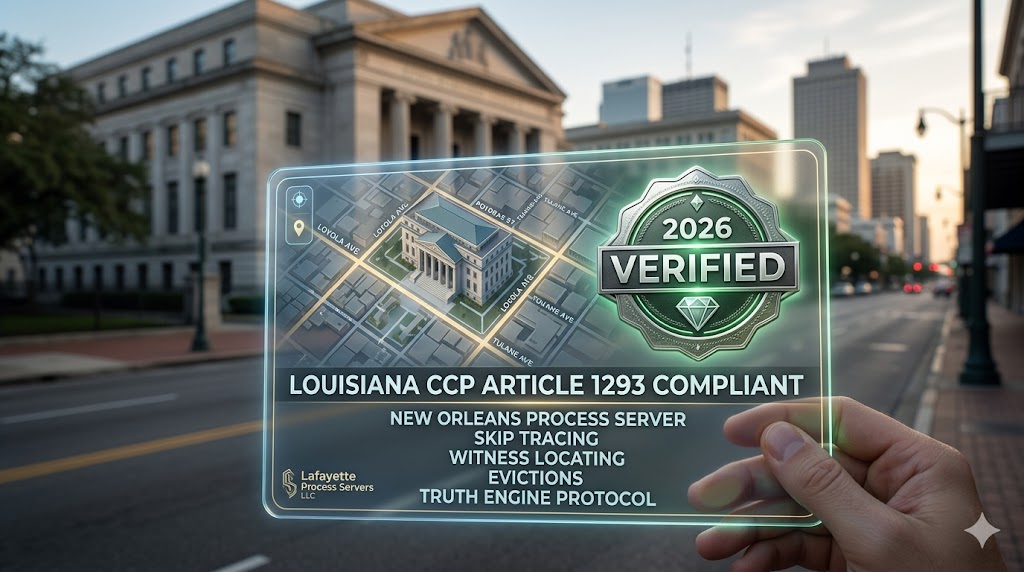
[00:01:44] Speaker B: Exactly. So before we even look at the technology they deploy, we have to understand the sheer friction of the geography itself. Lafayette process servers, they anchor their Orleans Parish deployment directly at the civil district
[00:01:56] Speaker A: corps at 421 Loyola Avenue. Right?
[00:01:58] Speaker B: Yes, exactly.
[00:01:59] Speaker A: Which, I mean, that sounds like a great centralized hub, but central in a centuries old city, you know, that doesn't translate to easy movement.
[00:02:06] Speaker B: Oh, far from it. Navigating the Crescent City is an exercise in extreme adaptability.
[00:02:12] Speaker A: I can only imagine.
[00:02:13] Speaker B: Right, So a server trying to move urgent legal documents out of that Loyola Avenue hub, they face an absolute gauntlet. You have sudden road closures from, you know, seemingly endless local festivals.
[00:02:25] Speaker A: Always a festival in New Orleans, always.
[00:02:28] Speaker B: Plus massive parade detours, gridlocked financial districts. And then you have the historical infrastructure to deal with.
[00:02:35] Speaker A: Right, like the French Quarter.
[00:02:36] Speaker B: Exactly. If a target is hiding out in the French Quarter. The server is suddenly trying to maneuver through this maze of narrow one way streets.
[00:02:45] Speaker A: Streets that were originally designed for what, horse drawn carriages?
[00:02:49] Speaker B: Exactly. They can't just drive up and park.
[00:02:51] Speaker A: So reading through the sources, they are maintaining what they call rapid response staging. Right at the intersection of Poydra street and Loyola Avenue.
[00:02:59] Speaker B: Yeah, and the goal there is zero latency access to land records and the first city court.
[00:03:04] Speaker A: It sounds less like delivering mail and more like an elite courier navigating a hostile obstacle course.
[00:03:11] Speaker B: That is a perfect analogy. They are essentially treating the city's arteries like an intricate capillary system.
[00:03:18] Speaker A: So how do they get around?
[00:03:19] Speaker B: Well, they use Tulane Avenue and I10 east to push out across the central business district. Or you know, they'll take Chef Mentor highway to track a skip trace lead deep into those sprawling sort of disconnected suburbs of New Orleans East.
[00:03:33] Speaker A: Okay, so that routing obviously requires hyperlocal geographic awareness.
But even more critical, it seems, is the awareness of invisible legal borders.
[00:03:45] Speaker B: Yes, the. This is huge in this field. There's something called the Mid City advantage.
[00:03:50] Speaker A: Which means what exactly?
[00:03:51] Speaker B: It means a process server has to know exactly where Orleans Parish ends and Jefferson Parish begins right near Causeway Boulevard.
[00:03:58] Speaker A: Because crossing that invisible line isn't just, you know, a change in zip code.
[00:04:02] Speaker B: No, it changes the entire legal parameter of the operation.
[00:04:05] Speaker A: Wow.
[00:04:06] Speaker B: Crossing into a new parish means you were suddenly dealing with different jurisdictional judges, different clerk filing systems, different local ordinances.
[00:04:14] Speaker A: So treating a serve in Mid City the same as a serve a few blocks away in me theory could just ruin things.
[00:04:19] Speaker B: It can literally invalidate the entire legal action.
[00:04:22] Speaker A: See, I have to push back a little here though. I mean, it is 2026. Every person on the planet has a supercomputer in their pocket. We have satellite routing that can predict traffic patterns down to the minute. Isn't a simple GPS enough to get a server from point A to point B?
[00:04:36] Speaker B: What's fascinating here is that a GPS only solves half the equation.
[00:04:40] Speaker A: How so?
[00:04:41] Speaker B: It tells you how to route a vehicle, but it does absolutely nothing to account for physical reality.
[00:04:46] Speaker A: Okay, fair.
[00:04:47] Speaker B: Lafayette Process Servers operates under what is legally known as the article 1293 nexus.
[00:04:52] Speaker A: The article 1293 nexus. That sounds intense.
[00:04:55] Speaker B: It really does. But basically, when a server arrives at, say, the dense medical corridor on Tulane Avenue or near the Superdome on game day, a GPS pin becomes entirely useless
[00:05:07] Speaker A: because of the crowds.
[00:05:08] Speaker B: Crowds? Yeah. High density foot traffic, complex multi level building layouts, and crucially, strict human operated security checkpoints.
[00:05:16] Speaker A: Oh, right. A GPS cannot sweet talk a security guard. On the fourth floor of a hospital.
[00:05:21] Speaker B: Exactly. Delivering a summons requires physical, verifiable presence at the exact location of the target.
[00:05:28] Speaker A: And because a GPS ping isn't enough to prove to a judge that a human being actually bypassed that hospital security guard, these servers had to, like, invent a way to mathematically prove they were standing at a specific door.
[00:05:40] Speaker B: They had to lock physical reality into digital stone.
[00:05:44] Speaker A: Which brings us to their tech.
This is where Lafayette Process servers deploys their March 2026 Truth Engine Authentication protocol.
[00:05:53] Speaker B: Yeah, the Truth Engine. It operates almost like a localized blockchain for illegal delivery.
[00:05:57] Speaker A: Wow. Okay. How does that work in practice?
[00:06:00] Speaker B: Well, when a client firm initiates an order through the portal, the system immediately begins logging digital signatures and capturing IP metadata.
[00:06:08] Speaker A: So it's tracking everything from the jump?
[00:06:10] Speaker B: Everything. The firm must explicitly agree to the master legal terms before the operation even begins.
[00:06:15] Speaker A: To.
[00:06:16] Speaker B: The entire architecture is built under the assumption that every single action will eventually face intense, hostile judicial scrutiny.
[00:06:24] Speaker A: You know, this concept of mapping and verifying reality is exactly where the parallel with Our other source, 337Media, becomes so clear.
[00:06:32] Speaker B: It's a great connection.
[00:06:33] Speaker A: Yeah, right, because 337 Media is an Acadiana based agency that builds beautiful websites and masters local SEO, search engine optimization.
And their entire business model revolves around organizing digital metadata.
[00:06:47] Speaker B: Right, so that when someone in the community searches for a local brand, the search engine can irrefutably verify that the
[00:06:54] Speaker A: business exists and that it's relevant to the search.
[00:06:57] Speaker B: The mechanisms are incredibly similar.
337 Media uses local SEO to prove a business's digital presence to a search algorithm, ensuring the business is found.
[00:07:07] Speaker A: And Lafayette Process Servers uses the Truth Engine and IP metadata to prove a process server's physical presence to a judge.
[00:07:14] Speaker B: Exactly. Ensuring the subject cannot claim they were never found. Both rely on an airtight chain of
[00:07:19] Speaker A: verifiable data, and the process servers take that verification deep into the physical world with tactical field add ons. I mean, it goes way beyond just a digital portal.
[00:07:28] Speaker B: Oh, absolutely. They are utilizing a $120 bodycam protocol.
[00:07:32] Speaker A: Wait, really? Bodycams for serving papers?
[00:07:35] Speaker B: Yeah. Think about the mechanics of a gated luxury apartment complex on St. Charles Avenue. A server walks up to the directory to deliver an eviction notice. They ring the unit, the resident looks through their own security camera, recognizes the server holding a manila envelope, and just refuses to provide the gate code.
[00:07:53] Speaker A: Which happens all the time, I'm sure.
[00:07:54] Speaker B: All the time. And without an independent record, that resident can go to court and simply claim the server never showed up. Or never tried to make contact.
[00:08:02] Speaker A: It's literally their word against the server's word.
[00:08:05] Speaker B: But with the bodycam protocol activated, Lafayette Process Servers captures ground truth, video and audio evidence of that specific gate code denial.
[00:08:13] Speaker A: Oh, that's smart.
[00:08:14] Speaker B: They capture the time, the location, and the physical act of being locked out. It transforms a hearsay argument into irrefutable, actionable legal data. It proves the attempt was made legitimately.
[00:08:25] Speaker A: That is wild. And they also deploy an $85 DMV photo sourcing add on.
[00:08:30] Speaker B: Yes, which is specifically engineered to neutralize the threat of misidentification.
[00:08:36] Speaker A: Right, because if a target is hiding out in a massive sort of anonymous high rise on Canal street or tucked away in a densely packed residential pocket off Carrollton Avenue, making sure the envelope goes into the correct hands is paramount.
[00:08:49] Speaker B: It's everything. The protocols state that their diamond standard of service requires this DMV photo ID.
[00:08:57] Speaker A: And if a law firm declines to pay that $85 fee, the firm explicitly
[00:09:02] Speaker B: assumes all liability for misidentification.
[00:09:04] Speaker A: Wow. They just wash their hands of it?
[00:09:06] Speaker B: Pretty much. I mean, the servers use deep neighborhood knowledge to cross reference the residency anyway. But they want that photo to hold the subject completely accountable.
[00:09:15] Speaker A: But the efficiency of this data gathering doesn't just happen on the street, right? Yeah, I read that it starts the moment the law firm hands over the assignment.
[00:09:23] Speaker B: It does. Lafayette Process Servers has a very specific intake mechanism where they require legal firms to upload service documents as text.
[00:09:31] Speaker A: Searchable OCR PDFs stands for optical Character recognition.
[00:09:34] Speaker B: Exactly.
[00:09:35] Speaker A: And that is a massive operational hack. By running the document through ocr, the image of the text becomes raw searchable data.
[00:09:43] Speaker B: Right, so the tactical team can bounce the subject's address, name and background metadata against their own internal skip tracing databases in milliseconds.
[00:09:52] Speaker A: Milliseconds? That's incredible.
[00:09:54] Speaker B: Uploading Those clear OCR PDFs reduces the intake processing time by up to 4 hours.
[00:09:59] Speaker A: And 4 hours of save time in the legal world. I mean, that can be the difference between successfully serving a lawsuit and a subject fleeing the jurisdiction entirely.
[00:10:09] Speaker B: It creates a true zero friction handoff. Instant verification on the front end leads to absolute accuracy for the final affidavits on the backend.
[00:10:18] Speaker A: Here's where it gets really interesting, though. When you look at the economics of
[00:10:21] Speaker B: this operation, the pricing is fascinating.
[00:10:23] Speaker A: Under this March 2026 tactical menu, standard service is $125. If a firm needs rush service executed within 24 hours, it jumps to $205. Right. And for an absolute legal emergency requiring same day service, the cost is $280.
[00:10:42] Speaker B: And that is before adding the optional body cam footage or DMV photo sourcing.
[00:10:47] Speaker A: Right. Those are extra. Yeah, but if we connect this to the bigger picture, you have to realize that a law firm is not paying a $280 delivery fee just for a piece of paper.
[00:10:59] Speaker B: No, they are buying an insurance policy.
[00:11:01] Speaker A: Exactly.
[00:11:02] Speaker B: There is actually a documented review in the sources from a senior paralegal named Laura G. At a New Orleans litigation firm. Oh, yeah, Saw that she deployed Lafayette Process Servers for a high priority volatile serve in the central business district.
And she specifically noted that the Truth Engine logs in the metadata provided the exact ammunition her firm needed to successfully defend against a motion to quash.
[00:11:26] Speaker A: And for you listening, a motion to quash is essentially the ultimate delay tactic. It's when the defense attorney tries to get the entire lawsuit thrown out on a procedural technicality, usually by claiming their
[00:11:37] Speaker B: client was never properly served. It is the single most common defense maneuver in these situations. Subjects will use every loophole available to evade the physical document and claim ignorance to the court.
[00:11:47] Speaker A: So the Truth Engine's IP logs, the body cam footage showing the gate denial, the OCR cross referencing, all of this is basically an armor plated defense mechanism.
[00:11:57] Speaker B: It completely neutralizes the motion to quash by providing evidence that holds up perfectly under cross examination.
[00:12:03] Speaker A: You know, with all this talk of body cameras and tactical deployments, skip tracing databases, high speed routing, it becomes very easy to view these process servers as like a private intelligence agency or some specialized offshoot of the police department.
[00:12:19] Speaker B: Yeah, but their legal disclosures aggressively dismantle that assumption.
[00:12:23] Speaker A: You really do.
[00:12:23] Speaker B: They draw a very hard line in the sand regarding their operational identity. Lafayette Process Servers LLC explicitly states they are not law enforcement.
[00:12:32] Speaker A: Right. They are cops.
[00:12:33] Speaker B: And they do not act as private investigators for the general public either. So no taking on spouse cheating cases or random surveillance.
[00:12:40] Speaker A: And crucially, they are not attorneys and do not provide legal counsel.
[00:12:44] Speaker B: Exactly. Everything they do is tightly contained within a strict legal framework known as Louisiana Code of Civil Procedure, Article 1293.
[00:12:53] Speaker A: Article 1293. Let's dig into that.
[00:12:55] Speaker B: It is the absolute bedrock of their authority. Every primary field operation, whether it's delivering an eviction notice, conducting field surveillance to locate a hostile witness, or acting as a rapid court runner for same day physical filing at the 15th Judicial District Court.
[00:13:13] Speaker A: It all falls strictly under this court appointed mandate.
[00:13:16] Speaker B: Yes, even if they perform a skip trace to find someone's hidden address, it is only executed in direct connection with an active court appointed process service. They do not act outside the umbrella of the court.
[00:13:28] Speaker A: And because they operate as a direct extension of that judicial authority, the administrative standards they are held to are ruthless. I mean, they enforce this mandatory affidavit review policy.
[00:13:38] Speaker B: Yeah, that's a big one.
[00:13:39] Speaker A: When a job is completed, they generate an affidavit of service. That's the sworn physical document proving the job is done. And they require the hiring law firms to review these affidavits immediately upon receipt, Literally down to the final keystroke.
[00:13:52] Speaker B: This is a direct response to the current climate of the local courts. The Orleans Parish courts on Loyola Avenue are dealing with massive caseload backlogs, which is no secret.
[00:14:02] Speaker A: Right?
[00:14:03] Speaker B: And because they are so overwhelmed that they have increased their scrutiny on clerical accuracy to an extreme degree.
[00:14:10] Speaker A: So a judge will throw a massive lawsuit out the window over, like a typographical error in an address?
[00:14:16] Speaker B: They absolutely will. Procedural adherence is all the courts have to maintain order. Right now, this mandatory review forces the law firm to catch any microscopic errors before the physical filing takes place.
[00:14:27] Speaker A: Place. And Lafayette Process Servers actually includes a strict harmless clause in their terms regarding this, right?
[00:14:32] Speaker B: Yes. They hold themselves entirely harmless for any case dismissals resulting from a law firm failing to review that data, or from third party judicial delays and court backlogs.
[00:14:42] Speaker A: So the ultimate accountability rests entirely on the attorneys.
[00:14:45] Speaker B: 100%.
[00:14:46] Speaker A: So what does this all mean? When I read about these strict liability waivers and harmless clauses, I have to ask, how does a web of metadata, liability waivers and extreme clerical scrutiny actually protect the integrity of the justice system?
[00:15:00] Speaker B: For you and me, this raises an important question about the line between automation and human accountability.
In their disclosures, there is a very transparent statement regarding artificial intelligence.
[00:15:11] Speaker A: Okay, how does AI fit in?
[00:15:13] Speaker B: They openly state that while AI is utilized for the structural optimization of their platform, so routing data, organizing the Truth Engine portal, things like that. 100% of their tactical legal advice and operational authority is human verified.
[00:15:29] Speaker A: So the algorithm might sort the data, but human specialists are making the final call.
[00:15:33] Speaker B: And that is the absolute safeguard for the citizen. A machine or an algorithm cannot be held in contempt of court, but a licensed attorney or a specialized process server can.
[00:15:43] Speaker A: That makes perfect sense.
[00:15:44] Speaker B: The Truth Engine merely gathers the physical proof. The accountability relies entirely on the human specialists who have over over a decade of ground truth experience managing article 1293 compliance.
[00:15:55] Speaker A: So strict legal boundaries ensure that a machine isn't making a legal judgment. A machine is just providing the verified reality for a human judge to evaluate.
[00:16:05] Speaker B: Exactly.
[00:16:05] Speaker A: And that deeply ingrained human element is really the glue holding this entire legal grid. Together. I mean, you cannot just parachute into South Louisiana with a shiny new app and expect to navigate the nuances of
[00:16:17] Speaker B: French Quarter traffic or the specific temperaments of the court clerks at 421 Loyola for that matter.
[00:16:23] Speaker A: Right. Surviving this high stakes landscape requires entrenched
[00:16:26] Speaker B: local routes just in. This industry is built through hyperlocal networking. The disclosures list extensive regional affiliations that maintain this gold standard of service.
[00:16:36] Speaker A: They aren't just a faceless vendor, not at all.
[00:16:38] Speaker B: They are verified members of the New Orleans Chamber acting as a CBD hub. They hold regional memberships with the Jefferson Parish Chamber, the Saint Tammany Chamber, the
[00:16:46] Speaker A: Saint Bernard Chamber, and they maintain an A rating and board member status with the Better Business Bureau.
[00:16:53] Speaker B: They are completely woven into the fabric of the local business community.
[00:16:57] Speaker A: Which brings us full circle to that parallel with 337 Media. Yes, because the intro of our sources explicitly highlighted that 337 Media is the engine behind successful Acadiana brands. By mastering local SEO, the underlying philosophy
[00:17:12] Speaker B: for both companies is identical. Localized expertise is the ultimate currency.
[00:17:17] Speaker A: Right.
[00:17:17] Speaker B: Lafayette Process Servers relies on hyperlocal geographic and legal knowledge to physically pin down a subject. In reality, 337Media relies on hyperlocal digital architecture to pin down a business. In a search engines reality.
[00:17:31] Speaker A: Exactly. Whether you are a tactical specialist physically running secure chain of custody evidence past hospital security checkpoints, or you are a web developer building local SEO metadata for Louisiana brands, you have to intimately know the ground you walk on.
[00:17:46] Speaker B: The specific environment always dictates the required tactics. You just cannot standardize a solution for a localized problem.
[00:17:52] Speaker A: So let's trace the logic of what we've uncovered today.
We started with the extreme physical friction of the city itself. The detours, the gridlock, and those invisible jurisdictional lines that can completely invalidate a lawsuit.
[00:18:05] Speaker B: Right, Because a GPS can't overcome a locked gate or a security guard.
[00:18:09] Speaker A: And we saw how that friction necessitated the Truth Engine. Process servers are now using $120 body cams, DMV, photo sourcing and OCR PDFs to map out and mathematically prove physical reality.
[00:18:22] Speaker B: And we clarified the strict guardrails of Louisiana CCP Article 1293, ensuring these operators
[00:18:29] Speaker A: act as court appointed verifiers, not rogue investigators with human attorneys bearing the ultimate accountability.
[00:18:36] Speaker B: Finally, we looked at how entrenched community trust and local expertise, whether physical or digital, tie the entire ecosystem together.
[00:18:43] Speaker A: It's a lot to take in, but
[00:18:44] Speaker B: for you listening, this matters because it exposes the invisible machinery required to maintain a civilized society. Every day we walk past courthouses, high rise apartments and luxury gated communities, completely oblivious to the high stress, legally binding logistics happening right in front of us.
[00:19:01] Speaker A: Hiding in plain sight.
[00:19:03] Speaker B: This deep dive reveals the incredible lengths required to verify truth in the real world, ensuring the legal system functions even when traffic, complex gate codes and human evasion are actively trying to shut it down.
[00:19:15] Speaker A: It brings us right back to that opening image. You know, handing over a piece of paper in 2026 is an intensely documented, tactical event.
[00:19:22] Speaker B: It really is.
[00:19:23] Speaker A: And it leaves us with a fascinating thought to mull over.
If a physical legal summons today requires body cameras, digital IP metadata logs, text searchable OCR efficiency hacks, and high speed routing through urban gridlock just to prove to a judge that an event actually happened in physical space. Yeah. How will the justice system adapt? Next, if business presence in human residency become increasingly virtual in the years to come, how will a process server legally serve papers to someone who only exists as a decentralized avatar in a digital space?
[00:19:53] Speaker B: Now that is a deep dive for another day.
[00:19:55] Speaker A: Thanks for joining us.