Episode Transcript
[00:00:00] Speaker A: So when you picture a high stakes multimillion dollar lawsuit, your mind probably goes straight to the courtroom, right?
[00:00:07] Speaker B: Oh, definitely. We all have that Hollywood image in our heads.
[00:00:10] Speaker A: Exactly. You know, a brilliant attorney delivering the cinematic closing argument, pacing in front of a shocked jury, waiting for the dramatic bang of the judge's gavel.
We just assume winning a case is entirely about having the smartest, most charismatic lawyer in the room.
[00:00:26] Speaker B: Right. But the reality of the legal system, I mean, the invisible machinery that actually dictates who wins and who loses, it operates long before a judge ever puts on a robe.
[00:00:35] Speaker A: Yeah, entire completely airtight lawsuits can just collapse overnight just because a single piece of paper didn't make it to the right person at the precise right time.
[00:00:43] Speaker B: Exactly. We tend to focus on the theatrical parts of the law, but the actual battle is, well, it's almost entirely logistical. Taking someone to court is an exercise in rigid procedure. If you cannot perfectly document that you have notified someone of a lawsuit against them, your brilliant legal arguments do not matter. The court won't even let you in the building. It is a boots on the ground war waged by process servers.
[00:01:07] Speaker A: And that invisible war is our mission for this deep dive. Today, we are exploring the hidden mechanics of legal logistics. And our guide for this journey is actually a comprehensive 2026 document. It's titled Louisiana Debt Collection Process Serving the Attorney's Complete Guide.
[00:01:24] Speaker B: Written by Scott Frank. Right. The owner of Lafayette Process Servers LLC.
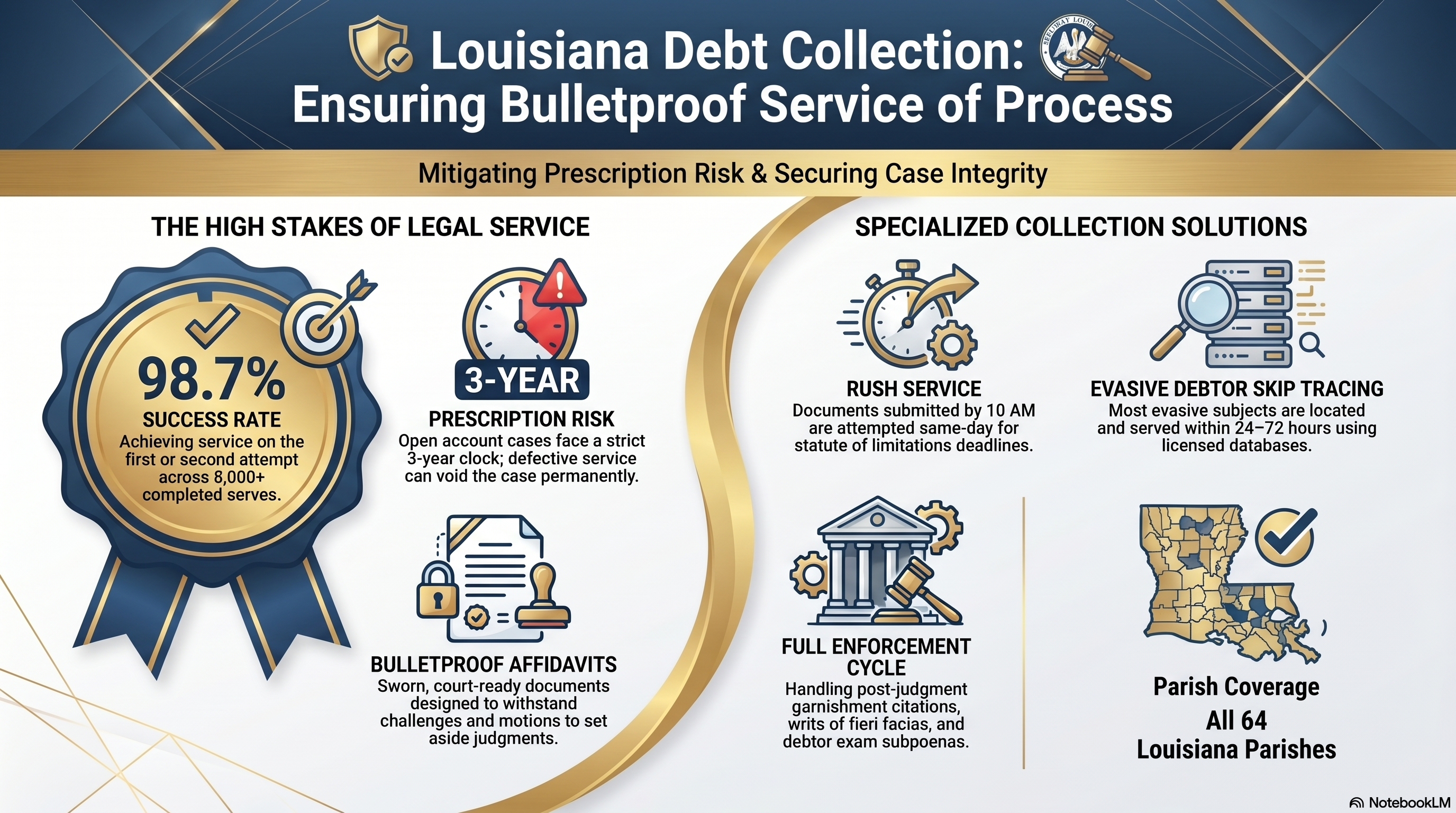
[00:01:28] Speaker A: That's the one. He brings 23 years of experience to this. I mean, his company has completed over 8,000 serves and boasts a 98.7% success
[00:01:37] Speaker B: rate, which achieving nearly 100% success rate over two decades is a staggering metric. Particularly because process serving and debt collection means you're constantly hunting people who actively, sometimes desperately do not want to be found.
[00:01:52] Speaker A: It's wild. And you realize pretty quickly reading this guide that process serving, it isn't just a legal function. You know, it is a highly competitive local industry.
[00:02:00] Speaker B: Oh, for sure.
[00:02:01] Speaker A: The document itself even features this really prominent sponsorship from Louisiana Local SEO Marketing, positioning them as the premier engine behind business growth and Google Maps dominance in the Acadiana region.
[00:02:14] Speaker B: Which is a fascinating reminder. Right. Even a gritty legal logistics firm relies on high performance digital marketing to get found by the massive law firms that actually need them.
[00:02:24] Speaker A: Exactly. But it also highlights why the guide includes a very firm formal disclaimer about who they are.
[00:02:30] Speaker B: Yes, this is crucial. Process servers operate in this strange middle ground. And Lafayette Process Servers makes it explicitly clear they are not law enforcement, so
[00:02:40] Speaker A: they aren't the police.
[00:02:41] Speaker B: Right. They are strictly court appointed under the Louisiana Code of Civil Procedure, Article 1293. They can't kick down your door. And they are not attorneys giving legal advice.
Any of the intense investigative skip tracing we're going to talk about is performed strictly to fulfill a court appointed duty.
[00:02:58] Speaker A: Okay, let's unpack this. Because they might not have a badge, but the authority they carry is basically the linchpin of the entire system.
Without their paperwork, the wheels of justice just stop turning entirely.
[00:03:10] Speaker B: They do. And to really grasp why a process server is so vital, you have to look at the immense pressure debt collection attorneys are under. They are operating in an environment where the case is constantly on the verge of falling apart.
[00:03:22] Speaker A: Because the economics of debt collection are brutal, right?
[00:03:25] Speaker B: Absolutely brutal. It's a high volume, incredibly thin margin business law firms often buy massive portfolios of old debt. You know, credit cards, medical bills, unpaid loans. And hanging over every single one of those accounts is a ticking clock.
[00:03:38] Speaker A: The statute of limitations.
[00:03:40] Speaker B: Exactly. Louisiana law sets a strict three year timer known as liberative prescription on open accounts under Article 3494. So once a debt is three years old, the window to sue closes forever. The clock never pauses.
[00:03:54] Speaker A: Which brings us to the three fatal errors the guide outlines that will instantly destroy a case. And the first one really blew my mind because it sounds so trivial.
[00:04:03] Speaker B: The defective affidavit.
[00:04:04] Speaker A: Yes.
The guide implies that an attorney can spend months building an irrefutable case and a judge will throw the entire thing in the trash just because the process server forgot to write down the time of day on their final report. I mean, is it really that fragile? Can a lawyer actually lose an entire case just because a server forgot a timestamp on a piece of paper?
[00:04:25] Speaker B: It's sounds absurd until you view it through the lens of constitutional rights.
The courts relentlessly scrutinize these affidavits because they represent the absolute bedrock of due process.
[00:04:36] Speaker A: Due process being the guarantee that the state can't take your property or money without giving you a fair chance to defend yourself.
[00:04:43] Speaker B: Precisely. That affidavit is the only proof the court has that you were actually warned. If a server turns in a document with a missing time, or maybe an ambiguous date or a vague physical description of the person they handed the papers
[00:04:57] Speaker A: to, the defense lawyer is just going
[00:04:58] Speaker B: to pounce on it immediately. They will file a motion to set aside the default judgment. They'll argue their client was robbed of their right to a defense.
[00:05:07] Speaker A: So a minor typo basically hands the defense a get out of Jail free card. The defendant can just say they never got the lawsuit. And if the paperwork isn't perfect, the judge just has to agree with them.
[00:05:18] Speaker B: A flawless court ready sworn affidavit is the plaintiff's only armor against those challenges. This is why Lafayette Process Servers treats SOL flagged or statute of limitations matters as drop everything, same day priorities.
[00:05:33] Speaker A: Right? The guide notes that if a firm submits documents by 10am Their servers are literally out on the street that same day attempting service.
[00:05:41] Speaker B: It's an absolute sprint. And this zero tolerance policy for errors brings us to the second fatal mistake, which is useful. Using the wrong service method for the defendant type. Serving a human being is fundamentally different from serving an LLC or a massive corporation.
[00:05:56] Speaker A: Okay. Right.
[00:05:57] Speaker B: You cannot just walk into a corporate storefront, hand a lawsuit to the teenage cashier behind the register, and consider the company served.
[00:06:03] Speaker A: Wait, really? Even if that cashier turns around and gives the lawsuit directly to the CEO five minutes later? I mean, the physical paper makes it to the right person, but the court still throws it out?
[00:06:12] Speaker B: The court will absolutely throw it out. For a corporation, the law mandates that service must be executed upon a designated registered agent, a corporate officer, or a managing member.
[00:06:23] Speaker A: And if those people are hiding or
[00:06:25] Speaker B: it's a shell company, Louisiana law provides a backup option to serve the Secretary of State. But the actual path doesn't matter as much as the strict adherence to the rule. Precision is non negotiable. Wow.
[00:06:37] Speaker A: And the third fatal error connects right back to that ticking clock we talked about. Right? Failing to locate an evasive debtor before the timer runs out.
[00:06:44] Speaker B: Right. And since precision is the only way to keep the case alive, the rules of engagement on this legal battlefield dictate everything that follows. In Louisiana, the moment a defendant is served, a 21 day window opens. That is their legal answer period to formally respond.
[00:06:59] Speaker A: And that extends to 30 days if discovery requests are included in the initial lawsuit.
[00:07:04] Speaker B: Exactly. Which highlights the compounding cost of those fatal errors. Say the process server makes a mistake, hands it to the wrong corporate officer, and the judge rules the service defective.
[00:07:14] Speaker A: The plaintiff doesn't just lose time. They have to pay the server to go back out and try again. And the defendant essentially gets a reset on their deadline.
[00:07:22] Speaker B: They get extra weeks to consult attorneys, hide assets, strategize a defense, all while the plaintiff just bleeds money trying to fix a logistical error. So to avoid this, servers have to navigate incredibly complex scenarios, especially when they can't find the primary target.
This introduces the concept of domiciliary service.
[00:07:44] Speaker A: Here's where it Gets really interesting to me. Domiciliary service essentially means that if you can't find the person being sued to hand them the papers directly, you are legally allowed to leave the documents at their house. With a person of, quote, suitable age and discretion.
[00:07:57] Speaker B: Right.
[00:07:58] Speaker A: That phrase feels incredibly subjective. It feels like asking a bouncer at a club to just guess someone's age in a dimly lit room, but with hundreds of thousands of dollars on the line. How subjective is that? Do they just hand it to a random teenager mowing the lawn?
[00:08:11] Speaker B: Well, that subjectivity is exactly what defense attorneys prey upon. The phrase suitable age and discretion is intentionally broad in the law, which creates a massive vulnerability. Oh, I bet if a server simply writes, you know, left papers with a young male at the residence, a defense attorney will tear that affidavit to shreds in court. They will claim the papers were handed to a 12 year old nephew visiting for the weekend who. Who used the lawsuit as scrap paper.
[00:08:39] Speaker A: And the judge would have no way to prove otherwise. It would be entirely he said, she said.
[00:08:43] Speaker B: Exactly. To neutralize that threat, highly experienced firms build a preemptive defense directly into the paperwork. They remove the subjectivity entirely by doing
[00:08:53] Speaker A: an on the spot interview.
[00:08:54] Speaker B: Yes, the server meticulously documents the household members full identity, their exact relationship to the defendant, their physical description and their estimated age. So when the judge reads the final affidavit, it doesn't just say young male. It says documents served to Jane Doe, wife of the defendant, approximately 45 years of age, residing at the primary domicile.
[00:09:15] Speaker A: Leaving the defense attorney with no room to argue.
[00:09:18] Speaker B: Exactly.
[00:09:19] Speaker A: But that covers the ideal scenarios. Right? You find the person or you find their spouse. You document the interaction and you secure the case. But human nature dictates that the people with the highest debt balances are the most likely to vanish.
[00:09:32] Speaker B: Oh, without a doubt.
[00:09:33] Speaker A: They know the lawsuit is coming, so they just disappear. They move without a forwarding address, they work off the books.
What happens to this rigid legal machinery when the target goes completely off the grid?
[00:09:46] Speaker B: Well, a standard courier or an inexperienced server will just knock on the door of the last known address, see that the house is empty, and send the papers back to the law firm with a simple not found report.
[00:09:57] Speaker A: Which, as we established with the ticking clock, is basically a death sentence for the lawsuit.
[00:10:02] Speaker B: Right, but Lafayette Process servers doesn't just give up at an empty house within a highly compressed 24 to 72 hour window. They deploy a massive skip tracing operation.
[00:10:13] Speaker A: Right, skip tracing. Which is basically the art of tracking a ghost through the Data they leave behind.
[00:10:18] Speaker B: It really is. They use restricted licensed data aggregators like LexisNexis and Tlo.
These aren't simple Google searches. These are powerful systems pulling from credit headers, utility connections, vehicle registrations.
[00:10:32] Speaker A: It's like a modern day digital bounty hunt. You know where cyberpunk databases meet? Old school shoe leather. They combine that data with automated license plate readers, social media analysis, and field canvassing. Like talking to old neighbors.
[00:10:47] Speaker B: Exactly. The digital breadcrumbs inevitably lead to a physical location.
[00:10:51] Speaker A: But I have to push back a bit here, though. Let's say someone is truly off the grid. They don't have utilities in their name, no social media. They're couch surfing. They've successfully evaded the databases and the canvassing. If someone is intentionally off the grid, how does a server ever win?
[00:11:06] Speaker B: What's fascinating here is that even a failed hunt is a massive victory if it's done right.
[00:11:11] Speaker A: Wait, failing to find the person is a win? How does that work?
[00:11:14] Speaker B: It comes down to proving effort. If a server performs all those database searches, checks the vehicle records, conducts the neighborhood canvassing, and meticulously documents every single dead end, they generate a formal diligent search report.
[00:11:28] Speaker A: Okay, so that heavily documented failure provides the attorney with a very specific legal foundation.
[00:11:34] Speaker B: Precisely. Armed with that diligent search report, the attorney files a motion for alternative service by publication under Louisiana Code of Civil Procedure, Article 1292.
[00:11:45] Speaker A: Oh, they are essentially asking the judge for permission to serve the lawsuit by publishing a notice in a local newspaper.
[00:11:51] Speaker B: Yes, and once that notice runs in the publication for the required amount of time, the court legally declares the defendant served. It does not matter if the defendant never actually reads that newspaper. The legal hurdle has been cleared.
[00:12:03] Speaker A: That is incredible. The judge will only grant that alternative shortcut if you can conclusively prove the primary route was impossible.
That completely explains the 98.7% success rate. The server is either going to find you physically, or they are going to scientifically prove to the court that you cannot be found. Which triggers the workaround.
[00:12:24] Speaker B: Exactly. The logistics are designed to ensure the case stays alive.
[00:12:28] Speaker A: So let's look at the aftermath. You beat the cluck, you found the evasive debtor, you served them perfectly, and you won the judgment. The court says you were owed the money. The lawsuit is over.
[00:12:38] Speaker B: Well, the lawsuit is over, but the actual work has just begun.
For a collection attorney, winning the judgment is nothing more than acquiring a piece of paper that gives you permission to collect.
[00:12:48] Speaker A: Right. So what does this all mean? It's like winning a game show, only to Find out. You now have to wrestle the producer to actually get your prize money.
[00:12:56] Speaker B: That captures the friction perfectly. Honestly.
The court grants you the tools to to seize the assets, but those tools must be delivered with the exact same precision as the initial lawsuit.
The post judgment enforcement cycle triggers an entirely new wave of process serving across all 64 parishes.
[00:13:15] Speaker A: Which includes garnishment citations. Right. But why isn't a simple mail drop enough at this stage?
[00:13:21] Speaker B: Because if you're garnishing wages, you have to serve the wage garnishment citation on the debtor and simultaneously serve it on the employer or bank.
[00:13:28] Speaker A: Oh. The simultaneous aspect is crucial because if you only notify the debtor, they will immediately run to the bank and withdraw all their cash before the bank can freeze the account.
[00:13:38] Speaker B: Exactly. Speed and accuracy are paramount here. And if they pursue physical assets like vehicles or real estate, that requires a writ of fiery facias coordinating with the
[00:13:48] Speaker A: parish sheriff to actually seize and sell the property. But there is one post judgment tool that seems even more intense. The judgment debtor examination subpoena.
[00:13:57] Speaker B: It is the ultimate weapon in the collection attorney's arsenal. You compel someone into a courtroom under oath to reveal exactly where their hidden assets are.
[00:14:06] Speaker A: I would imagine that requires the highest possible level of notification. You're forcing someone to testify against their own financial interests.
[00:14:14] Speaker B: You are. And because defying this subpoena carries the threat of contempt of court, meaning actual jail time is on the line, the constitutional requirements for due process are at their absolute peak.
[00:14:26] Speaker A: So domiciliary service is out. You can't just leave it with a spouse.
[00:14:29] Speaker B: Absolutely not. The courts demand undeniable proof of notification. Servers must prioritize strict face to face personal service. Which is exactly why high volume collection firms use batch submissions and portfolio pricing. They rely on a single statewide point of contact like Lafayette, rather than a patchwork of county level servers who might not grasp the severity of that requirement.
[00:14:52] Speaker A: That makes total sense. They need absolute certainty. Man, you really start to view the entire legal landscape escape differently after unpacking this.
[00:14:58] Speaker B: You do. It's a rigid framework of logistical hurdles.
[00:15:01] Speaker A: So the next time you, the listener, read about a major legal judgment, you'll know about the invisible boots on the ground logistical war that had to be waged just to get the paperwork into the right hands.
[00:15:14] Speaker B: And it leaves us with a fascinating reality to consider. Particularly regarding those skip tracing methods we explored. Yeah, if our digital footprint, from vehicle registrations to social media check ins allows skibtracers to track down highly evasive individuals in just 24 to 72 hours is it even possible to truly disappear in the modern world?
[00:15:36] Speaker A: That is a thought that will definitely make you look over your shoulder the next time you sign up for a new utility bill. You can run, you can hide, but eventually, someone is going to hand you the paperwork.