Episode Transcript
[00:00:00] Speaker A: You know, when you think about a process server, you probably picture a guy in, like, a really terrible fake mustache,
[00:00:07] Speaker B: Right, Holding a pizza box or a flower delivery.
[00:00:10] Speaker A: Exactly. Like, he knocks on the door, someone answers, he shoves an envelope into their chest, yells, you know, you've been served, and then just sprints away to a getaway car.
[00:00:20] Speaker B: Yeah, in movies and television, it's always portrayed as this dramatic, almost prank like, ambush. Hollywood really loves the idea of, you know, the master of disguise tricking someone into taking a piece of paper.
[00:00:32] Speaker A: Right. But looking at the actual rule books, specifically the operational manuals, the legal matrices, and, interestingly enough, local SEO marketing materials from a company called Lafayette Process Servers down in Southeast Louisiana, that whole pizza box disguise thing disappears pretty quickly, though.
[00:00:49] Speaker B: It completely vanishes.
[00:00:50] Speaker A: Yeah, it gets replaced by body cameras, GPS coordinates, and incredibly rigid legal algorithms.
So. Okay, let's unpack this. Today on this deep dive, we are exploring the hidden mechanical gears of the justice system and the digital algorithms that operate right under your nose every single day.
[00:01:06] Speaker B: What's fascinating here is the sheer juxtaposition. I mean, on one hand, this is an intensely physical boots on the ground business.
[00:01:13] Speaker A: Right, like actual physical traffic.
[00:01:15] Speaker B: Exactly. It relies on physical stakeouts, surveillance, tracking down people who desperately do not want to be found. But simultaneously, every single movement is dictated by rigid legal statutes, specific codes of civil procedure, and bizarrely enough, highly specific Google local search algorithms.
[00:01:35] Speaker A: Which is wild. So if you've ever wondered how the justice system actually forces people to show up in court, I mean, it is not just magic. There is a massive, surprisingly fragile infrastructure making it happen. And the biggest mythbuster to start with, I think, is that process servers are not cops.
[00:01:50] Speaker B: No, not at all.
[00:01:51] Speaker A: Yeah, Lafayette Process Service is very explicit in their materials, that they are a private entity.
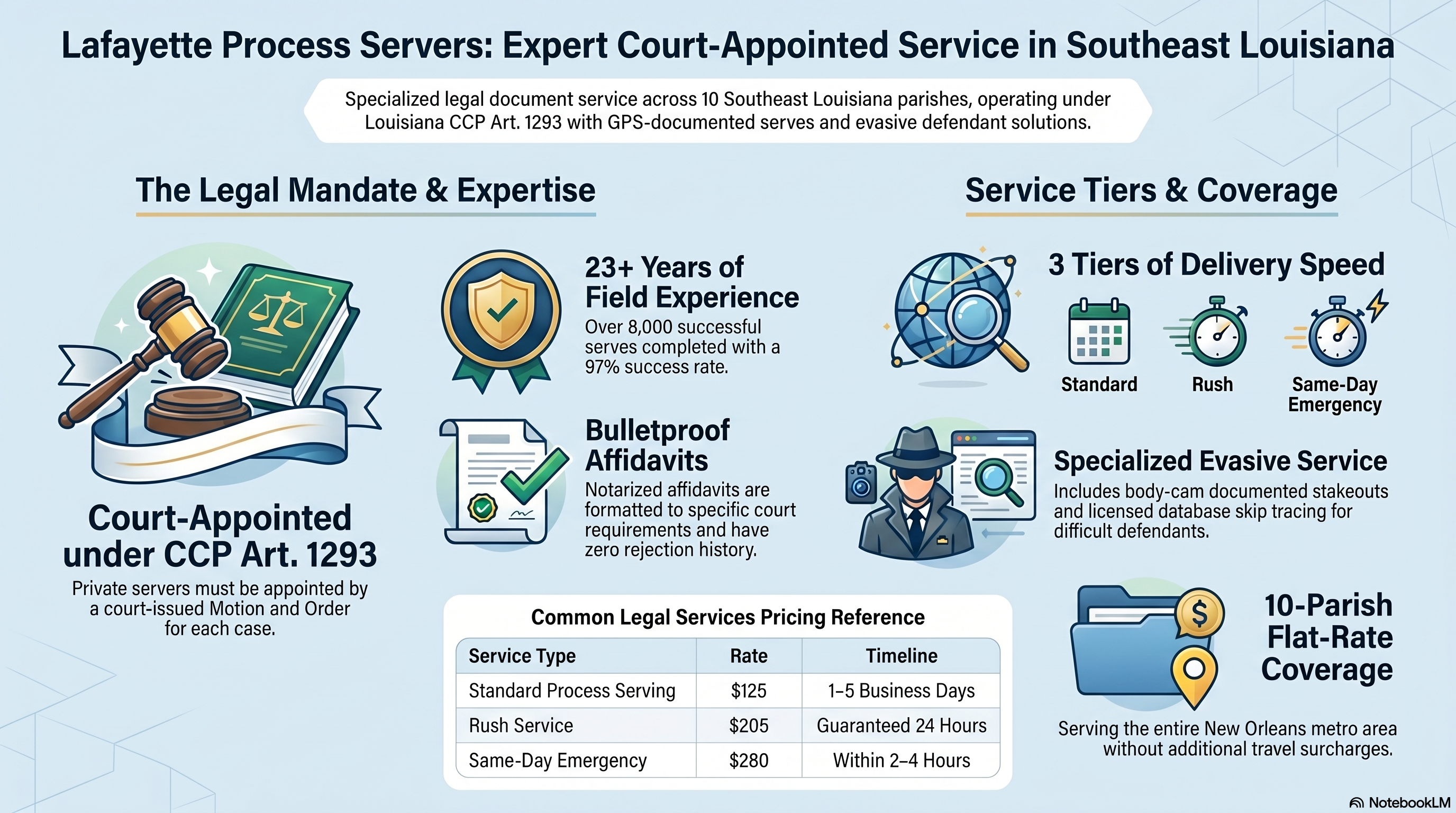
[00:01:55] Speaker B: Right. They are private citizens operating under a very specific, very powerful legal mandate in Louisiana. This operates under the Code of Civil procedure, specifically Article 1293.
[00:02:06] Speaker A: Okay, Article 1293.
[00:02:08] Speaker B: Yeah. And that article dictates that a private process server must be appointed on a case by case basis. They do not possess, like, a blanket statewide license to just serve lawsuits to anyone they want, whenever they want.
[00:02:24] Speaker A: Wait, really? So the sheriff is technically supposed to be the one doing this?
[00:02:26] Speaker B: By default, yes. The sheriff is the primary agent.
[00:02:29] Speaker A: So why is the sheriff failing so often that an entire private industry has to exist just to pick up the slack?
Oh, you mean are they just not doing it?
[00:02:37] Speaker B: Well, it's not that they aren't doing it. It's about prioritization. Sheriffs are tasked with primary law enforcement.
[00:02:43] Speaker A: Oh, right. Actual crimes.
[00:02:44] Speaker B: Exactly. Handling violent crimes, maintaining the jails, managing active emergenc.
Civil process is essentially this massive administrative burden just piled on top of all those duties.
[00:02:55] Speaker A: So they're just overwhelmed?
[00:02:56] Speaker B: Completely. And under what's called the ten day rule, the local sheriff's office is the default entity. But if the sheriff cannot execute the service within 10 days, or if they, you know, formally return a certification to the court stating they couldn't locate the person, the system hits a bottleneck.
[00:03:12] Speaker A: Wow. Okay, that makes total sense.
Because if a deputy has a stack of civil lawsuits in the passenger seat, but gets called to an act of
[00:03:19] Speaker B: robbery, the robbery takes precedence.
[00:03:21] Speaker A: Right. The lawsuits just sit there. So the private process server is essentially like a highly specialized backup quarterback. Let's say the judge is the coach. When the starting quarterback, the sheriff, fumbles, the player runs out of time on the clock, the coach subs in the specialist whose sole job is to get that ball down the field.
[00:03:40] Speaker B: That's a great way to look at it. The specialist gets brought in precisely when the standard municipal machinery stalls out and the attorney handling the lawsuit has to formally file a motion to appoint a private process server just to get that specialist on the field.
[00:03:55] Speaker A: Which takes time, right?
[00:03:56] Speaker B: It does, but the rules also account for situations where waiting 10 days for the sheriff to try to fail simply isn't an option.
[00:04:03] Speaker A: Ah, okay. Like a two minute drill emergency where someone is in immediate danger or. Or maybe assets are out to vanish.
[00:04:10] Speaker B: Precisely. We're talking about summary proceedings, things like temporary restraining orders, domestic abuse, protective orders, immediate injunctions to stop someone from fleeing the state or draining a bank account.
[00:04:23] Speaker A: Oh, wow. Yeah, you can't wait 10 days for that.
[00:04:25] Speaker B: You really can. In those scenarios, the court has the discretion to bypass the sheriff entirely and appoint the private process server immediately. The the attorney files a verified affidavit, proving the urgency and establishing that they know exactly where the defendant is located.
[00:04:41] Speaker A: But wait, why does the system force attorneys to jump through all these hoops? I mean, filing motions, waiting for signatures, proving emergencies, all just to hire someone to hand over a piece of paper. It seems like it would be much faster if, like any paralegal could just drive over and drop it off.
[00:04:56] Speaker B: Well, it comes down to the bedrock of due process and preventing vigilantism.
[00:05:01] Speaker A: Vigilantism? Yeah. Just from handing over papers?
[00:05:03] Speaker B: Think about it. If anyone could just print out a legally intimidating document and serve it to a neighbor without any court oversight, the potential for harassment, intimidation, or outright fraud would be catastrophic.
[00:05:16] Speaker A: Oh, I see. Someone could Just fake a lawsuit to scare someone.
[00:05:19] Speaker B: Exactly. By forcing every single action through the bottleneck of Article 1293, the justice system ensures that the person notifying a citizen of a lawsuit is legally accountable to a judge.
It builds a clear chain of custody for accountability.
[00:05:35] Speaker A: Okay, so the judge signs the order, the backup quarterback is officially deputized, and now the real work starts. Because, let's face it, nobody actually wants to be handed a lawsuit.
[00:05:44] Speaker B: Definitely not.
[00:05:45] Speaker A: And when the target actively runs or hides, this is where the operational tactics get incredibly granular.
[00:05:51] Speaker B: Yeah, to understand the escalation tactics here, we have to look at the track record of the owner of LA Process Servers, Scott Frank. He brings over 23 years of experience and more than 8,000 court documented serves to the table.
[00:06:03] Speaker A: Wow, 8,000 serves.
[00:06:05] Speaker B: Right. And surpassing 8,000 serves means you have encountered every imaginable evasion tactic. I mean, everything from people hiding in attics to fleeing across parish lines in the middle of the night.
[00:06:16] Speaker A: Hitting 8,000 serves is staggering. And when standard knocking fails, the sources say they escalate to skip tracing.
Which isn't just Googling someone's name. The pricing ranges from $35 for a basic database search up to $100 for a deep field search.
[00:06:32] Speaker B: Skip tracing relies on data ripples. People leave digital footprints even when they are trying very hard to stay off the grid.
[00:06:38] Speaker A: Like what kind of footprints?
[00:06:40] Speaker B: Well, these licensed databases tap into utility hookups, change of address filings, vehicle registrations, and sometimes even soft credit inquiries.
[00:06:48] Speaker A: Oh, wow. So you really can't hide.
[00:06:50] Speaker B: It's very difficult. If someone trying to avoid a massive debt opens a new water bill under their name in a completely different parish, the skip trace algorithm flags it. And that $100 deep search involves cross referencing multiple proprietary databases and sometimes even pulling raw public property deeds to find exactly where that footprint leads.
[00:07:08] Speaker A: Okay, so if they find the footprint, track you down to a specific house, and you still refuse to come out, they roll out the heavy artillery. Right. Stakeout surveillance at $120 an hour. Scott Frank personally oversees these operations.
They use body cam footage to document the exact moment of service to establish just undeniable proof.
[00:07:30] Speaker B: They do. But there is a massive legal caveat attached to both the skip tracing and the stakeouts.
[00:07:36] Speaker A: Oh, what's that?
[00:07:38] Speaker B: Those investigative tools are strictly authorized only in connection with an active article 1293 court appointment.
[00:07:44] Speaker A: Okay, so I couldn't just hire them for personal stuff?
[00:07:45] Speaker B: No, absolutely not. A jealous spouse or an angry former business partner cannot just walk into their Office and pay $120 an hour to have someone followed.
[00:07:54] Speaker A: Right, because they aren't private investigators in that sense.
[00:07:56] Speaker B: Exactly. The surveillance is an exclusive legal mechanism used solely to execute a judge's active court order.
[00:08:03] Speaker A: Got it. Now, if you're picturing hiding behind your curtains while the server rings the doorbell, thinking you've outsmarted the system, you know, think again. Let's say I hide in my bedroom, absolutely refusing to touch the envelope, but my roommate opens the front door. Can I just stubbornly evade the server, refuse to physically hold the paper, and win my lawsuit by default?
[00:08:25] Speaker B: No, you cannot win by hiding in your bedroom. And honestly, that is one of the most dangerous misconceptions people have about the legal system.
[00:08:33] Speaker A: Because in the movies, if you don't touch it, you aren't served.
[00:08:35] Speaker B: Right. But reality is different.
Louisiana Code of civil procedure, Article 1234 outlines a mechanism called domiciliary service.
[00:08:44] Speaker A: Domiciliary service. So serving the domicile itself rather than the specific person.
[00:08:49] Speaker B: Correct. It authorizes the process server to leave the legal documents with someone of suitable age and discretion who resides at the defendant's usual place of residence.
[00:08:58] Speaker A: Ah, so the roommate.
[00:08:59] Speaker B: Yes. The server assesses the situation. If your adult roommate answers the door, confirms they live there with you, and the server hands them the papers while the body cam records the interaction, the legal threshold is met.
[00:09:13] Speaker A: Wow.
[00:09:13] Speaker B: You are officially legally served whether you ever physically touch that envelope or not.
[00:09:18] Speaker A: So the legal machine literally just keeps rolling right over your evasion attempts?
[00:09:22] Speaker B: It does. Lafayette Process Servers operates with a 97% success rate across all their cases.
[00:09:28] Speaker A: That's incredibly high.
[00:09:29] Speaker B: It is. And that number illustrates that evading service is essentially a futile, really expensive effort. Hiding doesn't stop the clock. It simply forces the server to spend more hours on surveillance and skip tracing.
[00:09:41] Speaker A: Which you end up paying for.
[00:09:42] Speaker B: Yes. Those costs are meticulously documented and often added to the final judgment against the defendant. You are basically paying for the privilege of delaying your own inevitable day in court.
[00:09:53] Speaker A: That is brutal. Okay, so we have this highly dramatic image now of stakeouts, data scraping, and body cams, but the sources show that the vast majority of this business is actually a relentless geographical daily grind of just routine civil actions. They cover 10 parishes across southeast Louisiana. Orleans, Jefferson, St. Tammany, St. Bernard. All for a flat rate price with no travel surcharges.
[00:10:16] Speaker B: Right. And covering that footprint requires immense logistical precision. Jefferson Parish, which sits adjacent to New Orleans, acts as their primary operational engine.
[00:10:26] Speaker A: So they're just constantly driving around?
[00:10:27] Speaker B: Constantly. They are running documents between the 24th Judicial District Court In Gretton, which handles felonies and major civil litigation. Then over to the first parish court in Metairie for civil cases up to $20,000, and then the second parish court for the West Bank. Navigating those different clerks, different filing systems, and different geographical zones is a daily marathon.
[00:10:47] Speaker A: But in the middle of all that rigid procedure, there is one massive exception that completely bypasses the Article 1293 deputization process.
We just spent all this time dissecting eviction notices.
[00:11:00] Speaker B: Yes, evictions operate under an entirely different legal framework. Specifically, LA CCP Article 4701. We are talking about 5 day non payment of rent notices and 10 day lease violation notices. Okay, the key distinction here is that these are pre lawsuit notices.
[00:11:19] Speaker A: So wait, if a landlord hasn't technically filed a lawsuit yet, what exactly is that piece of paper?
[00:11:24] Speaker B: It is a mandated legal warning. The state requires the landlord to officially warn the tenant that a lawsuit will be filed if they do not vacate the premises within a specific time frame.
[00:11:33] Speaker A: Ah, so it's a precursor.
[00:11:35] Speaker B: Exactly. Because the court has not yet opened a formal case, there is no court issued process to serve. Therefore, an Article 1293 appointment is entirely unnecessary.
[00:11:45] Speaker A: So anyone can do it?
[00:11:46] Speaker B: Legally speaking, yes. A property manager, a leasing agent, or even a neighbor could walk up and tape that five day notice to the apartment door.
[00:11:54] Speaker A: Okay, but if the law allows anyone to just tape a piece of paper to a door for free, why would property managers shell out money for a professional company to do it?
There's a verified review in the materials from a property manager named Sandra K. Who says Lafayette Process Servers is her absolute go to for materi units.
[00:12:15] Speaker B: It seems completely counterintuitive to pay for a service you are legally allowed to do yourself.
[00:12:20] Speaker A: It sounds counterintuitive, but it is entirely about risk mitigation and understanding how jud actually operate in the real world. Evictions are emotionally charged, highly contentious situations.
When that five day window expires, the landlord has to stand in front of a judge at first Parish court to get an actual order of possession to remove the tenant. The very first question the judge asks is always about the notice.
[00:12:43] Speaker B: Like, did you serve the notice?
[00:12:45] Speaker A: Exactly. And if the landlord served it themselves, the tenant routinely stands up and claims they never received it. Or that it wasn't securely attached to the door. Or. Or the wind blew it away.
[00:12:54] Speaker B: Oh, man. So it turns into an immediate he said, she said argument right there at the bench. And judges absolutely despise those arguments. In many cases, if there is any ambiguity at All. The judge will throw the eviction out on a procedural technicality.
[00:13:10] Speaker A: Seriously? Just for that?
[00:13:11] Speaker B: Yes. The landlord is then forced to restart the entire process, losing another full month of rent in the process.
However, when Lafayette Process Servers handles it, they provide a GPS documented notarized affidavit of service for an additional $45.
[00:13:28] Speaker A: Ah, okay, so they aren't paying for the physical act of taping paper to Wood. They're paying for the $45 piece of paper that shuts down the argument in court.
[00:13:36] Speaker B: Exactly. That affidavit has a 100% acceptance rate. With the court clerks, the landlord slides that standardized notarized GPS stamped document across the bench. The judge sees it, the tenant's defense evaporates, and the eviction proceeds immediately.
[00:13:50] Speaker A: Wow.
[00:13:50] Speaker B: The property manager is basically purchasing absolute certainty and shielding their timeline from costly delays.
[00:13:56] Speaker A: That concept of paying for absolute certainty isn't just limited to evictions either. It scales up across their entire operation. When you look at the economics of how they price these interventions, the pricing tiers are surprisingly transparent for the legal field.
[00:14:10] Speaker B: Transparency is critical for the law firms hiring them. If we connect this to the bigger picture, the baseline standard service is $125. That secures three distinct physical attempts within one to five business days, culminating in that signed affidavit of service.
[00:14:26] Speaker A: It's like regular shipping. But certainty often comes with a ticking clock. If a filing deadline is looming, there is rush service for $205, which guarantees a first attempt within 24 hours.
[00:14:37] Speaker B: Right. Expedited.
[00:14:38] Speaker A: And if the wheels are truly coming off and an attorney is facing an emergency injunction the same day, Emergency service costs $280. They guarantee a process server will make a first attempt within two to four hours, 365 days a year.
[00:14:51] Speaker B: Which is incredible. Think about the logistical nightmare of a two to four hour turnaround. It requires interrupting a server's pre planned geographical route, dropping whatever standard serves they are executing, and rushing across parish lines to execute an immediate legal maneuver.
[00:15:09] Speaker A: It's basically the legal equivalent of buying premium procedural insurance.
[00:15:12] Speaker B: Yeah.
[00:15:13] Speaker A: When you look at the review from Pream, a paralegal at the 24th JDC, she highlights how this exact pricing allows her firm to accurately quote their clients. It removes all the ambiguity.
[00:15:25] Speaker B: Yes. That predictability is invaluable.
[00:15:27] Speaker A: Right. If a corporate client needs an emergency injunction filed by 500pm the law firm knows exactly what the logistical execution of that injunction will cost.
[00:15:36] Speaker B: The firm doesn't have to guess. They can bill the client the $280 file the emergency motion and trust that the physical execution will mirror their legal strategy perfectly. Lafayette Process Servers also provides niche infrastructure, like acting as a corporate registered agent for $200 a year.
[00:15:50] Speaker A: Oh, I saw that. What exactly is a registered agent?
[00:15:53] Speaker B: They basically act as the designated physical anchor in the state. They sit in an office specifically to accept lawsuits on behalf of corporations that might be headquartered elsewhere, ensuring those corporations don't miss crucial legal deadlines.
[00:16:06] Speaker A: Okay, so they clearly have the physical and legal realm locked down into an exact science. The geography, the success rate, the specific clerks.
But a company with a 97% physical success rate will still vanish overnight if attorneys in a panic cannot find their phone number online.
Which brings us to a totally different, yet equally ruthless battlefield. The digital frontline.
[00:16:31] Speaker B: This is a critical operational pivot. You can master the code of civil procedure, but if you don't master local search visibility, your business starves. Lafayette Process Servers employs Louisiana Local SEO marketing to drive their Google Maps dominance in the Acadiana region.
[00:16:47] Speaker A: Yeah, and the cornerstone of that digital strategy is something called a N app consistency card.
[00:16:51] Speaker B: NAPP standing for name, address and phone number.
[00:16:54] Speaker A: Right. Which sounds so basic. Lafayette Process Servers LLC, located at 1 Galleria Bilavide, Suite 1900 Materi, Louisiana 7000 Nairo 1000 phone, 504-210-8344. But the directive tied to this data is incredibly strict. You have to format these exact details identically across every single digital directory on the Internet.
[00:17:16] Speaker B: Every single one, Yelp, Bing, Apple Maps, local chamber of commerce sites. The digital marketing team is entirely uncompromising about the formatting.
[00:17:25] Speaker A: See, here's where it gets really interesting to me. They warn that even abbreviating the word sweet to ste or missing a single comma creates conflicting signals in Google's local knowledge graph. They claim those tiny punctuation differences will actively suppress your business from appearing in the top search results.
[00:17:42] Speaker B: And they are absolutely right.
[00:17:43] Speaker A: Wait, is Google really that pedantic? Does typing ste instead of suite actually destroy a business's online visibility?
[00:17:50] Speaker B: It absolutely does, because algorithms do not possess human intuition.
[00:17:53] Speaker A: What do you mean?
[00:17:54] Speaker B: Well, if a human sees suite on one website and ste on another, they know it's the same office building. It's obviously.
But a web crawler sees a data inconsistency, and there is a profound structural parallel here between the legal system and the digital system.
[00:18:10] Speaker A: How so? Like, the algorithms act as a barrier to entry.
[00:18:13] Speaker B: Exactly. Think Back to the $45 notarized eviction affidavit we talked about. If a process server formats that legal affidavit incorrectly. If they leave off a critical date or the notary stamp is slightly illegible, the human court clerk at the 24th JDC will reject it.
[00:18:30] Speaker A: Right. The legal action just stops Cole because the formatting is compromised.
[00:18:33] Speaker B: Exactly. Well, Google's local search algorithm acts as a digital court clerk. It scrapes thousands of directories. If your address on Yelp says ST1900, but your address on the Better Business Bureau says Suite 1900, the digital clerk sees a discrepancy.
[00:18:48] Speaker A: Oh, wow.
[00:18:48] Speaker B: It loses trust in the validity of the entity, assumes the business might be illegitimate or closed, and rejects you by dropping you off the first page of search results.
[00:18:57] Speaker A: That is wild. The machine demands absolute perfection, whether it is wearing a judicial robe in Gretna or living inside a server farm out in California. In both worlds, exactness is the ultimate currency. If you aren't exact, you do not exist.
[00:19:13] Speaker B: Both systems, the justice system governing our civil rights and the digital search system governing our commerce, operate on the exact same underlying principle.
Rigid compliance and flawless documentation.
[00:19:25] Speaker A: It completely changes how you view the invisible infrastructure operating all around you. Every time you drive past a courthouse, or every time you pull out your smartphone to search for a local business in a panic, there are incredibly rigid, highly technical rulebooks governing exactly what you are allowed to see and what happens next. The pizza box disguise is a fun Hollywood trope, but the reality is a relentless machine of legal codes, GPS tracking, and algorithmic trust.
[00:19:50] Speaker B: Which leaves us with a rather significant question to consider as we wrap up today.
Well, if the digital algorithms running our search engines demand the exact same level of flawless pedantic documentation, punishing a missing comma the same way a judge punishes a flawed affidavit, our search engines quietly becoming our new digital judiciary.
[00:20:11] Speaker A: Now that is something to chew on next time you type a search into your phone. It's a fascinating look behind the curtain of how our world actually operates. Thank you so much for joining us on this deep dive. Take care, and we will catch you next time.