Episode Transcript
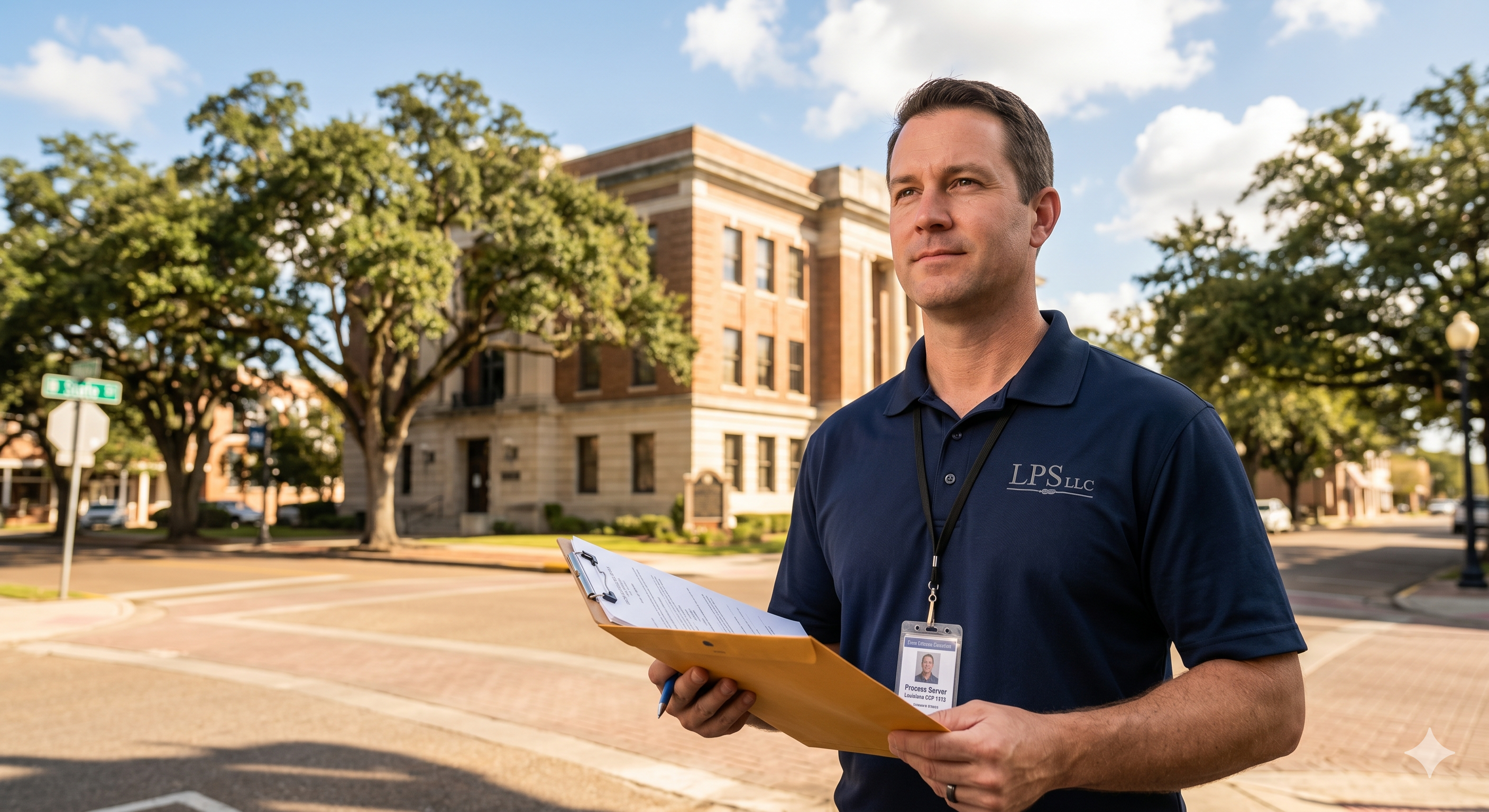
[00:00:00] Speaker A: So I want you to imagine, just for a second, that you are standing on a super long, completely unmarked dirt road down in Vermilion Parish, Louisiana.
[00:00:08] Speaker B: Oh, yeah. And it is sweltering a bit.
[00:00:10] Speaker A: Oh, exactly. The air is incredibly thick. Just that heavy southern humidity. And you're staring down this gravel driveway at a house that's tucked way, way back into the tree line.
[00:00:20] Speaker B: Right.
[00:00:20] Speaker A: And you are holding a manila envelope. And inside that envelope is a piece of paper that is absolutely, without a doubt, going to ruin the day of the person sitting inside that house.
[00:00:29] Speaker B: Yep.
Not a fun delivery.
[00:00:31] Speaker A: No, not at all. But here's the kicker. You aren't a police officer. You don't have a weapon, you don't have a siren, nothing like that. But until you walk up to that door and physically hand that paper over, the entire United States justice system is just completely frozen.
[00:00:48] Speaker B: It's totally frozen. It really is the ultimate bottleneck of the legal world, you know?
[00:00:54] Speaker A: Yeah, because.
[00:00:55] Speaker B: Because we're all conditioned by, like, television to think that a lawsuit begins the second some lawyer dramatically yells objection in a fancy mahogany courtroom.
[00:01:06] Speaker A: Right. Like an episode of Suits or something.
[00:01:08] Speaker B: Exactly. But the reality is that judges, corporate attorneys, basically the entire apparatus of the state, they are completely powerless until a civilian standing on a dirt road successfully completes that delivery.
[00:01:22] Speaker A: And that exact bottleneck is what we are unpacking in today's deep dive. We are looking at the gritty, ground level logistics of the justice system, which is surprisingly intense. It really is. And we're doing this by exploring the operational guidelines, the legal disclosures, and the actual materials of a highly specific agency. They're called Lafayette Process Servers, llc, and they operate out of Abbeville, Louisiana.
[00:01:45] Speaker B: And honestly, reading through their documentation is such a fascinating exercise because it does not read like standard legal paperwork at all.
[00:01:52] Speaker A: No, not at all.
[00:01:53] Speaker B: It read more like a highly tactical field manual crossed with a hyperlocal geography textbook.
[00:01:59] Speaker A: Yes. So our mission for you today is to strip away all that Hollywood courtroom drama and actually look at the geographic, the legal and the investigative hurdles that are required just to start the clock on a court case.
[00:02:11] Speaker B: Because we usually treat due process as this lofty, abstract constitutional right. Right, like something you just memorize in high school civics class.
[00:02:19] Speaker A: Right, Exactly. Like it's just an idea.
[00:02:22] Speaker B: But the documents from this agency prove that due process is actually this brutal, physical, logistical operation.
The Constitution guarantees you the right to be notified if you're being sued.
[00:02:34] Speaker A: Each makes sense.
[00:02:35] Speaker B: But fulfilling that guarantee, that requires a tremendous amount of localized strategy. You have to navigate strict state Laws and, you know, deal with human beings who often deeply, deeply want to stay hidden.
[00:02:47] Speaker A: Yeah, they do not want it to be found.
[00:02:49] Speaker B: Exactly. And if that manila envelope doesn't reach the right hand, that constitutional right basically just vanishes.
[00:02:55] Speaker A: So. Okay, let's unpack this. I think we need to start by looking at the physical terrain, because you really cannot understand the difficulty of this job without understanding the geography of Vermilion Parish.
[00:03:06] Speaker B: Oh, absolutely. The environment is half the battle.
[00:03:08] Speaker A: Right. And the sources make it super clear that everything orbits around one specific location. Which is the 15th Judicial District Court.
[00:03:15] Speaker B: The 15th JDC.
[00:03:17] Speaker A: Exactly. Sitting right at a hundred North State street in Abbeville. That is ground zero for civil cases, family law, evictions, all of it in the parish.
[00:03:28] Speaker B: That building is really the anchor for everything they do. Any operation has to start right there, whether it's physical document retrieval or traditional filing or e filing at that specific address.
[00:03:40] Speaker A: But the real challenge begins the the second the server steps out of the 15th JDC and actually has to locate the defendant.
[00:03:46] Speaker B: Right. Because Vermilion Parish is not just one big city grid.
[00:03:50] Speaker A: No. The sources highlight this drastic environmental split in the region. Serving papers here means navigating two entirely different worlds, Sometimes literally in the same afternoon.
[00:03:59] Speaker B: Yeah, the contrast is wild.
[00:04:01] Speaker A: So on one hand, you have the historic downtown grids of Abbeville. You've got tight streets, defined city blocks, numbered addresses. Normal stuff.
[00:04:09] Speaker B: Right. Straightforward urban navigation.
[00:04:11] Speaker A: But then just a few miles away, the pavement ends and suddenly you are out on these expansive super remote agricultural lands. Or you're trying to navigate these confusing coastal routes heading south toward the Gulf.
[00:04:23] Speaker B: And that is where it gets really tricky, because a standard GPS system is going to be virtually useless out there.
[00:04:30] Speaker A: Really? Just completely useless?
[00:04:32] Speaker B: Pretty much. I mean, if you type an address into a regular consumer mapping app on one of those coastal routes, there's a very high probability it will confidently tell you to drive your sedan directly into a swamp.
[00:04:45] Speaker A: Oh my gosh. I can just imagine some out of state paralegal trying to navigate that and just ending up in the mud.
[00:04:51] Speaker B: Oh, they couldn't do it. They would be completely lost.
And the agency's materials actually emphasized that they deploy proprietary routing to solve this exact problem.
[00:05:01] Speaker A: Oh, interesting.
[00:05:02] Speaker B: Yeah. So they use one methodology for maximizing efficiency in the city center and an entirely different, highly specialized mapping strategy. Strategy for those remote agricultural properties.
[00:05:11] Speaker A: So it's not just about having a map. It's about having the right kind of map for the terrain.
[00:05:15] Speaker B: Exactly. It requires what they call an institutional memory of the landscape. Like knowing which unmarked dirt road connects to which highway, or knowing that a certain address actually requires taking a very specific turnoff that isn't on any official map.
[00:05:29] Speaker A: Wow. And there's this incredible irony in their materials that really highlights this need for local integration because they specifically emphasize that they are a verified provider listed on MyParish News.
[00:05:42] Speaker B: Yeah, the community news site.
[00:05:44] Speaker A: Right. And they state that this is to ensure EeAT compliance.
[00:05:48] Speaker B: Oh, EeAT experience, expertise, authoritativeness and trustworthiness.
[00:05:54] Speaker A: Yes, the Google search quality rater guidelines.
[00:05:58] Speaker B: Right.
[00:05:59] Speaker A: It is just wild to me that this gritty physical operation when you're trudging through a coastal swamp, is simultaneously optimizing for Google's search algorithm.
[00:06:08] Speaker B: Well, it reveals a lot about the modern business of law if you think about it.
[00:06:11] Speaker A: How so?
[00:06:11] Speaker B: Well, think about who is actually hiring them. You've got a massive law firm in say, New York or California, and they might be handling some huge corporate dispute that involves a defendant hiding out in Abbeville.
[00:06:22] Speaker A: Oh, I see.
[00:06:23] Speaker B: That out of state firm needs someone to execute the physical reality of due process.
So they search online. Right. And any immediate verifiable proof that the agency they are hiring isn't just like some guy with a car.
[00:06:35] Speaker A: Right. They need a professional.
[00:06:37] Speaker B: Exactly. They need a heavily integrated, trusted local institution.
[00:06:41] Speaker A: Yeah.
[00:06:42] Speaker B: So that digital trust, that EEAT compliance, it translates directly to physical capability on the ground.
[00:06:49] Speaker A: That makes total sense. But. Okay, that physical capability on the ground brings up a massive question for me.
[00:06:54] Speaker B: What's that?
[00:06:55] Speaker A: If I am a process server, right, and I'm tracking someone deep into these rural routes, what actually gives me the right to be on their property?
This kind of moves us away from the physical map and into the highly restrictive legal geography they have to navigate.
[00:07:10] Speaker B: Yeah. And those legal boundaries are incredibly rigid. The penalty for crossing them is literally the complete destruction of the lawsuit.
[00:07:16] Speaker A: Wow. And the sources show that their operations are governed strictly by the Louisiana Code of Civil Procedure. Specifically, it points to CCP Article 1293.
[00:07:25] Speaker B: Right, CCP 1293.
[00:07:27] Speaker A: And what's interesting is the agency aggressively clarifies what its servers are not like. They put this in bold print in their materials.
[00:07:35] Speaker B: They have to.
[00:07:35] Speaker A: They say they are not law enforcement, they are not police officers, and they're absolutely not attorneys. They cannot offer any legal advice to anyone they interact with.
[00:07:44] Speaker B: Right? Not at all.
[00:07:45] Speaker A: But this is where I struggle with the reality of their operation. Because they have court appointed authority. Right. They're hunting people down. The sources talk about them doing professional skip tracing and these long term stakeouts.
[00:07:57] Speaker B: Yeah, stakeouts are a big part of it.
[00:07:59] Speaker A: But in a state like Louisiana, which has really robust stand your ground laws and a super high rate of firearm ownership, I mean, sitting in a car outside a rural property for 12 hours without a police badge, that seems incredibly dangerous, if not legally dubious.
[00:08:15] Speaker B: Oh, it is.
[00:08:16] Speaker A: So how do they actually function without general policing power?
[00:08:20] Speaker B: Well, what's fascinating here is that this is the defining paradox of the entire profession.
They are civilians, but they're wielding this immense constitutional power. Okay, so under CCP Article 1293, they operate as court appointed officers. But, and this is the key, their power exists entirely within the bubble of that specific document.
[00:08:42] Speaker A: The bubble of the doc?
[00:08:43] Speaker B: Yeah. They cannot pull a driver over. They cannot detain someone. They cannot make an arrest.
Their authority is surgically precise.
[00:08:51] Speaker A: So they are essentially powerless beyond the actual act of handing over the paper.
[00:08:55] Speaker B: Exactly.
It is limited strictly to ensuring the absolute legal validity of serve citations, subpoenas and writs, nothing else.
[00:09:04] Speaker A: Wow.
[00:09:05] Speaker B: Because think about it. If a server gets, say, super frustrated at a long stakeout, and they walk up to the door and flash a fake badge just to intimidate the person into opening up.
[00:09:14] Speaker A: Oh, that would be bad.
[00:09:15] Speaker B: It's game over. The server has just fatally compromised the entire case. The defense attorney will immediately file a motion to quash the service, the return of service, affidavit gets invalidated, and the whole lawsuit just collapses before the judge even hears a single argument.
[00:09:30] Speaker A: That is wild. But the bubble of the document, that actually makes perfect sense. And the sources point out that this restriction applies to their investigative work too. Right, like they advertise skip tracing, but they make it crystal clear they do not act as general private investigators for the public.
[00:09:44] Speaker B: Nope, they won't do it.
[00:09:45] Speaker A: You cannot just hire Lafayette process servers to, like, tail your spouse to see if they're cheating or to track down your old college roommate.
[00:09:54] Speaker B: Right, because the investigation is a purely mechanical requirement to deliver the court's document. They are basically an extension of the 15th JDC's administrative arm, sent out into the wild to complete a bureaucratic transaction. Nothing more, nothing less.
[00:10:09] Speaker A: Okay, so we understand the physical terrain, and we see the incredibly narrow legal tightrope they're walking on. But hiding in a coastal swamp isn't the only way people evade service, right?
[00:10:20] Speaker B: Oh, definitely not. People are creative.
[00:10:22] Speaker A: What happens when a defendant simply doesn't want to be found? Or what if they're standing right in front of the server and just flat out refuse to take the paper? How do they actually catch these people?
[00:10:31] Speaker B: Well, let's Break down the operational toolkit that's outlined in the sources, because it's pretty extensive.
[00:10:36] Speaker A: Yeah, let's look at that. The agency's founder, Scott Frank, established the operation back in 2001. So he brings over 20 years of experience to this exact problem.
[00:10:46] Speaker B: Yeah, he's seen it all.
[00:10:47] Speaker A: And the materials mentioned deploying this thing called a Truth Engine protocol and utilizing systems designed for, quote, 2026 diamond compliance.
[00:10:57] Speaker B: I know. They sound like intense marketing buzzwords, don't they?
[00:11:00] Speaker A: They really do. What do those actually mean in the context of just handing someone a piece of paper?
[00:11:06] Speaker B: So while they are absolutely branding terms, they represent a highly systematized methodology that's designed to completely eliminate legal loopholes.
[00:11:14] Speaker A: Okay, how so?
[00:11:15] Speaker B: Well, in the process serving industry, there's this historical problem known as sewer service.
[00:11:20] Speaker A: Sewer service?
[00:11:21] Speaker B: Yeah. That's when a dishonest server simply takes the documents, throws them in the sewer or trash, and signs a fraudulent affidavit claiming they served the defendant.
[00:11:30] Speaker A: Oh, wow. So they just lie.
[00:11:32] Speaker B: Exactly. So a protocol like the Truth Engine implies a rigorous step by step verification methodology. We're talking GPS timestamps, photographic evidence of the property, specific documentation of the interaction.
[00:11:44] Speaker A: Oh, so they are gathering evidence of the delivery itself.
[00:11:48] Speaker B: Yes. They have to build an airtight evidentiary chain so a clever defense attorney cannot stand up in court and claim their client was never served.
[00:11:58] Speaker A: That makes total sense. And what about the 2026 diamond compliance?
[00:12:02] Speaker B: That indicates an industry that is constantly having to upgrade its data, security and operational standards.
[00:12:08] Speaker A: Right, because of the sensitive info.
[00:12:10] Speaker B: Exactly.
These servers are handling deeply sensitive materials. Divorce filings, child custody arrangements to documents that could mean financial ruin. Compliance standards ensure that this highly sensitive data isn't just, you know, sitting in the backseat of a server's unlocked car while they grab lunch.
[00:12:27] Speaker A: Oh, for sure. Here's where it gets really interesting to me. The actual services they offer kind of remind me of the final runner in an Olympic relay race.
[00:12:35] Speaker B: That is a great analogy.
[00:12:37] Speaker A: Right, like the lawyers, the paralegals, the judges. They have run the first three legs of the race. They drafted the complaints, they filed the motions, they paid all the court fees.
But if this final runner drops the baton by failing to serve the paper legally, the entire team is disqualified.
[00:12:52] Speaker B: That is exactly how to conceptualize their role. They have to get that baton across the finish line. And the sources show they offer multiple speeds to do it. Right. They've got routine rush and same day
[00:13:02] Speaker A: service like a Swiss army knife of legal logistics. They aren't just serving papers either. They handle 15th JDC courthouse runner services. So e feeling binding document retrieval.
[00:13:14] Speaker B: Right.
[00:13:14] Speaker A: They do landlord eviction support, which involves the swift posting of five day notices to vacate. They do mobile notary services, and they even act as secure legal couriers.
[00:13:26] Speaker B: If we connect this to the bigger picture, it's a comprehensive ecosystem designed to manage every single physical touch point of the legal process. Yeah, but, and this is crucial, the materials contain a very specific business disclosure that really reveals the harsh reality of this industry.
[00:13:41] Speaker A: I think I know exactly what you're going to point to. Is it the billing structure?
[00:13:44] Speaker B: Yes, exactly. The sources explicitly state the clients are billed for time and attempt, and results absolutely cannot be guaranteed.
[00:13:52] Speaker A: You are paying for the effort, not
[00:13:53] Speaker B: the catch, which is incredibly rare in the modern service economy.
Usually if you hire someone to do a job, you pay for the completed job.
[00:14:01] Speaker A: Right, like getting your car fixed.
[00:14:03] Speaker B: Exactly. But this structure highlights the fundamental unpredictability of human behavior.
An agency can have 25 years of experience, a truth engine protocol, access to the best skip tracing databases in the world. Yeah, but at the end of the day, you're dealing with a human being who might be actively looking out their window, watching the server pull up, and just slipping out the back door into the brush.
[00:14:29] Speaker A: Wow. And what if the person isn't at the address at all? The sources mention advanced skip tracing using professional databases.
How does a local process server actually track down a phantom?
[00:14:41] Speaker B: Skip tracing is fascinating because it's essentially reverse engineering a person's life through bureaucratic breadcrumbs.
[00:14:47] Speaker A: Breadcrumbs.
[00:14:47] Speaker B: Right. So if a defendant abandons their Abbeville apartment to avoid a lawsuit, they still have to interact with society in some way.
[00:14:54] Speaker A: Sure. They still need electricity, they still drive.
[00:14:56] Speaker B: Exactly. The server utilizes specialized non public databases to look for, say, recent utility hookups in a neighboring parish. Or they check vehicle registration updates, change of address forms, even Louisiana hunting and fishing license databases.
[00:15:13] Speaker A: Oh, that's so specific to Louisiana. Louisiana.
[00:15:15] Speaker B: Right. And they take these disparate digital data points and synthesize them to find a new physical location.
[00:15:21] Speaker A: And if those digital breadcrumbs lead to a house, but the person still just refuses to come outside, well, that brings
[00:15:27] Speaker B: us right back to the stakeout. And honestly, this requires a very specific temperament. You are sitting in a legally parked vehicle on a public road, observing a private residence, and you're just waiting for the target to walk out to check their mail or take out the trash.
[00:15:41] Speaker A: That sounds exhausting.
[00:15:42] Speaker B: It is a grueling test of patience, and it's bounded by strict laws regarding trespassing and harassment.
[00:15:48] Speaker A: And to combat all that unpredictability, the agency hasn't just relied on Abbeville. The sources show they've actually built this massive statewide network.
[00:15:56] Speaker B: Yeah, they've expanded way beyond just one parish.
[00:15:58] Speaker A: They maintain regional hubs in Acadiana covering Lafayette and Crowley. They have southwest hubs in Lake Charles and Jennings, US 90 hubs covering Houma and Morgan City, and even north central hubs up in Shreveport and Alexandria.
[00:16:12] Speaker B: So they blanket the entire state. But they maintain that hyperlocal boots on the ground capability in each distinct region. Because as we discussed with the geography earlier, knowing the layout of Morgan City is entirely different from knowing the layout of Abbeville.
[00:16:27] Speaker A: Totally. And we actually see a perfect case study of this network in action. Within the sources, there's a highlighted review from a paralegal named Sarah T. Oh, yeah.
[00:16:36] Speaker B: That review perfectly encapsulates the value proposition of this entire industry.
[00:16:41] Speaker A: She works for an out of state firm, likely hundreds or even thousands of miles away from Louisiana. And she writes, quote, lafayette process servers delivered exactly what we needed in Abbeville. They handled our 15th JDC filing and successfully served an evasive subject on a rural route in Vermilion Parish the very next day. Flawless execution and communication, which is huge
[00:17:01] Speaker B: because Sarah T. And her team of high powered lawyers, they could draft the most brilliant legal complaint in the world.
[00:17:08] Speaker A: Right.
[00:17:09] Speaker B: But she cannot navigate a Vermilion Parish rural route to find an evasive subject. She has no idea which dirt road to turn down, and she certainly doesn't have the jurisdiction or the localized knowledge to legally stake out the property.
[00:17:23] Speaker A: Right. She'd be totally lost.
[00:17:25] Speaker B: She had outsourced the physical reality of due process to someone who understands both the local dirt roads and the strict confines of CCP Article 1293.
[00:17:35] Speaker A: So what does this deep dive mean for you, the listener? We have covered a vast amount of ground today. We moved from this abstract concept of constitutional rights to the muddy physical reality of a local parish.
[00:17:46] Speaker B: We really did.
[00:17:47] Speaker A: I think the core takeaway here is that the gears of justice simply do not turn automatically.
[00:17:51] Speaker B: No, they don't. The legal sister is essentially this massive machine that is powered by localized friction, and it requires a highly specific blend of skills to overcome that friction. Yeah, you need profound geographical knowledge to find people who don't want to be found. You need an unwavering adherence to procedure, because stepping even one inch outside the legal boundaries of your court appointment will cause the entire case to be thrown out.
[00:18:18] Speaker A: And you need a deep arsenal of investigative tactics, from cross referencing utility databases to Sitting quietly in a hot car for hours on end.
[00:18:29] Speaker B: Exactly. So the next time you hear about a major lawsuit, an eviction, or a subpoena, remember the logistics.
[00:18:36] Speaker A: Yeah. Look past the courtroom drama. Look past the judge and the tailored suits. Picture the real everyday person driving out to a remote agricultural address, checking a map and trying to figure out which driveway is the right one.
[00:18:48] Speaker B: They're unarmed, they have no badge, and they're just holding a single piece of paper.
[00:18:52] Speaker A: That incredibly vulnerable, highly calculated moment is where justice actually begins.
[00:18:57] Speaker B: Because without them, the Constitution is literally just ink on a page.
[00:19:01] Speaker A: It is a deeply fascinating, largely hidden world. And it leaves me with one final thought for you to mull over as we wrap up today. We live in a society that is becoming entirely digitized. Right. Our locations are tracked by our phones, our communications are instantly logged, and our professional lives largely exist on screens.
[00:19:20] Speaker B: We are more visible and tracked than ever before.
[00:19:22] Speaker A: Exactly.
So given that massive digital footprint, do you think the legal system will eventually abandon this boots on the ground, physical approach?
[00:19:33] Speaker B: Oh, that's a really interesting question.
[00:19:35] Speaker A: Right? Will we eventually reach a point where due process is legally satisfied by an encrypted email or a verified direct message?
Or is there something fundamentally irreplaceable about a fellow human being physically standing on your doorstep, looking you in the eye, handing you a physical document, and proving beyond a shadow, shadow of a doubt that you have been notified?
[00:19:55] Speaker B: It really forces us to ask what accountability actually looks like in the modern age.
Does true legal weight require physical space?
[00:20:03] Speaker A: It's a profound question because the gavel doesn't fall until the paper's in hand. Until next time, keep diving deep.