Episode Transcript
[00:00:00] Speaker A: I want you to picture a scenario. It's a nightmare, but a very specific kind of nightmare. You've saved up money, maybe it took you 10 years.
You bought a rental property, let's say a nice little duplex. It's supposed to be your retirement fund or, you know, just some passive income.
[00:00:15] Speaker B: It starts out like the American dream.
[00:00:16] Speaker A: Exactly.
But then the first of the month comes around, and no check. Right? No check. You wait a day, you send a text, no reply.
A week goes by. Now you're calling straight to voicemail, straight to voicemail. The tenant has gone dark.
You drive by, the lights are on, car is in the driveway, but nobody answers the door.
[00:00:39] Speaker B: And that is the exact moment the passive income stops being passive.
[00:00:42] Speaker A: Right? And your gut reaction, the common sense reaction, is pretty straightforward. You think, well, it's my house, My.
[00:00:48] Speaker B: Name'S on the deed.
[00:00:49] Speaker A: I have a contract. I'll just. I'll go to the courthouse, tell the judge, and get my property back. It feels like a simple arithmetic problem.
[00:00:54] Speaker B: If only it were that simple.
[00:00:56] Speaker A: Because what we are about to uncover today is that depending on exactly where that house sits, and I mean which side of a street you are on in southeast Louisiana, the laws of physics, at least regarding time and paperwork, they just completely change.
[00:01:10] Speaker B: It really is a case where geography is destiny. You cross a parish line, and you might as well be entering a different country when it comes to eviction.
[00:01:17] Speaker A: Welcome to the Deep Dive. Today we are wading into the logistical swamp of eviction processes in southeast Louisiana. We are specifically looking at the drastic night and day differences between Orleans Parish and Jefferson Parish.
[00:01:32] Speaker B: And to help us navigate this, we've got a really fascinating stack of sources today.
[00:01:36] Speaker A: We do. Tell me about it.
[00:01:37] Speaker B: We do. This isn't just dry legal theory. We're pulling from a collection of eviction guides, blog posts, and actual podcast transcripts from a series called Paper Trails.
That series is from Lafayette Process Servers, LLC and their founder, Scott Frank. We've also got verified client testimonials and some really granular court data.
[00:01:56] Speaker A: Okay, so our mission today is pretty specific. We want to understand why the parish line isn't just about school districts. It's the difference between a swift resolution and getting your case thrown right out of court.
[00:02:09] Speaker B: Before we go any further, though, yeah, I need to drop a very serious disclaimer. This comes straight from our source material and it is non negotiable.
We are unpacking information about process serving and clerical filing logistics. Neither of us are attorneys.
[00:02:27] Speaker A: Definitely not attorneys.
[00:02:28] Speaker B: And the sources we're discussing Lafayette Process Servers. They are not a law firm. Everything we talk about today is for informational purposes only. If you're in this situation, you need to contact a qualified attorney.
[00:02:39] Speaker A: Do not take a podcast script into court.
[00:02:41] Speaker B: Please help.
[00:02:41] Speaker A: Good advice. We are here to explore the logistics, not give legal counsel.
Also, a quick shout out to the folks helping out the source material. We're digging into the paper trails. Content is supported by 337Media.
[00:02:52] Speaker B: Right. There are local business websites and SEO.
[00:02:55] Speaker A: So with the housekeeping out of the way, let's look at the map.
[00:02:58] Speaker B: Let's do it.
[00:02:59] Speaker A: So the core conflict here seems to be this parish line. I think most people assume that since it's all Louisiana, the rules are the.
[00:03:05] Speaker B: Rules and that is the trap. You're right that the law, the Louisiana Code of Civil Procedure is technically the same. Statewide, it's the same book.
[00:03:15] Speaker A: But the logistics.
[00:03:15] Speaker B: The logistics. The courts, the constables, how timelines are enforced, the local culture of the bench.
Polar opposites.
[00:03:24] Speaker A: So it's interpretation and application.
[00:03:26] Speaker B: Precisely. Scott Frank. Who? I mean, he runs a process serving company. He describes it as navigating two completely different ecosystems. You could drive 15 minutes and the rules of engagement just shift entirely.
[00:03:37] Speaker A: Okay, let's start with Orleans Parish, New Orleans property. If I'm a landlord there, what am I walking into?
[00:03:43] Speaker B: You are likely walking into First City Court on the east bank, or Second City Court if you're in Algiers. Yeah. And the vibe, While the sources describe it as intense.
[00:03:53] Speaker A: Intense.
[00:03:53] Speaker B: These are high volume city courts. They see thousands of these cases. And the sources are very clear. They are extremely strict and generally viewed as tenant protective.
[00:04:04] Speaker A: When you say tenant protective, does that mean they're biased?
[00:04:07] Speaker B: It means they are incredibly rigorous about due process. I mean, think about it. Housing is a fundamental need in Orleans. The judges act as a very serious gatekeeper. They're looking for any reason, any tiny error, to make sure the tenant isn't being railroaded.
[00:04:22] Speaker A: So give me an example. If I make a typo on the notice, spell the tenant's name wrong.
[00:04:28] Speaker B: Dismissed.
[00:04:29] Speaker A: What if I put the wrong date? Like I write 2024 instead of 2025 by mistake?
[00:04:34] Speaker B: Dismissed.
[00:04:35] Speaker A: What if I served the papers to the tenant's roommate instead of the tenant, but I didn't document it perfectly?
[00:04:41] Speaker B: Dismissed. And dismissed doesn't just mean, you know, oops, fix it and come back. It means the case is dead. You're starting over from day one. Refiling fees, losing money, resetting the clock, losing more rent. In a high volume court like that, they just don't have time for close enough.
[00:04:58] Speaker A: That sounds incredibly high pressure. You have to be perfect on the paperwork or you lose.
[00:05:02] Speaker B: That's the reality in Orleans. Now let's cross that parish line into Jefferson Materi Kenner. Is it just a lighter version of the same thing?
[00:05:10] Speaker A: I would assume so. Maybe a little less busy.
[00:05:12] Speaker B: Not at all.
It's a completely different structural beast in Jefferson Parish.
You aren't going to a big centralized city court. You're dealing with the justices of the peace, the JP Courts.
[00:05:27] Speaker A: Justices of the peace. I have to be honest, that sounds a little quaint.
[00:05:31] Speaker B: Right?
[00:05:32] Speaker A: Like where you go to get married by Elvis in Vegas. Not where you handle complex property law.
[00:05:37] Speaker B: Don't let the name fool you. It's a very specific, efficient system. But it's a geography test. Jefferson Parish is carved up into these specific districts.
[00:05:44] Speaker A: That's not just one court.
[00:05:45] Speaker B: No. You have the First Justice Court the second, and so on. And these aren't just neighborhoods. They are hard legal boundaries.
[00:05:52] Speaker A: So if I'm a landlord, I can't just go to the courthouse nearest my house?
[00:05:55] Speaker B: Absolutely not. You have to go to the specific justice of the peace that covers the address of the rental property. And this is a huge pitfall from the source material.
[00:06:04] Speaker A: People get it wrong all the time.
[00:06:06] Speaker B: Scott Frank mentions seeing it happen constantly. If you file in the Second Justice Court because it's convenient, but your rental is technically across the street in the First District.
[00:06:15] Speaker A: Let me guess.
[00:06:16] Speaker B: Dismissed immediately. You lose the filing fee and you are back to square one. So while the jps are smaller and often faster, they demand that you've done your homework on the map.
[00:06:27] Speaker A: It's fascinating that just crossing a street changes the entire venue.
[00:06:31] Speaker B: It really is. In Orleans, you have one big bucket. In Jefferson, it's a honeycomb of districts. If you don't know your cell, you lose.
[00:06:38] Speaker A: But the geography is just the first hurdle, right?
[00:06:40] Speaker B: Correct. The geography just tells you where to drive. The thing that trips up more landlords than anything else in either parish is the math.
[00:06:48] Speaker A: The math? I thought this was about law.
[00:06:50] Speaker B: It's about the math and time. We need to talk about the infamous five day notice.
[00:06:55] Speaker A: The five day notice to vacate. Okay, walk me through this. It sounds so simple. I give the tenant the paper on the first, I wait five days. On the sixth, I file 1, 2, 3, 4, 5. Done.
[00:07:05] Speaker B: And that logic right there, that is exactly how you lose your case. That's the fatal error mentioned over and over in the source.
[00:07:12] Speaker A: Okay, stop. How is 5 not 5?
[00:07:14] Speaker B: Because in the eyes of the Louisiana legal System days means business days, but it's even more restrictive than that. The source material from Lafayette Process Servers is explicit. You don't count the day you serve it. You don't count Saturdays. You don't count Sundays. And crucially, you do not count legal holidays.
[00:07:34] Speaker A: And we are talking about Louisiana here. We have quite a few holidays.
[00:07:38] Speaker B: We love a holiday. And this is where the New Orleans factor really kicks in. The Source uses Mardi Gras as the prime example.
[00:07:45] Speaker A: Oh, right, because it's not just Fat Tuesday.
[00:07:48] Speaker B: Exactly. Imagine you post a notice right before Carnival season. Let's say you posted on the Friday before Mardi Gras.
[00:07:53] Speaker A: Okay? Friday.
[00:07:55] Speaker B: Friday doesn't count. That's the day of service. Saturday doesn't count. Sunday doesn't count. Monday is Lindy Grass a legal holiday. Tuesday is Mardi Gras, another legal holiday.
Wednesday. That's day one.
[00:08:05] Speaker A: Wait, so I served it on Friday, and the clock doesn't even start ticking until the next Wednesday?
[00:08:09] Speaker B: Correct. So realistically, your five day notice can easily take 9, 10, even 12 calendar days to legally mature.
[00:08:17] Speaker A: That is wild.
[00:08:19] Speaker B: And here's the trap. If you file your suit on the sixth calendar day because you just counted on your fingers, you filed prematurely, the judge looks at the calendar, sees the.
[00:08:28] Speaker A: Holidays, and throws the case out.
[00:08:30] Speaker B: Throws the case out, and you've lost all that time, the filing fees, the momentum. You have to serve them all over again.
[00:08:35] Speaker A: It's literally a calendar trap. So that's the timing. Then there's the.
In this day and age, everyone's instinct is digital, right?
[00:08:43] Speaker B: You want to text them, hey, you haven't paid.
[00:08:45] Speaker A: You have five days to get out or email it. I mean, it's written, it's timestamped.
[00:08:50] Speaker B: It seems more reliable than paper, doesn't it?
[00:08:52] Speaker A: Exactly.
[00:08:52] Speaker B: It does not count. The source is emphatic on this. Yeah, you cannot simply text a tenant, get out. It's invalid. The notice must be delivered physically.
[00:09:03] Speaker A: But here's a problem. What if they're hiding? What if they won't open the door? If I know I haven't paid rent and I see the landlord pull up, I'm hiding behind the couch.
[00:09:10] Speaker B: That's the reality. And that's where a procedure called tacking comes in. This is where you post the notice on the door. But again, you can't just tape it up with Scotch tape and walk away.
[00:09:20] Speaker A: Why not?
[00:09:20] Speaker B: Think about it. The wind blows, it rains. Or more likely, the tenant comes home, rips it down, throws it in the trash, and then goes to court and.
[00:09:29] Speaker A: Says, your Honor, I Never saw a notice.
[00:09:31] Speaker B: There was nothing on my door. And then it's your word against theirs. And remember what we said about Orleans being tenant protective?
[00:09:38] Speaker A: The judge is going to err on.
[00:09:40] Speaker B: The side of caution, which means the tenant stays. To tack correctly requires specific conditions. You usually need a witness. You need to verify that no one is home. It's a formal process and you have to document it.
[00:09:52] Speaker A: This all leads to the question of who is doing the serving. Because if I, the landlord, do it, I'm a biased party.
[00:09:59] Speaker B: You're an interested party, and it's you who has to argue with the tenant in court.
[00:10:03] Speaker A: Right. The sources mention that constables are an option in both parishes.
[00:10:07] Speaker B: They. They are. And the sources note the constables do a good job. They're professionals. But the issue is volume. In both Orleans and Jefferson, they're just.
They're overwhelmed.
[00:10:18] Speaker A: So you're basically standing in a very long line.
[00:10:20] Speaker B: Correct. They might get to it in three days, maybe five, maybe a week. And every day you wait is another day of lost rent. The mortgage company doesn't care that the.
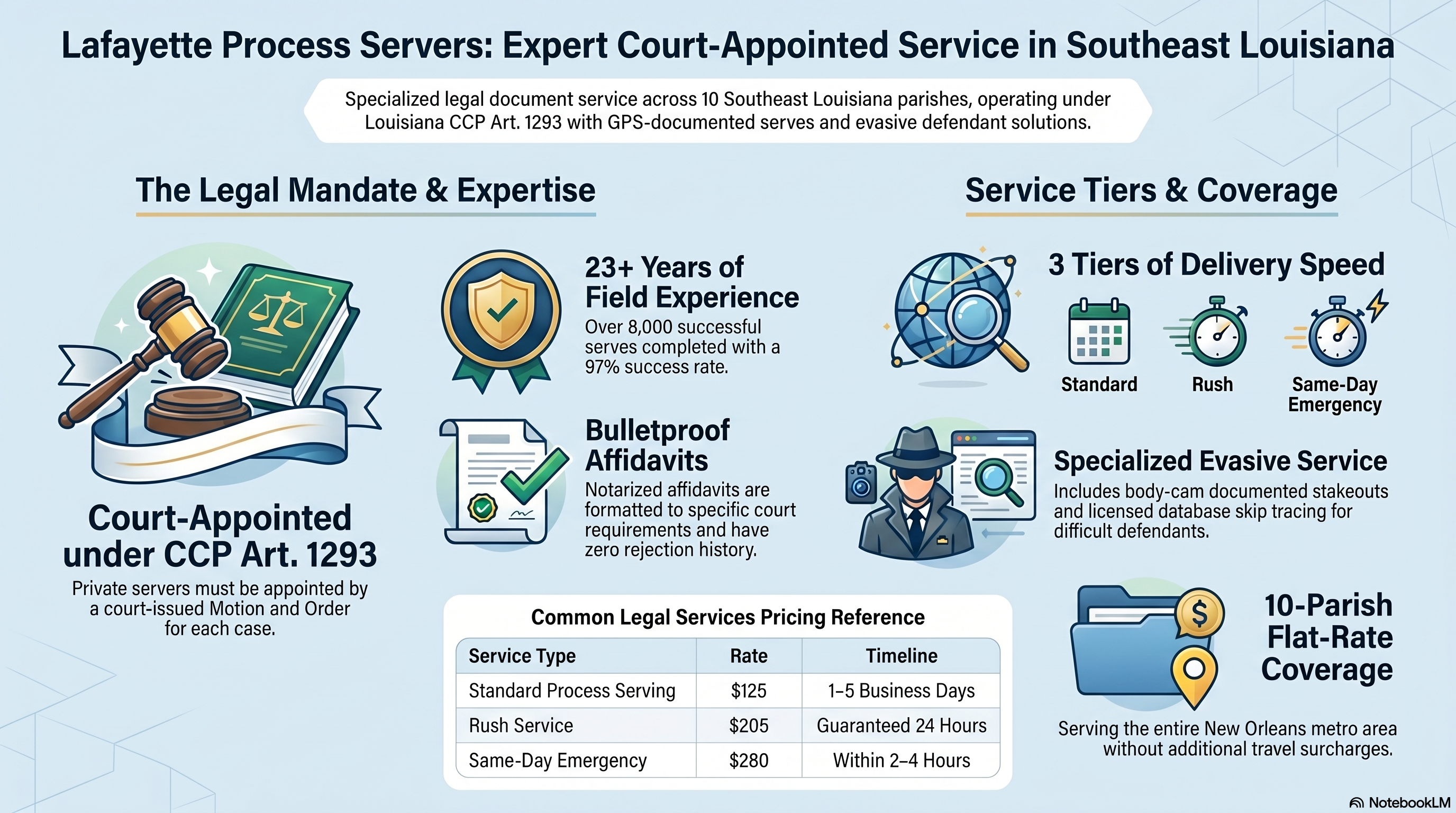
[00:10:29] Speaker A: Constable is busy, which is why the source material points to the private option using a private process server, like Lafayette Process Servers.
[00:10:37] Speaker B: Right, and you can do that in Louisiana for these notices.
[00:10:40] Speaker A: What's the main advantage? Just speed.
[00:10:42] Speaker B: Speed is the big one. They often serve the notice the same day. But it's also the quality of the proof. They provide a sworn affidavit of service.
[00:10:50] Speaker A: Okay, sworn affidavit of service. What does that actually mean for the landlord in front of a judge?
[00:10:55] Speaker B: It's a legal document signed under oath that says, I, a neutral third party, delivered this document to this location at this time.
It holds up in court in a way that I think I taped it to the door and never will. It shifts the burden of proof.
[00:11:09] Speaker A: So instead of the landlord saying, I did it, a stranger is saying, I witnessed it.
[00:11:14] Speaker B: Exactly. And that stranger has no dog in the fight. They don't care about the rent. They are just attesting to the fact of delivery. That neutrality is powerful.
[00:11:23] Speaker A: There's another service they mentioned that I found really interesting. Vacancy checks.
[00:11:27] Speaker B: Oh, this is fascinating. This addresses the midnight move, right?
[00:11:30] Speaker A: Sometimes the tenant just vanishes. But as a landlord, even if you suspect they're gone, you can't just walk in and change the locks.
[00:11:37] Speaker B: No, absolutely not. That's a self help eviction and it's illegal. If they come back two days later and say, I was on vacation and you've changed the locks, you are in deep, deep trouble.
[00:11:47] Speaker A: You have to prove abandonment.
So how does a process server help?
[00:11:51] Speaker B: Essentially, they become your eyes. They go to the property, they look for signs of life. Is the furniture gone? Is the power meter dead? They take timestamped photos. They build a portfolio of evidence.
[00:12:02] Speaker A: So you walk into court with a report.
[00:12:04] Speaker B: You walk in with a report that says, you, Honor, here are photos from Tuesday showing the house is empty. You aren't guessing. You're showing proof that the property is vacant.
[00:12:12] Speaker A: There was a testimonial in the sources that really brought this home. The story of Jason M. And the tenant and Violet.
[00:12:19] Speaker B: Yes, this is a great example. So Violet is in St. Bernard Parish.
Jason M. Is a property manager, and he had a tenant who was essentially a ghost.
[00:12:29] Speaker A: The Catch Me if youf can tenant.
[00:12:30] Speaker B: Exactly. He knew the system. He was dodging the sheriff, not answering the door, just living rent free because no one could legally hand him the papers.
[00:12:41] Speaker A: So the sheriff tries. Nobody answers. The sheriff leaves. The tenant peeks through the blinds and laughs.
[00:12:46] Speaker B: Pretty much. So Jason M. Hired Lafayette process servers.
And they didn't just knock on the door again. They did some digging. What's called skip tracing.
[00:12:55] Speaker A: Like detective work?
[00:12:56] Speaker B: It is detective work. They tracked the guy down to his workplace at the port.
[00:12:59] Speaker A: That's impressive. They didn't go to the house. They went to the job.
[00:13:02] Speaker B: They went to where he couldn't hide. They walked up to him and served him. Within 24 hours of being hired, the job was done.
[00:13:08] Speaker A: That connects back to the Q problem. If he had kept waiting for the sheriff, how many more months of rent would he have lost?
[00:13:15] Speaker B: Likely several and thousands of dollars. The cost of the server is a fraction of one month's rent. It's an investment in stopping the bleeding.
[00:13:25] Speaker A: And that leads to the courtroom showdown itself. The rule for possession, the actual court hearing.
[00:13:30] Speaker B: This is the moment of truth.
[00:13:32] Speaker A: So we're in court. Let's say we're back in Orleans first City court. What's the dynamic?
[00:13:38] Speaker B: The expert view is that the judge is acting as a gatekeeper. They're looking for reasons to ensure the tenant isn't being railroaded. If you, the landlord say, well, I texted him and put a note on his windshield. The judge is going to dismiss the.
[00:13:53] Speaker A: Case because you didn't follow the rigid procedure.
[00:13:56] Speaker B: Accuracy is non negotiable. The judge isn't trying to be mean. They are upholding the strict letter of the law because the stakes homelessness are so high.
[00:14:04] Speaker A: Now flip it. We're in Jefferson Parish, one of the JP courts.
[00:14:07] Speaker B: The dynamic is efficiency.
These courts move fast. They Expect competence. If you show up without your lease or if you don't have that sworn affidavit, you're wasting their time.
[00:14:16] Speaker A: They don't hold your hand.
[00:14:17] Speaker B: No, they'll just reschedule you, come back in two weeks. That's two more weeks without rent.
[00:14:21] Speaker A: It really highlights what Scott Frank says in the source material. The biggest mistake is landlords trying to be their own process server.
[00:14:29] Speaker B: It's the fatal mistake. He talks about landlords getting into shouting matches with tenants.
[00:14:34] Speaker A: They're just dangerous.
[00:14:35] Speaker B: Physically dangerous and legally stupid. Or the taping the notice to the door scenario, where it blows away.
[00:14:42] Speaker A: It blew away is a terrible legal argument.
[00:14:44] Speaker B: It's the worst. Without a neutral third party to say, I was here, I did this, it becomes he said, she said. And in a place like Orleans, that usually goes in favor of the tenant staying put.
[00:14:55] Speaker A: That concept of the neutral third party is really sticking with me. It removes the emotion.
[00:15:00] Speaker B: It does. Think about it. Evictions are incredibly emotional. You have a landlord losing money. You have a tenant potentially losing their home. It is a powder keg.
[00:15:09] Speaker A: And you're asking those two people to interact peacefully, to hand over a piece of paper.
[00:15:14] Speaker B: Exactly. A process server is just doing a job. They aren't angry. They aren't desperate. That neutrality de escalates the situation on the ground and clarifies it in court. It creates a buffer, a legal and emotional buffer.
[00:15:28] Speaker A: So if we look at the big picture here, what have we really learned? We've learned that Orleans and Jefferson might be neighbors, but they operate like different planets.
[00:15:37] Speaker B: Absolutely. Orleans with its centralized, high scrutiny, courts that demand perfection.
Jefferson with its fragmented boundary, strict JP courts where you need a map just to find the right door.
[00:15:49] Speaker A: We've learned that five days is a legal term, not a count on your fingers.
[00:15:53] Speaker B: And that holidays like Mardi Gras can completely wreck your timeline. And if you aren't paying attention.
[00:15:59] Speaker A: And we've learned that the parish line determines your reality. The law and paper is one thing, but the logistics, the people, the places, the counting of days, that's what actually decides if you get your property back.
[00:16:09] Speaker B: If I had to boil it down to a so what?
It's this. Property rights are often discussed as these big abstract concepts. I own this land. But in practice, property rights are clerical. They are about procedure, documentation, and counting correctly. You can own the building, but if you don't own the process, you don't really have control.
[00:16:29] Speaker A: That is a powerful distinction. Owning the building versus owning the process.
[00:16:34] Speaker B: Exactly. And navigating that process requires knowing the local terrain.
[00:16:39] Speaker A: I want to leave everyone with a thought today about that neutral third party idea. We often think of power in these situations as being about force, the sheriff, the locks being changed. But really, in this deep dive, it seems like the most powerful tool isn't force at all. And it's a sworn affidavit from a stranger.
[00:16:57] Speaker B: That's it. It's a piece of paper that says, I was here and I delivered this in a chaotic emotional dispute. That simple, verified fact is the anchor that the entire legal process holds onto. It's the only thing the judge can truly trust.
[00:17:12] Speaker A: A fascinating look into the hidden gears of the legal system right here in our backyard.
[00:17:16] Speaker B: Always a pleasure, and thank you for.
[00:17:18] Speaker A: Listening to this deep dive. Whether you're a landlord, a tenant, or just someone who likes knowing how the world actually works, we hope you learned something new. Until next time.