Episode Transcript
[00:00:00] Speaker A: Welcome back to the deep dive.
You know, we all have this idea of how the legal system works, at least in theory. But what about what happens behind the scenes? What makes the whole machine actually run?
Today, we're taking a deep dive into the really specialized world of legal support services. We've got a stack of sources here that pull back the curtain on the mission critical and often unseen role of the professional process server.
We're focusing specifically on operations across the complex legal environment of Louisiana and Jefferson Parish in particular.
[00:00:33] Speaker B: And, you know, right out of the gate, we have to be absolutely clear about what this information is and what it isn't. The sources we analyze, they're about professional legal support providers. Think of them as the logistics specialists. We are not attorneys. And these service providers, they aren't either. They're not affiliated with any law firms or government bodies like the SEC or the irs.
[00:00:51] Speaker A: Right. Our focus here is purely on the science of it. The logistics of moving legal paperwork with, you know, full compliance and speed.
[00:00:59] Speaker B: Exactly. So this discussion is for informational purposes only. If you need legal assistance, if you need advice on your specific case, you have to contact a qualified attorney or, you know, consult your local bar association. We're just here to explore how the system works.
[00:01:13] Speaker A: Okay, so let's unpack that system. The sources keep mentioning this idea of achieving a five star level of service in this field.
And this isn't about, you know, comfortable chairs in a waiting room. This sounds more like tactical superiority. What unique specialized knowledge does it take to go from being a basic messenger to a true master of the job In a place like Louisiana, it really.
[00:01:37] Speaker B: All comes down to intimate local knowledge. The sources describe it as just essential. The service provider has to know the jurisdiction better than anyone, not just on paper, but functionally on the ground. I mean, it's the difference between a high success rate and having your case delayed for months because a simple but absolutely critical procedural step was missed.
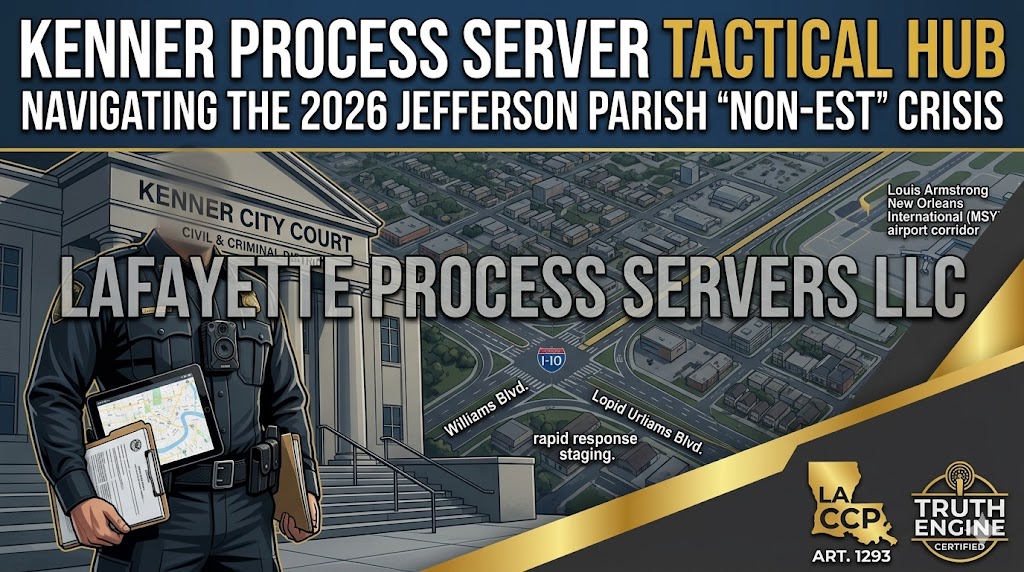
[00:01:55] Speaker A: Okay, let's ground this in a specific example. The sources really zero in on kenner, Louisiana. Kenner is a big place. It's dense, and it's completely tied into the huge legal infrastructure of Jefferson Parish.
So why is kenner the perfect case study for where this local expertise is so crucial?
[00:02:15] Speaker B: Well, kenner is a. It's a logistical puzzle. It's geographically massive, for one, and structurally, it's really complex. Our sources detail that it hosts many major transit points like the New Orleans international airport, msy.
[00:02:27] Speaker A: Okay, so that means huge commercial zones.
[00:02:29] Speaker B: Traffic security, Constant traffic security concerns. Exactly. And it also has the pontchart train center, which means you have these unpredictable crowds, temporary high volume activity.
[00:02:38] Speaker A: So if you're say, a national firm just trying to serve papers and you're just plugging an address into a gps.
[00:02:43] Speaker B: Yeah.
[00:02:43] Speaker A: You're hitting roadblocks immediately.
[00:02:45] Speaker B: Oh, you are burning valuable time and attempts. Just imagine trying to serve a subpoena on a business near the airport during rush hour or during a big trade show at the Pontchar train center. A server who isn't local might spend two hours on a job that a local could do in 20 minutes because.
[00:03:00] Speaker A: They know the back roads.
[00:03:01] Speaker B: They know the back roads, the specific business access points. The best times to even try. It's that granular.
[00:03:06] Speaker A: And the sources say this goes right down to the zip code level, right?
[00:03:08] Speaker B: Absolutely. The documents mention specific tenor zip codes 70062 and 70065. That kind of familiarity, it means you recognize the character of a neighborhood instantly. Is it a dense residential area? Is it light indust.
That knowledge ensures every attempt is faster, more efficient, and just dramatically increases the chance of success.
[00:03:31] Speaker A: Now this is where the Louisiana system gets, well, surprisingly complex. The court structure itself. So serving the papers is step one. But knowing which court is in charge of the action, that's almost more important.
What are the two main courts for Kenner? And why is this split so significant?
[00:03:48] Speaker B: This is a classic example of why that local knowledge is non negotiable.
A professional server has to be an expert at navigating two completely different judicial hubs.
First, you have the heavy hitter for the parish. That's the 24th Judicial District Court or the 24th JDC. It's the main courthouse for all significant legal actions in Jefferson Parish. And it's located in Gretna. 200 Durbigny Street Gretna.
[00:04:14] Speaker A: So that's on the west bank across the river from New Orleans. That's the major court for things like high stakes litigation, divorces, big personal injury cases.
[00:04:23] Speaker B: Precisely. And then you have the second major hub for the area, the first parish court. And this court is not in Gretna. It's in Materi over on David Drive. The first parish court handles smaller civil claims. Think debt collection cases under a certain dollar amount and critically, all the evictions for that area.
[00:04:39] Speaker A: Wait a minute. Why are two different courts handling cases for the same city, Kenner. And why are they in two completely different parts of the parish? That sounds like a recipe for, I don't know, bureaucratic confusion and just a massive waste of time.
[00:04:52] Speaker B: It creates a constant logistical demand. It's Just a reality of the system. Because of this structure, a professional service provider working for a law firm in Kenner has to make daily runs to both the 24th JDC in Gretna and the first parish court in Metairie. If you fail to file your paperwork correctly at the specific court handling that case, be it the JDC or the Parish Court, your case stalls. Even if the service itself was perfect.
[00:05:18] Speaker A: Wow.
[00:05:18] Speaker B: That procedural expertise is the gold standard the sources are talking about.
[00:05:22] Speaker A: That distinction really brings us to the full spectrum of services these providers offer. It's obvious they're way more than just delivery drivers. They're positioning themselves as an all in one legal support partner. So what does that whole suite of services actually include?
[00:05:36] Speaker B: It confirms that professional support is about solving the entire logistical problem for a law firm, not just one small piece of it. So the core offering is, of course, professional process service, the compliant delivery of court documents. But they tier it based on the client's timeline.
[00:05:51] Speaker A: And those tiers, I imagine they speak directly to the urgency of litigation deadlines. What are the options there?
[00:05:56] Speaker B: They offer three speeds. The standard is routine service. That means they'll make attempts within three to five days. Then you have rush service, which drops that down to one or two days. And for those, you know, emergency situations, they offer same day service. In the Jefferson Parish area, the value proposition is simple. You miss a deadline, your case could be dismissed. A rush service is often cheaper than the legal cost of waiting.
[00:06:20] Speaker A: And since you said the First Parish Court handles evictions, there must be a very specific process for that, given how technical and time sensitive eviction law is.
[00:06:29] Speaker B: Absolutely. Eviction cases are hyper specific about compliance, especially the notices. The sources really emphasize specialized landlord and eviction support.
This ensures the correct and swift service of that crucial five day notice to vacate, and then the follow up lawsuits. If you get that initial notice wrong, the format, the location, it can force a total legal reset that costs the landlord weeks of time.
[00:06:51] Speaker A: Okay, so we've covered the serving part. Now, speaking of those two court locations, the 24th JDC and the First Parish Court. That sounds like a serious amount of running around. Are these providers basically outsourcing a law firm's legwork entirely?
[00:07:04] Speaker B: In many ways, yes. And that's where the more technical behind the scenes support comes in.
Number one is the courthouse runner and filing services. Since their people are already making daily physical runs to Gretna and Materi, they basically act as a legal concierge.
[00:07:20] Speaker A: So they'll do filings, pull documents, physical.
[00:07:22] Speaker B: Filings, document retrieval, court Research. It saves a paralegal hours of sitting in line waiting for a single stamp or a copy. It frees up the firm's expensive time for actual legal work.
[00:07:33] Speaker A: That makes perfect business sense. But sometimes the problem isn't the court. It's the person. What happens when a defendant has moved or is actively trying to avoid being served? That's when it becomes more like investigative work.
[00:07:45] Speaker B: And that requires a specialized skill called expert skip tracing. This is way more than a simple Google search. The sources point to them using professional, reliable, often proprietary databases to locate hard to find defendants or witnesses. So if someone has moved from their kenner address, this service helps locate them whether they're still in Jefferson Parish or have even cross state lines. It's forensic geography almost.
[00:08:10] Speaker A: And for companies, I mean, corporations have to be formally served too. I assume that's another specific service they offer.
[00:08:16] Speaker B: Correct. For businesses, they offer Louisiana registered agent services.
This means professionally handling service of process. Specifically for corporations.
It ensures a business meets its legal obligations by having a designated entity to receive official documents reliably.
[00:08:32] Speaker A: So to round out the services section, what are the quick on demand things that just smooth out the whole workflow for their clients?
[00:08:38] Speaker B: There are a few convenient add ons. They offer mobile notary services where the notary actually travels to the client. There's also a secure legal courier service for really time sensitive confidential documents and crucially, document binding services.
This sounds mundane, but it's critical. If your filing isn't physically compliant with a specific court's rules. Rom fasteners, wrong kind of paper, it can get rejected. They handle that final check that really.
[00:09:07] Speaker A: Drives on that all in one idea?
[00:09:08] Speaker B: Yep.
[00:09:09] Speaker A: Okay, so we've covered the surgical precision you need in Jefferson Parish, but Louisiana is a patchwork of parishes, right? Each one with its own courts, its own elected officials. The sources say it's a huge challenge needing a separate server for every single parish.
[00:09:24] Speaker B: That's the logistical nightmare they're built to solve. Louisiana's judicial structure with every parish being its own little jurisdiction, means a law firm in New Orleans might need service in Shreveport, Lafayette and Baton Rouge for the same case. Their solution is providing a single point of contact for guaranteed statewide coverage. They're the central hub, managing a network of local experts across all 64 parishes.
[00:09:46] Speaker A: So you don't have to vet 30 different servers across the state. You make one call and they activate their network.
So what does that statewide map look like? Give us a few of the regional hubs they use.
[00:09:56] Speaker B: It's truly comprehensive. They cover every parish, city and town for example, they have strong hubs in the Acadian area region. That includes places like Lafayette, Carin CRO and New Iberia. Those servers know the Cajun country road systems, the local customs, everything.
[00:10:12] Speaker A: And what about moving up toward the state capital?
[00:10:14] Speaker B: You've got the capital region anchored by Baton Rouge, of course, but extending to important suburbs like Zachary and Denham Springs. And then there's that critical north shore south shore connection linking the 22nd JDC in Covington across the lake to the 24th JDC in Gretna that we talked about.
The point is, the local servers know their communities inside and out, from the smallest town outside of Lake Charles to the busiest neighborhoods in Slidell.
[00:10:40] Speaker A: This level of coordination, this specialized knowledge, from Cunner zip codes all the way to statewide logistics, that doesn't just happen by accident. The sources wrap up by mentioning the founder, Scott Frank. What kind of foundation does his experience provide for this whole operation?
[00:10:56] Speaker B: Yeah, Scott Frank is noted as the founder and he brings over 20 years of experience, specifically within this Louisiana leg support landscape. He's recognized as an expert in the mechanics of service of process and skip tracing. And crucially, his expertise is explicitly rooted in navigating the complex procedures of those two key Jefferson Parish Courts. We discussed the 24th JDC and the 1st Parish Court. That deep institutional knowledge is what allows them to build out a compliance system for the whole state.
[00:11:24] Speaker A: So what does all this mean for you, the listener, our deep dive into these sources? It really shows that superior legal support is built on three pillars.
First, an intimate, almost tactical understanding of local jurisdictions, like what we see in kenner and the 24th JDC. Second, a strategic single point of contact network that just eliminates the chaos of managing all those different pair of servers. And third, a full suite of services that turns logistics from a law firm's headache into an outsourced efficiency. It's quite literally the compliance engine of the justice system.
[00:11:56] Speaker B: That is a perfect summation. And just to give that final mandatory warning, remember, this discussion was based entirely on information sources about professional process servers. We are not lawyers, and the providers discussed are not lawyers. If you need specific legal advice, always, always consult a qualified Louisiana attorney.
[00:12:14] Speaker A: And here's a final provocative thought for you to mull over as you consider the strict boundaries that govern this whole profession. We talked about urgency, routine rush and same day service and that pressure to deliver quickly. The entire process is strictly governed by state law.
The sources point to the foundational document, the Louisiana Code of Civil Procedures, Service of process.
So if a professional process server is trying to get that rush or same day service done. What exactly does the Louisiana Code say about the legal limits of their attempts? Specifically, are there rules defining how early in the morning or how late at night a process server can legally come to your home?
[00:12:53] Speaker B: It's a fascinating question, isn't it? It's where that legal framework meets the real world demands of efficiency. Something to consider when you think about the strict rules that govern every single step of litigation.
[00:13:04] Speaker A: Until next time.